The 15 Promises of the Rosary are among the most treasured encouragements in Catholic devotional life, a set of graces that, according to a cherished tradition, the Blessed Virgin Mary offered to those who pray her Rosary faithfully. Handed down through the Dominican family, they are attributed to St Dominic and to Blessed Alan de la Roche. This guide explains each one reverently and accurately, and shows how to receive them the way the Church intends.
Table of Contents
What Are the 15 Promises of the Rosary?
The promises are fifteen assurances of grace, protection, and heavenly help that, in Catholic tradition, Our Lady made known to those who pray her Rosary with devotion. They are not magic words or guarantees to be claimed on demand. Read rightly, they are a mother’s tender encouragement to keep company with her Son through a prayer she loves.
Taken together, they sketch what a faithful life of the Rosary tends to bear. There is grace for the present moment, strength against sin, growth in virtue, comfort at the hour of death, and the sure hope of heaven. Every promise finally points past the beads to Christ, whose mysteries we ponder as the prayers pass through our fingers.
- Grace and protection in daily life
- Strength against sin and temptation
- Growth in virtue and love of God
- Comfort at death and the hope of heaven
Because they are so consoling, the promises deserve to be understood carefully—generously, but without exaggeration. The sections below set out where they came from, what each one says, and how to let them shape a genuine friendship with God.
The Origin of the Promises
Devotion to the Rosary grew slowly over many centuries. Long before the beads took their present form, monks prayed the one hundred and fifty psalms, and many of the faithful who could not read prayed one hundred and fifty Hail Marys in their place—a ‘Psalter of Mary.’ Meditation on the life of Christ was gradually woven in, and the Rosary as we know it took shape.
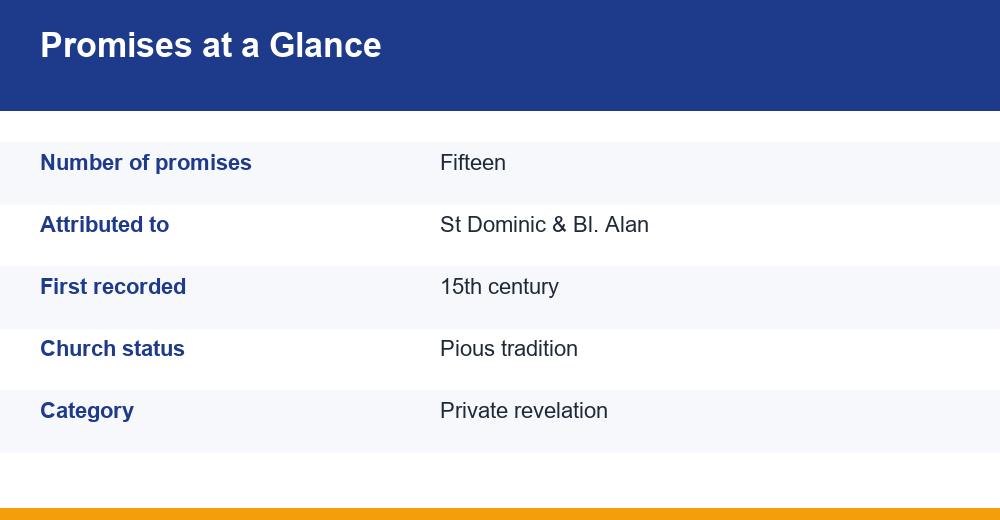
Catholic tradition links the preaching of the Rosary to St Dominic in the thirteenth century, during the Church’s struggle against error in southern France. In the fifteenth century a Dominican friar, Blessed Alan de la Roche, revived the Rosary confraternity across Europe and recorded the fifteen promises, saying he had received them through private revelation. To trace this longer story, see our overview of the history of the Rosary.
Historians debate the earliest details, and the Church has never claimed to settle them. What is beyond doubt is the enduring fruit of the devotion, which popes and saints have commended warmly for some eight hundred years.
The Fifteen Promises, One by One
Here are the fifteen promises in their traditional form, each with a brief word to help you receive it in the spirit of the Church.
- Signal graces. Those who faithfully serve Our Lady by praying the Rosary will receive singular, particular graces—help fitted to their needs and to the state of their soul.
- Special protection. Mary promises her protection and the greatest graces to all who recite the Rosary, keeping them close as a mother keeps her children.
- The Rosary is a powerful armour against hell; it destroys vice, lessens sin, and helps the Church overcome error and heresy in every age.
- The Rosary makes virtue and good works flourish. It draws down God’s abundant mercy and turns the heart away from worldly vanity toward the things that last forever.
- The soul that entrusts itself to Mary through the Rosary shall not perish—a promise of her constant intercession for those who seek her help.
- Those who pray the Rosary devoutly, meditating on its mysteries, will not be overwhelmed by misfortune or die unprepared; the just remain in God’s grace and grow worthy of eternal life.
- Those with a true devotion to the Rosary will not die without the sacraments of the Church, that great mercy at the end of life.
- The faithful will know God’s light and the fullness of his grace throughout life and at death, and will share at last in the merits of the blessed.
- Mary will help to free from purgatory the souls who were devoted to her Rosary, hastening them toward the vision of God.
- The faithful children of the Rosary will share a high degree of glory in heaven, their love for Mary blossoming into eternal joy.
- Whatever you ask through the Rosary, you shall obtain—always understood in keeping with God’s holy will and your true good.
- Those who spread devotion to the Rosary will be helped by Mary in all their necessities, for she is not outdone in generosity.
- She has obtained from her Son that the friends of the Rosary shall have the whole court of heaven as their intercessors in life and at death.
- All who pray the Rosary are Mary’s beloved children and, in Christ, the brothers and sisters of Jesus himself.
- Devotion to the Rosary is a great sign of predestination—a reason for hope in God’s mercy, never a guarantee that presumes upon it.
Read as the Church reads them, these are words of maternal tenderness rather than a contract. The eleventh promise in particular simply echoes the Gospel: what we ask is granted according to God’s will and our salvation, not as a blank cheque for every passing wish. Trust, not calculation, is the right response.
A Pious Tradition, Not Defined Dogma
To value the promises well, it helps to know how the Church weighs such things. Public revelation—the deposit of faith—was completed with the death of the last Apostle, and nothing will be added to it. Private revelation may help the faithful in a particular time, yet it never belongs to the faith we are bound to believe.
The 15 promises of the rosary belong to this second category. They reach us as pious tradition through Blessed Alan de la Roche, and the Church has never defined them as revealed doctrine. Even great approved apparitions, such as Fatima, remain private revelation; the promises rest on humbler ground still, and Catholics are free to embrace them with trust or to hold them lightly.
What the Church does hold out to everyone is the Rosary itself. As Pope St John Paul II taught in Rosarium Virginis Mariae, it is at heart a Christ-centred prayer that leads us, in Mary’s company, to contemplate the face of her Son.
Common Misunderstandings to Avoid
Because the promises are so consoling, they are sometimes misread. A few gentle clarifications keep the devotion healthy and free of superstition, so that the Rosary remains what it is meant to be—a prayer of loving trust rather than a bargain struck with heaven.
- They are not a spell: reciting a set number of Rosaries never compels God or Our Lady to act.
- They do not replace the sacraments, sincere conversion, or a life of charity.
- ‘Signal’ graces mean help suited to each soul, not a promise of worldly success or comfort.
- A holy death is offered to the repentant, never claimed as a right by those who presume.
Understood rightly, the 15 promises of the rosary never encourage presumption. They describe how God delights to reward humble, persevering prayer, while always leaving his freedom and our free response fully intact. The promise is real; the response of a faithful heart is what makes it fruitful.
How to Receive These Graces Rightly
Because the promises are so generous, it is worth saying plainly what they are not. They are not a transaction, as though a fixed number of prayers could oblige God to act. Grace is always his free gift, and the promises quietly presuppose the very things that make any devotion fruitful: faith, repentance, and a life turned toward charity.
- Pray with attention, meditating on the mysteries rather than rushing the words
- Stay in the state of grace, with regular recourse to Confession and the Eucharist
- Let the Rosary reshape your life, drawing you away from sin toward love
- Trust God’s will, especially when he answers differently than you had hoped
Seen this way, the Rosary is less a lever than a school of the Gospel and a path of friendship with Christ. If you have ever asked why the Rosary still matters in a busy modern life, the promises answer gently: because, through Mary, it keeps drawing the soul back to her Son.
Praying the Rosary Well
The graces come through the prayer, so it is worth praying it well. The Rosary unfolds in four sets of mysteries—the Joyful, the Luminous, the Sorrowful, and the Glorious—each a window onto the life of Christ. Pope St John Paul II proposed the Luminous mysteries in 2002, and the weekly pattern below is now widely followed.
A full Rosary is five decades. Each decade holds one Our Father, ten Hail Marys, and a Glory Be, framed by the opening prayers and the closing Hail Holy Queen. Announce a mystery for each decade and let the words carry your mind into the scene.
| Day | Mysteries | Focus of the mysteries |
|---|---|---|
| Monday | Joyful | The Incarnation and Christ’s childhood |
| Tuesday | Sorrowful | Christ’s Passion and death |
| Wednesday | Glorious | The Resurrection and heavenly glory |
| Thursday | Luminous | Christ’s public ministry |
| Friday | Sorrowful | Christ’s Passion and death |
| Saturday | Joyful | The Incarnation and Christ’s childhood |
| Sunday | Glorious | The Resurrection and heavenly glory |
Whatever the day, the heart of the Rosary is meditation, not speed. Picture each Gospel scene, and let the familiar prayers hold you within it. One decade prayed slowly and with love is worth more than a full Rosary rushed.
The Quiet Fruits of a Faithful Rosary
Ask those who pray the Rosary daily what it has given them, and you will usually hear not of dramatic favours but of a quiet steadiness—a day more ordered, a heart more at peace, a sense of never being alone. This is how the 15 promises of the rosary are most often fulfilled: gently, over years, in a soul slowly conformed to Christ.
The consolation the Rosary brings is real, but it is spiritual rather than a remedy for every trouble. If you are carrying heavy anxiety, grief, or despair, please also reach out to a trusted doctor, counsellor, or priest; God commonly works through good human care alongside prayer.
So begin simply. Take up the beads today, pray one decade with love, and let Our Lady lead you, one mystery at a time, closer to her Son.
Frequently Asked Questions
Are the 15 promises of the rosary official Church dogma?
No. They are a pious tradition attributed to Blessed Alan de la Roche and are considered private revelation, not defined dogma. The Church commends the Rosary very highly, yet Catholics remain free to accept the promises or to set them aside without any fault.
Who first recorded the promises?
According to Dominican tradition, they were written down in the fifteenth century by Blessed Alan de la Roche, who linked them to St Dominic and to Our Lady herself. The historical details are debated, but the devotion has nourished the faithful for centuries and endures today.
Does the promise ‘whatever you ask you shall obtain’ mean every request is granted?
It must be read with the Gospel. God grants what we ask through the Rosary in keeping with his will and our salvation. He always answers, sometimes with something better than we requested, and always in his own good time rather than on demand.
How often should I pray the Rosary to receive these graces?
There is no fixed quota to unlock a reward. A daily Rosary is a beautiful goal, yet even a single decade prayed attentively pleases God. What matters is faithful, prayerful devotion carried on over time, offered with love rather than counted like a transaction.