If your mind drifts the moment you pick up your beads, take heart: rosary distractions are among the most common experiences in the whole life of prayer, and they are no sign that you are praying badly. Even the greatest saints wrestled with a wandering mind. This guide offers eight gentle, time-tested ways to pray with more focus, along with the freeing truth that turning back to God is itself a prayer.
Table of Contents
Why Rosary Distractions Are Perfectly Normal
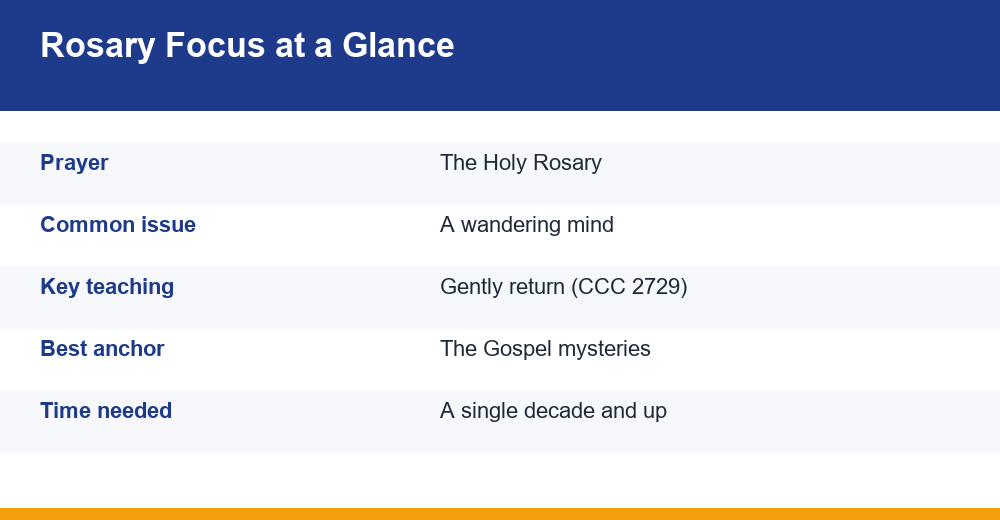
The first thing to understand about rosary distractions is that they are utterly ordinary. The mind is restless by nature, leaping from thought to thought long before we ever pick up the beads. The Catechism of the Catholic Church treats this kind of distraction as the habitual difficulty of prayer, not a rare failure reserved for beginners, but a struggle shared by nearly everyone who prays.
So when your attention scatters toward the grocery list, an old conversation, or tomorrow’s schedule, you have not ruined anything. You have simply discovered what every praying soul eventually learns: our focus is fragile, and it is grace, not sheer willpower, that steadies the heart.
The Catechism also offers a gentle remedy. Rather than hunting our distractions down, it says, all that is necessary is to turn back to our heart. That quiet turning back, repeated as often as needed, is not an interruption of prayer, it is prayer. Each time you notice your mind has drifted and return to Jesus and Mary, you make a small, real act of love.
Take comfort, too, in the company you keep. The great masters of prayer wrestled with the very same restlessness. St. Teresa of Avila wrote candidly of how the wandering imagination refuses to sit still, and St. Francis de Sales taught that even if we did nothing in prayer but bring our straying heart gently back a hundred times, our hour would be very well spent. If the saints struggled, we are in good company.
What a Wandering Mind Is Really Telling You
The Catechism goes further still and finds meaning in the wandering itself. A distraction, it teaches, quietly reveals what we are truly attached to, the worries, hopes, and desires that govern our hearts more than we realize. Seen this way, a scattered mind becomes a small window into what we most need to hand over to God.
This reframes the entire struggle. Instead of scolding yourself, you can treat each stray thought as useful information and gently offer it back to the Lord:
- A recurring worry? Hand it to God as an intention for that decade.
- A person who keeps surfacing? Pray for them, and let them become part of your Rosary.
- Restlessness or heavy tiredness? A gentle sign to slow down or shorten your prayer.
The point is not to indulge every passing thought but to stop treating distraction as an enemy to be crushed. When you meet it with peace instead of panic, it loses much of its power, and the prayer quietly continues.
This is very much in keeping with the spirit of St. Therese of Lisieux, whose ‘little way’ turned small interruptions into acts of love. When a person or a worry surfaces in your prayer, you can do the same: pray for whoever comes to mind, and let the distraction quietly become intercession.
8 Practical Ways to Stay Focused
None of these methods will silence your mind forever, and that is not the goal. They simply give your attention something good to hold on to. Try one or two at a time; the aim is not a flawless Rosary but a prayerful one, even a distracted one. Here are eight simple, time-tested approaches for praying through rosary distractions.
- Gently return, without frustration. The instant you notice you have drifted, come back to the words on your lips. Expect to do this many times in a single Rosary.
- Announce and picture each mystery. Say its name, then let your imagination place you inside the Gospel scene, the stable, the road to Calvary, the empty tomb.
- Pray the words aloud or in a whisper. Hearing your own voice gives the restless mind a sound to follow.
- Slow down. Rushing all but guarantees drifting; let each Hail Mary breathe.
- Fix your eyes on something holy — a crucifix, an icon, a lit candle, or a piece of sacred art.
- Offer the distraction as a prayer. Turn the intruding worry or person into your intention for that decade.
- Keep it short when you must. One attentive decade is worth more than five hurried ones.
- Prepare before you begin. Take a slow breath, quiet your surroundings, and consciously place yourself in God’s presence.
Do not try to practice all eight at once. Choose the one or two that speak to you today, and let the rest wait for another time. A single method, used gently and returned to whenever the mind slips, will help far more than a whole toolkit taken up anxiously. The goal here is peace, not performance.
Setting the Scene Before You Begin
Much of our focus is won or lost before the first Hail Mary. A few moments of preparation can transform the prayer that follows. The spiritual masters have long counseled that we should not begin to speak to God while our thoughts are still scattered elsewhere; a short pause to recollect ourselves is always time well spent.
You need not wait for perfect quiet, which rarely comes. But small, deliberate signals can tell the mind and body that something sacred is beginning:
- Find the quietest corner and moment available to you, even a few stolen minutes.
- Place a crucifix, an icon, or an image of the day’s mystery where your eyes can rest on it.
- Light a candle, if you can, as a simple sign that prayer is beginning.
- Take three slow breaths and ask the Holy Spirit to help you pray.
The Church has long encouraged us to keep sacred images before us in prayer, so that whenever the mind wanders it has something holy to return to. The eyes often lead the heart, and a single beautiful image can carry an entire decade.
Let the Mysteries Be Your Anchor
The single most powerful cure for a drifting mind is also the most traditional: the mysteries themselves. In his 2002 apostolic letter Rosarium Virginis Mariae, St. John Paul II explained that naming each mystery opens up a scene for the mind to enter, directing the imagination toward a particular moment in the life of Christ.
This is the key insight: the Rosary is at heart a contemplative prayer, a way of gazing on the face of Christ alongside his Mother. The beads are less a checklist to finish than a rhythm that frees the mind to picture, ponder, and love. When the imagination is busy with the Gospel, it has far less room to wander.
Some find it helpful to pray a Scriptural Rosary, adding a short line of Scripture before each Hail Mary so that every bead carries the mind a step further into the scene. Others simply hold one detail, a word, a gesture, a face, for the whole decade. There is no single correct method; use whatever keeps your heart with Christ.
If you would like to go deeper, our guide on how to meditate on the rosary walks through entering each scene step by step. Praying the set of mysteries assigned to each day also gives your week a gentle structure and your attention a clear focus:
| Day | Mysteries | An anchor to hold |
|---|---|---|
| Monday & Saturday | Joyful | The wonder of the Incarnation |
| Tuesday & Friday | Sorrowful | Christ’s love in his suffering |
| Wednesday & Sunday | Glorious | The hope of the Resurrection |
| Thursday | Luminous | Christ revealed in his ministry |
Praying Aloud and Slowing the Pace
Distraction thrives on two things: speed and a silent mouth. Two simple, physical habits push back against both. The first is to pray aloud, or at least in a low whisper. Giving the prayer a voice engages the body and hands the wandering mind a steady sound to follow.
The second is simply to slow down. When we race to finish, the words blur together and the mind slips away between the beads. Let each bead be like a heartbeat, unhurried, steady, and given its full weight.
- Whisper the words when you cannot pray fully aloud.
- Pause for a single breath after you announce each mystery.
- Let the second half of each Hail Mary be a touch slower than the first.
- Pray along with a trusted recorded Rosary when you are tired and your focus falters.
These are not mere tricks. They honor the truth that we are body and soul together: when the body prays, with voice, breath, and a slow, deliberate pace, the soul more easily follows it into stillness.
Praying the Rosary in a Busy Life
For many people, the deepest source of a wandering mind is simply a crowded life. When the day is packed with responsibilities, the noise follows us right into our prayer, and the beads can feel like one more task to finish before collapsing into bed.
The remedy is rarely more silence than we can realistically find, but a Rosary that fits the day we actually have. Our reflections on praying the rosary in a busy life offer gentle rhythms for exactly this season:
- Pray a single decade when a full Rosary feels out of reach.
- Attach your prayer to a daily anchor, the commute, a walk, the washing-up.
- Pray along with a recorded Rosary or a trusted app when your energy is low.
- Let a child’s interruptions become part of a family Rosary rather than a defeat.
A distracted Rosary prayed faithfully in a demanding season is worth far more than a perfect one that never gets started. Fidelity, not flawlessness, is what God asks of us.
When Rosary Distractions Discourage You
One of the subtlest dangers in the spiritual life is not the wandering mind itself but the discouragement that can follow it. It is easy to conclude that because we cannot concentrate, we cannot really pray, and so, little by little, to give up altogether.
Take heart: rosary distractions cannot strip your prayer of its worth. God receives the offering of your time and your will, not a flawless performance. A Rosary you struggled through with love may please him more than one prayed with perfect ease.
That said, be gentle with yourself. If your restlessness in prayer comes with persistent anxiety, intrusive thoughts, or distress that reaches well beyond your prayer time, it is wise to speak with a trusted priest or spiritual director, and, where needed, a qualified professional. Grace and good counsel work together, never against each other.
Above all, keep beginning again. The saints were not those who were never distracted, but those who never stopped returning. Every fresh start is a small victory, and every return to God is already a prayer.
Frequently Asked Questions
Is it a sin to be distracted while praying the Rosary?
No. Distraction that you do not choose is not a sin at all, but a normal weakness of the human mind. What matters is that you gently turn back to the prayer whenever you notice you have drifted. That simple act of returning is itself pleasing to God.
How do I stop my mind from wandering during the Rosary?
You probably cannot stop it completely, and you do not need to. Instead, give your mind something good to hold: picture each mystery, pray the words aloud, slow your pace, and rest your eyes on a crucifix or icon. Then return gently, as often as it takes.
Does a distracted Rosary still count?
Yes. God looks at the love and intention behind your prayer, not at a flawless performance. A Rosary prayed faithfully through many distractions can please him more than an effortless one. Offer him your very struggle, keep beginning again, and trust that your effort is received.
What should I do with the thoughts that keep interrupting my prayer?
Turn them into prayer. If a worry surfaces, hand it to God as your intention for that decade. If a person keeps coming to mind, pray for them. A recurring distraction often reveals what your heart is attached to and what most needs God’s grace.