Category: Prayer Life

Praying the Rosary well, day to day

  • Rosary for the Dead: A Complete 2026 Guide for November

    Rosary for the Dead: A Complete 2026 Guide for November

    The rosary for the dead is one of the oldest and most consoling ways Catholics keep faith with those who have gone before them. It uses the familiar beads and mysteries, adds a short prayer for the departed, and turns grief into intercession. This guide explains how to pray it at home, at a wake and through November, and why the Church encourages it.

    rosary for the dead — infographic

    Can You Pray a Rosary for the Dead? What the Church Teaches

    Yes. Offering a rosary for the dead is fully in keeping with Catholic teaching. The Church believes that death does not break the bond of charity between the faithful on earth and those who have died. We call this the communion of saints: one family in Christ, some still on pilgrimage, some being purified, some already in glory.

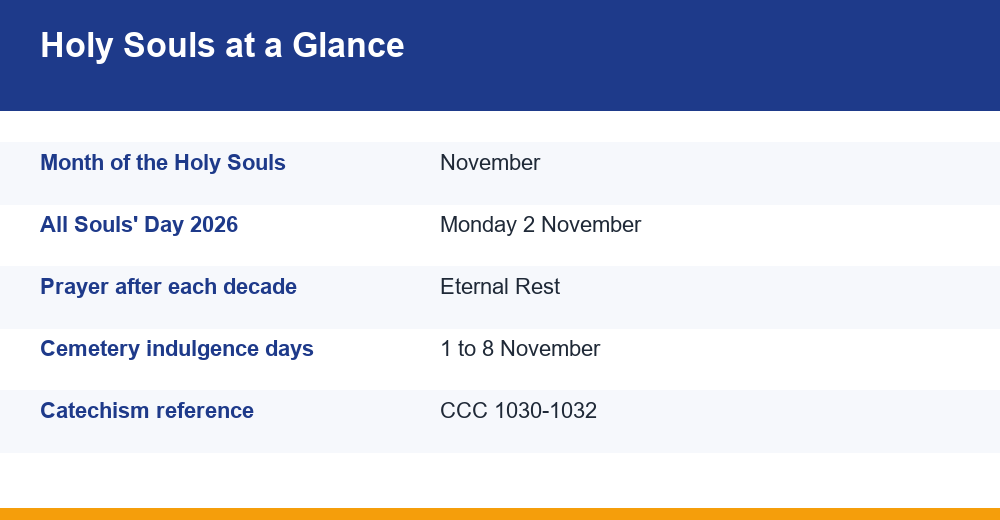
    The Catechism teaches that those who die in God’s grace and friendship, but are still imperfectly purified, are assured of their eternal salvation, yet undergo a purification after death so as to achieve the holiness needed to enter the joy of heaven. The Church calls this final purification purgatory, and stresses that it is entirely different from the punishment of the damned. You can read the full text in the Catechism’s section on the final purification (paragraphs 1030-1032).

    Paragraph 1032 links this teaching directly to prayer. It recalls the scene in 2 Maccabees 12, where Judas Maccabeus has an offering made for fallen soldiers so that they might be delivered from their sin. From the beginning the Church has honoured the memory of the dead and offered prayers for them, above all the Eucharistic sacrifice. It also commends almsgiving, indulgences and works of penance offered on their behalf.

    What the rosary does, and what it does not do

    The rosary is not a formula that guarantees an outcome. It is a prayer of trust: we place our loved one in the hands of a merciful God, through the intercession of Mary. Two points help keep it in proportion:

    • The Mass remains the greatest prayer for the dead. Having a Mass offered for a loved one is the first thing the Church recommends.
    • We pray for the dead without presuming on their eternal state. We do not know any soul’s final judgement, so we entrust each one humbly to God’s mercy.

    Why Catholics Pray for the Dead in November

    November opens with two linked days. On 1 November the Church celebrates the Solemnity of All Saints, honouring everyone already in heaven, known and unknown. On 2 November comes the Commemoration of All the Faithful Departed, better known as All Souls’ Day, when the whole Church prays for those still being purified. In 2026 All Saints falls on a Sunday and All Souls on the Monday that follows.

    The custom of a dedicated day for all the dead is usually traced to St Odilo, abbot of Cluny, who established an annual commemoration in his monasteries around the year 1000. The practice spread through Western Christianity and was eventually adopted by the universal Church. Over time the whole month came to be associated with the holy souls.

    Several reasons make November a natural season for this prayer:

    • The liturgy itself turns toward the last things as the Church year draws to a close before Advent.
    • Special indulgences for the souls in purgatory are attached to the first days of the month.
    • Families visit graves, light candles and write the names of their dead in parish books of remembrance.
    • In the northern hemisphere, the shortening days invite reflection on mortality and hope.

    Many parishes place a Book of the Dead near the altar for the whole month and remember those names at Mass. Praying the rosary at home with the same names in mind is a simple way to join that intention.

    How to Pray the Rosary for a Deceased Loved One

    A rosary for the dead follows the ordinary structure of the rosary. The difference lies in the intention you name at the beginning and the short prayer for the departed added at the end of each decade. Nothing else needs to change.

    1. Make the Sign of the Cross and state your intention, for example: “I offer this rosary for the soul of [name] and for all the faithful departed.”
    2. On the crucifix, pray the Apostles’ Creed.
    3. On the first large bead, pray the Our Father; on the next three small beads, three Hail Marys; then the Glory Be.
    4. Announce the first mystery and pause briefly to picture the scene.
    5. Pray the Our Father, ten Hail Marys and the Glory Be.
    6. Add the Eternal Rest prayer for the deceased, and the Fatima prayer if you wish.
    7. Repeat for the remaining four decades.
    8. Close with the Hail, Holy Queen, the concluding prayer, and a final Eternal Rest.

    Small touches that help

    • Say the person’s name aloud in the Eternal Rest prayer. It keeps the intention concrete.
    • Place a photograph or a lit candle nearby, as families often do at home altars.
    • If five decades feel too much in fresh grief, pray one decade each day. Any sincere prayer is pleasing to God.
    • Pray for those who have no one to remember them. The tradition has always included the forgotten souls.

    Can you pray for someone who was not Catholic?

    Yes. The Church’s prayer for the dead is not limited to her own members. The Eucharistic Prayers at Mass commend all who have died in God’s mercy, and canon law allows a priest to apply the Mass for anyone, living or dead. You can offer the rosary for a non-Catholic parent, spouse or friend with the same confidence, entrusting them to God, who alone knows the heart.

    What Prayer Is Said After Each Decade?

    The prayer customarily added after each decade is the Eternal Rest, known in Latin as the Requiem aeternam. Its words echo the Church’s funeral liturgy:

    Eternal rest grant unto them, O Lord, and let perpetual light shine upon them. May they rest in peace. Amen. May their souls and the souls of all the faithful departed, through the mercy of God, rest in peace. Amen.

    For one person, change “them” to “him” or “her”, or use the name. At a wake the prayer is usually said as a call and response, so everyone takes part.

    LeaderAll respond
    Eternal rest grant unto [name], O Lord,and let perpetual light shine upon him/her.
    May he/she rest in peace.Amen.
    May his/her soul and the souls of all the faithful departed, through the mercy of God, rest in peace.Amen.

    Where the Fatima prayer fits

    Many Catholics also add the Fatima prayer after the Glory Be: “O my Jesus, forgive us our sins, save us from the fires of hell; lead all souls to heaven, especially those in most need of thy mercy.” There is no fixed rule about order. A common pattern is Glory Be, then Fatima prayer, then Eternal Rest.

    Some local customs say the Eternal Rest after every Hail Mary instead of after each decade. Others replace the Hail Marys of one decade with ten Eternal Rest prayers. These are devotional variants rather than official rubrics, so follow your parish or family tradition.

    Which Mysteries Are Prayed for the Dead?

    The Church has not assigned special mysteries for the dead. Any set may be used. In practice, people choose in one of two ways: they follow the usual weekly pattern, or they pick the mysteries that speak most directly to death and resurrection. If you need a refresher on all twenty, see our guide to the mysteries of the rosary.

    For a rosary for the dead, the Glorious Mysteries are a frequent choice because they centre on the Resurrection, the Ascension and the hope of heaven. The Sorrowful Mysteries are also common, uniting the suffering of the bereaved with Christ’s Passion.

    MysteriesUsual daysWhy they suit prayer for the dead
    GloriousWednesday, SundayResurrection, Ascension and Assumption point to eternal life and the resurrection of the body
    SorrowfulTuesday, FridayChrist’s agony and death accompany the grief of family and friends
    JoyfulMonday, SaturdayRecall the gift of life; fitting for a peaceful death or a child’s funeral
    LuminousThursdayThe Eucharist and the Transfiguration offer a glimpse of glory

    The weekly pattern above follows the suggestion St John Paul II made when he added the Luminous Mysteries in 2002. At a wake, many families simply use the mysteries of the day. Others choose the Glorious set no matter the day. Both are correct; what matters is praying attentively.

    How to Pray the Rosary at a Wake or Vigil

    In many Catholic cultures, a rosary for the dead is prayed at the wake the night before the funeral, often in the funeral home, the family’s home or the parish church. The Church’s official funeral rites include a Vigil for the Deceased, a short Liturgy of the Word with readings, intercessions and prayers. The rosary is a cherished devotion that families often pray alongside it, before or after, with the guidance of the priest or funeral director.

    A simple order for a wake rosary

    1. A short welcome from the leader, naming the deceased and inviting everyone to pray.
    2. Sign of the Cross, Apostles’ Creed, and the opening Our Father, three Hail Marys and Glory Be.
    3. Five decades, each announced clearly, with the Eternal Rest in call-and-response form.
    4. Hail, Holy Queen and the concluding prayer.
    5. A closing prayer for the deceased and for the comfort of the family.

    Practical tips for leaders

    • Print the Eternal Rest response or put it on a card. Some guests may not be Catholic or may have forgotten the words.
    • Ask different family members to lead each decade. It gives grieving relatives a way to take part.
    • Keep a steady, unhurried pace. A full five-decade rosary takes roughly 20 minutes, depending on the group.
    • Invite non-Catholic guests simply to sit quietly; no one should feel pressured to recite prayers.

    Whoever leads need not be a priest or deacon. A family member, friend or parish volunteer can lead with complete propriety. If a priest is present, he may lead the Vigil and invite a lay person to lead the rosary.

    November Indulgences and the Holy Souls

    The Church teaches that indulgences can be applied to the dead (Catechism 1471). November offers two well-known plenary indulgences that can be gained only for the souls in purgatory:

    WhenWhat to doNotes
    1 to 8 NovemberDevoutly visit a cemetery and pray for the dead, even mentallyPlenary once each day; partial on other days of the year
    2 November (All Souls’ Day)Devoutly visit a church or oratory and pray the Our Father and the CreedWith the bishop’s consent, may be moved to the Sunday before or after, or to All Saints

    The usual conditions apply: sacramental confession, Holy Communion, prayer for the Pope’s intentions (an Our Father and Hail Mary is enough), and freedom from all attachment to sin, even venial sin. These conditions may be fulfilled several days before or after the prescribed work. Dioceses publish local guidance, so check your parish bulletin.

    The rosary itself carries a plenary indulgence when prayed under certain conditions, such as in a church or oratory or as a family. Our article on the rosary plenary indulgence explains those conditions in detail. Praying five decades at a loved one’s grave in early November is a beautiful way to combine both practices.

    Making the Rosary Part of Your Grief

    Grief is not a lack of faith. Christ wept at the tomb of Lazarus. A rosary for the dead gives sorrow a shape: repeated words when you have none of your own, and mysteries that place your loss inside the story of Christ’s death and resurrection.

    Many people find the rhythm of the beads calming in the weeks after a funeral. The same quiet repetition that makes the rosary for peace so steadying can bring rest to a heart unsettled by loss.

    Ways to keep remembering

    • Pray a decade on the anniversary of death, the person’s birthday and on All Souls’ Day.
    • Have a Mass offered on significant dates; ask at your parish office.
    • Keep a short list of your dead in your prayer book and name them in each rosary.
    • Join a parish November novena or a group rosary for the holy souls.
    • Teach children the Eternal Rest so the family keeps praying together for grandparents and relatives.

    Above all, pray with hope. The Church prays for the dead because she believes in the resurrection. Each Eternal Rest is a small act of faith that the love you shared is not finished.

    Frequently Asked Questions

    Can you pray the rosary for the dead?

    Yes. The Church teaches that the faithful on earth can help souls being purified after death through prayer, especially the Mass, as well as almsgiving, indulgences and penance (Catechism 1032). Offering a rosary for a deceased person is a long-standing Catholic devotion. You simply name the intention at the start and add the Eternal Rest prayer after each decade.

    Which mysteries are prayed for the dead?

    No mysteries are required. Many families follow the usual weekly schedule: Joyful on Monday and Saturday, Sorrowful on Tuesday and Friday, Glorious on Wednesday and Sunday, Luminous on Thursday. Others choose the Glorious Mysteries for any day because they focus on the Resurrection and eternal life, or the Sorrowful Mysteries to unite grief with Christ’s Passion.

    What prayer is said for the dead after each decade?

    The customary prayer is the Eternal Rest: Eternal rest grant unto them, O Lord, and let perpetual light shine upon them. May they rest in peace. Amen. It usually follows the Glory Be, and often the Fatima prayer. At wakes it is commonly said as a call and response, with the leader naming the deceased.

    How do you pray the rosary at a wake?

    A leader welcomes everyone, names the deceased and begins with the Sign of the Cross and the Creed. Five decades follow, each announced aloud, with the Eternal Rest said as a call and response after each one. It closes with the Hail, Holy Queen and a prayer for the family. Any family member or friend may lead.
  • Hail Holy Queen Meaning: 7 Essential Insights Line by Line

    Hail Holy Queen Meaning: 7 Essential Insights Line by Line

    The hail holy queen meaning is simpler and deeper than many people expect: it is a cry from exiles asking their Mother to bring them home to Jesus. In Latin it is the Salve Regina, a medieval antiphon that closes the Rosary and has ended the Church’s Night Prayer for centuries. Below you will find what each line says, where the prayer came from, and why it still suits ordinary Catholics today.

    hail holy queen meaning — infographic

    What Does Hail Holy Queen Mean?

    Put in one sentence, the prayer greets Mary as Queen and Mother, describes our condition as exiles in a world marked by sin and sorrow, and asks her to show us Jesus when our earthly journey is over. It is not a hymn of abstract praise. It is a petition spoken from the middle of real life.

    The opening word, Salve, is a Latin greeting that also carries the sense of ‘be well’ or ‘health to you.’ Regina means queen. So the first words are a respectful salute, the kind a subject offers a beloved sovereign. Yet within a few lines the tone shifts from court ceremony to the cry of a child who has lost the way home.

    That movement is the key to the whole hail holy queen meaning. Mary is honoured as Queen because she is the Mother of Christ the King, and she is approached as Mother because Christ gave her to his disciples from the Cross (John 19:26-27). Royal dignity and maternal tenderness are held together, not set against each other.

    The Church’s teaching supports both titles. The Catechism of the Catholic Church (n. 966), quoting the Second Vatican Council, describes Mary as exalted by the Lord as Queen over all things. Pope Pius XII’s 1954 encyclical Ad Caeli Reginam set out the doctrinal grounds for her queenship and instituted a feast in her honour, first kept on 31 May and moved in the 1969 calendar reform to 22 August, within the octave of the Assumption.

    Her queenship is always a service. She reigns by interceding for the Church and by pointing to her Son, never by competing with him.

    What Is the Salve Regina in Latin?

    Many readers search for the Salve Regina in Latin because they hear it sung at the end of Compline, at funerals, or by religious communities. The table below sets the traditional Latin beside the familiar English used in most English-speaking parishes. The English wording follows the version published by the United States bishops on their official Hail, Holy Queen prayer page.

    LatinEnglishPlain sense
    Salve, Regina, Mater misericordiae,Hail, holy Queen, Mother of mercy,Greeting to Mary as Queen and merciful Mother
    vita, dulcedo, et spes nostra, salve.our life, our sweetness and our hope.She leads us to Christ, our true life
    Ad te clamamus, exsules filii Hevae.To thee do we cry, poor banished children of Eve.We call out as heirs of exile
    Ad te suspiramus, gementes et flentes in hac lacrimarum valle.To thee do we send up our sighs, mourning and weeping in this valley of tears.Earthly life includes real grief
    Eia ergo, advocata nostra, illos tuos misericordes oculos ad nos converte.Turn then, most gracious advocate, thine eyes of mercy toward us,Ask her to look on us with compassion
    Et Iesum, benedictum fructum ventris tui, nobis post hoc exsilium ostende.and after this our exile show unto us the blessed fruit of thy womb, Jesus.The goal: to see Jesus in heaven
    O clemens, O pia, O dulcis Virgo Maria.O clement, O loving, O sweet Virgin Mary.Three closing cries of affection

    Notice that the Latin begins and ends its first sentence with salve, a small frame of greeting. Note also the phrase benedictum fructum ventris tui, which echoes Elizabeth’s words in Luke 1:42 and links this prayer directly to the Hail Mary.

    In parish use the prayer is usually followed by a versicle and response, which are not part of the antiphon itself but were attached to it in communal prayer. Most choirs use the Church Latin pronunciation common in Rome, so Iesum sounds like ‘YAY-soom’ and misericordiae like ‘mee-zeh-ree-COR-dee-ay.’

    Hail Holy Queen Meaning, Line by Line

    Each phrase carries its own weight. Reading them slowly is one of the best ways to pray the Salve Regina with attention rather than speed.

    Mother of mercy

    Mater misericordiae is the heart of the opening. Mary is not the source of mercy; God is. She is called its Mother because she bore Jesus, Mercy made flesh, and because she shares his compassion for sinners. Catholics turning to her are, in the end, being turned toward him.

    Our life, our sweetness and our hope

    These three titles can sound excessive at first. They make sense when read through Christ: Mary gave birth to the One who is the Life, she is sweet because grace has filled her, and she is our hope because her own glory shows what God intends for his redeemed people.

    Poor banished children of Eve

    This line names our inheritance. Eve, ‘mother of all the living,’ lost Eden through sin, and her children share that exile. Early Christian writers such as St Irenaeus contrasted Eve with Mary, the New Eve, whose obedience untied the knot of disobedience. Calling ourselves Eve’s banished children is a confession of need addressed to the woman who reversed Eve’s choice.

    Most gracious advocate

    An advocate pleads on someone’s behalf. The Catechism (n. 969) lists Advocate among Mary’s titles while stressing that this adds nothing to, and takes nothing from, the unique mediation of Christ. Asking her to turn her ‘eyes of mercy’ toward us is asking a mother to notice her struggling children.

    After this our exile

    Here the prayer reaches its goal. The final request is not for comfort or success but for the vision of Jesus. That is a short summary of Christian hope: the reward of faith is to see God.

    O clement, O loving, O sweet

    The closing triple cry is generally thought to be a later addition. A popular legend credits St Bernard of Clairvaux with adding it in Speyer Cathedral, but that story is tradition rather than documented history. Either way, it ends the antiphon with simple affection rather than argument.

    Taken together, these lines show that the hail holy queen meaning moves from greeting, to lament, to petition, to longing for heaven, which is roughly the shape of every Christian life.

    What Does Vale of Tears Mean?

    ‘Vale’ is an old English word for valley. The Latin lacrimarum valle literally means ‘valley of tears.’ The image draws on Psalm 84 (83 in the older numbering), which speaks of pilgrims passing through a dry valley, often rendered the valley of weeping, on their way to God’s house.

    The phrase does not claim that life is only misery. It acknowledges honestly that sickness, death, betrayal and failure are part of every human story after the Fall. Christians are pilgrims passing through, not settlers who must pretend the road is easy.

    • Realism: the prayer lets grief be spoken without embarrassment.
    • Direction: a valley is something one walks through, not a final home.
    • Companionship: we mourn ‘to thee,’ meaning our sorrow is addressed to someone who listens.
    • Hope: the next lines point beyond the valley to the vision of Jesus.

    People who are grieving often find this line the most consoling in the whole prayer, precisely because it does not hurry them past their tears.

    Who Wrote the Hail Holy Queen Prayer?

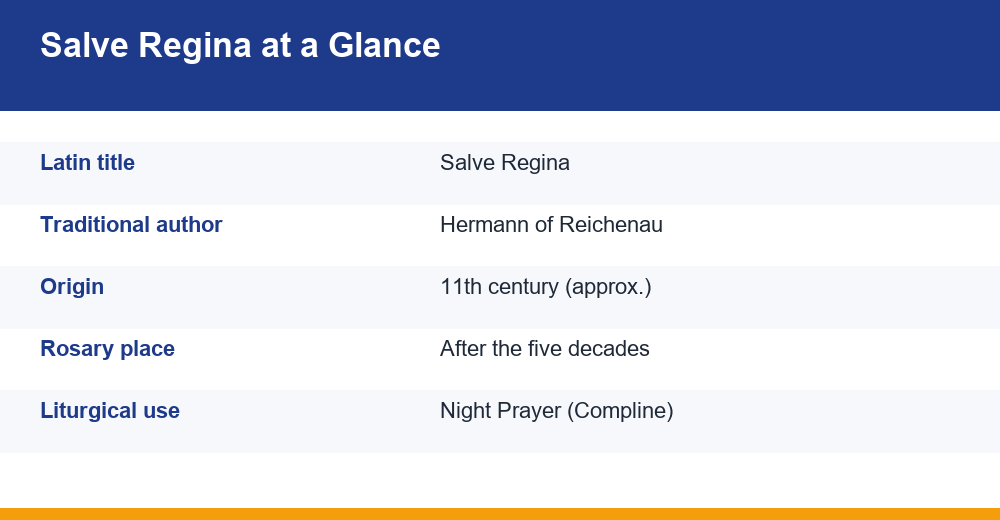
    No one can say with certainty. The author most often credited is Blessed Hermann of Reichenau (1013-1054), a Benedictine monk known as Hermannus Contractus, ‘Hermann the Lame,’ because of a severe physical disability. Despite being unable to walk and barely able to speak, he became a respected scholar of mathematics, astronomy, music and history.

    Older sources also name other possible authors, among them Bishop Adhemar of Le Puy and Bishop Peter of Compostela. The attribution to Hermann rests mainly on later tradition, and many modern musicologists treat the chant as anonymous. What can be said safely is that it was in use by the late 11th or early 12th century.

    PeriodDevelopment
    11th centuryAntiphon composed, traditionally by Hermann of Reichenau
    Early 13th centuryCistercians sing it regularly (dates vary by source)
    1220s-1230sDominicans begin the nightly Salve procession after Compline
    Later Middle AgesBecomes a standard Marian antiphon closing Compline
    1880sLeo XIII includes it in the prayers after Low Mass
    Mid-1960sPrayers after Low Mass dropped in liturgical reform

    Dates in the table are approximate where historians disagree; for instance, accounts differ on whether the Dominican procession began around 1221 or a few years later under Blessed Jordan of Saxony. What is clear is that the prayer spread quickly through monastic communities and from them into the wider Church.

    The Dominican connection matters for Rosary devotion, since the Order of Preachers did much to spread the Rosary. You can read more about that heritage in our article on Our Lady of the Rosary and her feast.

    The Salve Regina at Night Prayer

    The Church’s official prayer before sleep is Compline, called Night Prayer in English editions of the Liturgy of the Hours. It traditionally ends with an antiphon to the Blessed Virgin Mary, sung or said after the final blessing.

    In the older Roman arrangement, four Marian antiphons rotated through the year, each tied to a season. The Salve Regina belonged to the long stretch from Trinity Sunday until Advent, roughly corresponding to today’s Ordinary Time after Pentecost.

    AntiphonTraditional season
    Alma Redemptoris MaterAdvent through the Presentation (2 February)
    Ave Regina CaelorumFrom the Presentation until Holy Week
    Regina CaeliEaster season
    Salve ReginaFrom Trinity Sunday until Advent

    In the current Liturgy of the Hours, the Marian antiphon remains, and more freedom is allowed in choosing it, though the Regina Caeli is kept for Easter. Many communities still follow the seasonal pattern, and the Salve Regina is often the antiphon used on ordinary nights outside special seasons.

    There is something fitting in ending the day this way. Night is a small image of death, and the Salve Regina asks for the grace to see Jesus ‘after this our exile.’ Prayed at bedtime, the hail holy queen meaning becomes very concrete: we entrust the night, and one day the hour of death, to Mary’s care.

    Why It Ends the Rosary

    In the usual Western form of the Rosary, the Hail Holy Queen is prayed after the fifth decade, followed by a versicle and response and a concluding prayer. Our guide to the Rosary prayers in order sets out the full sequence from the Sign of the Cross to the final collect.

    1. Finish the fifth decade with the Glory Be (and the Fatima Prayer, if used).
    2. Pray the Hail, Holy Queen.
    3. V. Pray for us, O holy Mother of God. R. That we may be made worthy of the promises of Christ.
    4. Pray the closing collect, ‘O God, whose only begotten Son…’, which asks that by meditating on the mysteries we may imitate what they contain and obtain what they promise.
    5. End with the Sign of the Cross.

    Why this prayer? Partly history: it was already the Church’s beloved evening farewell to Mary when the Rosary took its familiar shape, so it was natural to use it as the closing antiphon. Partly theology: after meditating on the mysteries of Christ’s life, the soul is ready to ask for the one thing that matters most, to see Jesus face to face.

    The ending also answers a common objection that the Rosary is ‘all about Mary.’ Its final petition asks Mary to show us Jesus. That is why many Catholics argue, as we do in why the Rosary still matters, that it is a thoroughly Christ-centred prayer.

    Praying It Well Today

    Because it is short, the Salve Regina is easy to rush. A few simple habits can help you pray it with understanding rather than habit alone.

    • Pause at the commas. Each title of Mary is a separate act of trust.
    • Bring a real sorrow to the ‘valley of tears’ line, naming a person or situation.
    • Learn the Latin from the table above, especially if you attend sung Compline or a traditional Mass community.
    • Pray it at night, alone or as a family, as a brief form of Night Prayer.
    • Remember the dying. The words ‘after this our exile’ make it a fitting prayer at a sickbed or wake.

    Families sometimes worry that the older English, with ‘thee’ and ‘thine,’ sounds distant to children. It can help to explain one phrase each week. Once children understand that ‘banished children of Eve’ describes all of us, the prayer stops sounding strange and starts sounding honest.

    Above all, remember where the prayer is heading. The full hail holy queen meaning is fulfilled only when its final request is granted: that Mary, who once showed the infant Jesus to shepherds and Magi, will one day show him to us.

    Frequently Asked Questions

    What does Hail Holy Queen mean?

    It is the English title of the Salve Regina, a Marian prayer that greets Mary as Queen and Mother of mercy. The prayer describes humanity as exiled children of Eve living in a valley of tears, asks Mary to look on us with compassion, and ends by asking her to show us Jesus after this earthly life is over.

    Who wrote the Hail Holy Queen prayer?

    Authorship is traditionally credited to Blessed Hermann of Reichenau, an 11th-century Benedictine monk called Hermannus Contractus because of his severe disability. The attribution rests largely on later tradition, other medieval bishops have also been proposed, and many musicologists regard the chant as anonymous, so Hermann is best described as the traditional rather than proven author.

    Why is the Hail Holy Queen said at the end of the rosary?

    By the time the Rosary took its familiar form, the Salve Regina was already a beloved closing antiphon at Night Prayer. It suits the Rosary’s ending because, after meditating on the mysteries of Christ, the prayer asks Mary for the final grace of seeing Jesus in heaven, keeping the whole devotion centred on him.

    What does vale of tears mean?

    Vale is an older English word for valley, so vale of tears means valley of tears, from the Latin lacrimarum valle. It describes earthly life after the Fall, with its grief and suffering, as a road pilgrims pass through. The image echoes Psalm 84 and points toward a final home with God rather than despair.

  • Rosary Prayers in Order: The Complete Text of All 7 Prayers (2026)

    Rosary Prayers in Order: The Complete Text of All 7 Prayers (2026)

    The rosary prayers in order are simple once you see them laid out bead by bead: the Sign of the Cross and the Apostles’ Creed on the crucifix, then the Our Father, Hail Mary and Glory Be, and finally the Hail, Holy Queen with a closing prayer. Below you will find the complete text of each prayer, the bead it belongs to, where it comes from, and which parts the Church treats as optional, so you can pray with confidence instead of guessing.

    rosary prayers in order — infographic

    The Rosary Prayers in Order at a Glance

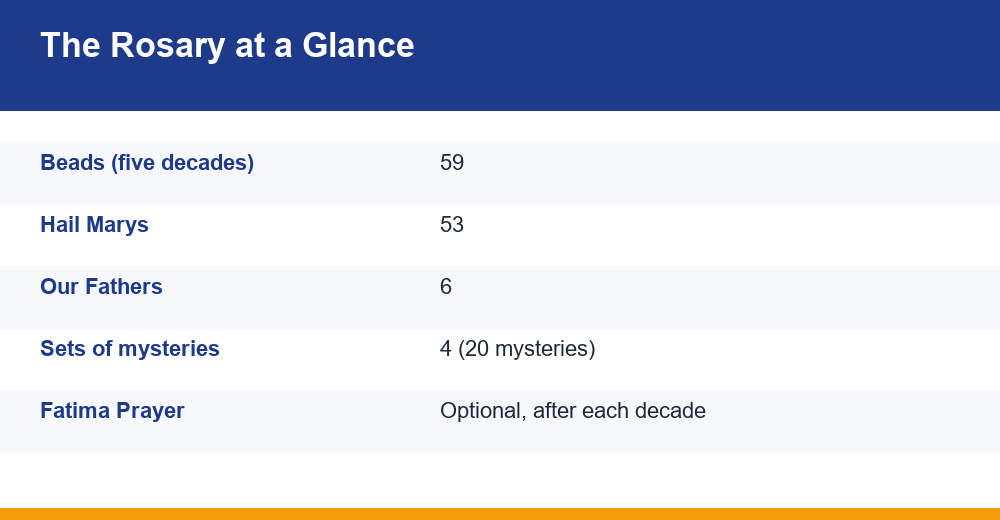
    So, what are the prayers of the rosary in order? A standard five-decade rosary has 59 beads: a crucifix, a short pendant strand of five beads, a centrepiece medal, and a loop of five decades. Each part of the chain tells your fingers which prayer comes next.

    The table below gives the full sequence of the rosary prayers in order, from start to finish. Keep it open the first few times you pray; after a week or two the pattern becomes second nature.

    StepWhere on the beadsPrayerHow many times
    1CrucifixSign of the CrossOnce
    2CrucifixApostles’ CreedOnce
    3First large beadOur FatherOnce
    4Next three small beadsHail MaryThree times
    5Chain before the next large beadGlory BeOnce
    6Fifth pendant bead, then each large bead in the loopAnnounce the mystery, then Our FatherFive times (once per decade)
    7Ten small beadsHail MaryTen per decade (50 in all)
    8Chain after each decadeGlory Be, then Fatima Prayer (optional)Five times
    9MedalHail, Holy Queen, versicle and responseOnce
    10Medal or crucifixClosing prayer and Sign of the CrossOnce

    Counting it all up, a complete rosary includes 53 Hail Marys, six Our Fathers and six Glory Bes. That is the whole structure. Everything else in this guide simply fills in the words and the history behind them.

    Opening Prayers: The Crucifix and First Beads

    What prayer do you say on the crucifix of the rosary?

    Holding the crucifix, you begin with the Sign of the Cross and then pray the Apostles’ Creed. Starting with the Creed is fitting: before meditating on the life of Christ, you profess the faith that the mysteries unfold.

    The Sign of the Cross

    In the name of the Father, and of the Son, and of the Holy Spirit. Amen.

    Tracing the cross is one of the oldest Christian gestures. The North African writer Tertullian, writing around the year 200, already described Christians marking their foreheads with the cross throughout the day. The Trinitarian words echo the baptismal command in Matthew 28:19.

    The Apostles’ Creed

    I believe in God, the Father almighty, Creator of heaven and earth, and in Jesus Christ, his only Son, our Lord, who was conceived by the Holy Spirit, born of the Virgin Mary, suffered under Pontius Pilate, was crucified, died and was buried; he descended into hell; on the third day he rose again from the dead; he ascended into heaven, and is seated at the right hand of God the Father almighty; from there he will come to judge the living and the dead. I believe in the Holy Spirit, the holy catholic Church, the communion of saints, the forgiveness of sins, the resurrection of the body, and life everlasting. Amen.

    The Creed grew out of the ancient baptismal profession used in the Church of Rome, often called the Old Roman Creed. A pious legend says each of the Twelve contributed one article; historians instead see a gradual development, with the text reaching its familiar Western form in the early Middle Ages. The wording above is the one used in the current English translation of the Roman Missal.

    The pendant beads

    1. On the first large bead, pray one Our Father.
    2. On each of the next three small beads, pray a Hail Mary. Many Catholics offer these for an increase in faith, hope and charity.
    3. On the chain after the third Hail Mary, pray the Glory Be.
    4. On the next large bead, announce the first mystery and pray the Our Father that begins the first decade.

    If the whole sequence still feels unfamiliar, our step-by-step rosary guide for beginners walks through a first rosary slowly, including how to hold the beads.

    Praying Each Decade: Our Father, Hail Mary, Glory Be

    The heart of the rosary is the five decades. Each one follows the same rhythm: announce the mystery, pray one Our Father, ten Hail Marys and one Glory Be. The words repeat, but the mind moves on to a new scene from the Gospel each time.

    Announcing the mystery

    At the large bead, name the mystery, for example “The first Joyful Mystery, the Annunciation.” The USCCB notes that a short Scripture reading may follow. The four sets of mysteries are traditionally assigned to particular days, as the table shows.

    MysteriesUsual days
    JoyfulMonday and Saturday (Sundays of Advent)
    SorrowfulTuesday and Friday (Sundays of Lent)
    GloriousWednesday and other Sundays
    LuminousThursday

    For each of the twenty mysteries and its Scripture passage, see our guide to the mysteries of the rosary.

    The Our Father

    Our Father, who art in heaven, hallowed be thy name; thy kingdom come, thy will be done on earth as it is in heaven. Give us this day our daily bread, and forgive us our trespasses, as we forgive those who trespass against us; and lead us not into temptation, but deliver us from evil. Amen.

    This is the prayer Jesus himself taught his disciples, recorded in Matthew 6:9-13 and in a shorter form in Luke 11:2-4. In the rosary it is prayed without the doxology “For the kingdom, the power and the glory,” which appears separately at Mass and is joined to the prayer in many Protestant traditions.

    The Hail Mary

    Hail Mary, full of grace, the Lord is with thee. Blessed art thou among women, and blessed is the fruit of thy womb, Jesus. Holy Mary, Mother of God, pray for us sinners, now and at the hour of our death. Amen.

    Ten of these make up each decade. Pope St. John Paul II, in his 2002 apostolic letter Rosarium Virginis Mariae, called the name of Jesus the centre of gravity of the prayer, and commended the custom of adding a short phrase after it that recalls the mystery being contemplated.

    The Glory Be

    Glory be to the Father, and to the Son, and to the Holy Spirit, as it was in the beginning, is now, and ever shall be, world without end. Amen.

    Known as the lesser doxology, this short hymn of praise to the Trinity goes back to the early Church. The phrase “as it was in the beginning” became standard in Western use by the sixth century. It closes every decade, turning the meditation back toward God.

    Where Does the Hail Mary Prayer Come From?

    The Hail Mary developed in two stages, and knowing them deepens the way you pray it. The first half is drawn from Scripture; the second half is the Church’s own petition, added over centuries.

    • “Hail, full of grace, the Lord is with thee” are the words of the Angel Gabriel at the Annunciation (Luke 1:28).
    • “Blessed art thou among women, and blessed is the fruit of thy womb” is Elizabeth’s greeting at the Visitation (Luke 1:42).
    • The names Mary and Jesus were added in the Middle Ages to make the greeting personal.
    • “Holy Mary, Mother of God, pray for us sinners” appeared gradually in the late Middle Ages, in a period marked by plague and widespread fear of sudden death.

    The title “Mother of God” (in Greek, Theotokos) had been solemnly affirmed at the Council of Ephesus in 431, so the petition rests on long-established doctrine. The prayer reached its fixed, universal wording when Pope St. Pius V promulgated the reformed Roman Breviary in 1568, following the Council of Trent.

    Is the Fatima Prayer Required in the Rosary?

    No. The Fatima Prayer is a widely loved addition, but it is not part of the rosary’s essential structure. The USCCB’s own instructions say simply that some add it after each decade. St. John Paul II likewise observed that the Glory Be is followed by a brief concluding prayer which varies according to local custom.

    O my Jesus, forgive us our sins, save us from the fires of hell, lead all souls to heaven, especially those in most need of thy mercy.

    According to the memoirs of Sister Lúcia, one of the three shepherd children of Fátima in Portugal, Our Lady taught this prayer during the apparition of 13 July 1917 and asked that it be said after each mystery. It spread widely after the Bishop of Leiria declared the apparitions worthy of belief in October 1930.

    Many families and parishes pray it as a matter of course, and there is every reason to include it. But if you are praying with a group that leaves it out, or using an older prayer book that does not print it, your rosary is still complete.

    The Closing Prayers of the Rosary

    What is the closing prayer of the rosary? After the fifth decade, most English-speaking Catholics pray the Hail, Holy Queen, followed by a versicle and response and a short collect, then end with the Sign of the Cross.

    Hail, Holy Queen (Salve Regina)

    Hail, holy Queen, Mother of mercy, our life, our sweetness and our hope. To thee do we cry, poor banished children of Eve. To thee do we send up our sighs, mourning and weeping in this valley of tears. Turn then, most gracious advocate, thine eyes of mercy toward us, and after this our exile show unto us the blessed fruit of thy womb, Jesus. O clement, O loving, O sweet Virgin Mary.

    V. Pray for us, O holy Mother of God.
    R. That we may be made worthy of the promises of Christ.

    The Salve Regina is one of four great Marian antiphons of the Liturgy of the Hours. It dates to at least the eleventh century and is traditionally attributed to Blessed Hermann of Reichenau, a German Benedictine monk, though scholars regard the authorship as uncertain. Cistercians and Dominicans made it a nightly chant, and from there it passed into the rosary. Our article on the meaning of the Hail Holy Queen explains its striking images, from “banished children of Eve” to the “valley of tears.”

    The concluding prayer

    Let us pray. O God, whose only begotten Son, by his life, death and resurrection, has purchased for us the rewards of eternal life; grant, we beseech thee, that while meditating on these mysteries of the most holy Rosary of the Blessed Virgin Mary, we may imitate what they contain and obtain what they promise, through the same Christ our Lord. Amen.

    This collect comes from the liturgy of the feast of Our Lady of the Rosary, kept on 7 October. Its petition sums up the purpose of the whole devotion: to imitate what the mysteries contain and obtain what they promise.

    Local custom shapes this final stage. Rosarium Virginis Mariae mentions prayer for the intentions of the Pope and the Litany of Loreto, and the USCCB notes that a prayer to St. Joseph may follow. Some communities also add the prayer to St. Michael.

    Required and Optional Parts Compared

    Many guides present every prayer as obligatory, which can leave newcomers anxious about getting it “wrong.” In reality, the rosary has a fixed core and a flexible frame. The table separates the two.

    ElementStatusOrigin
    Five decades (Our Father, 10 Hail Marys, Glory Be)Core of the devotionShaped by the Dominicans; confirmed by St. Pius V in 1569
    Meditation on a mysteryEssential to the rosary’s spiritMedieval; Luminous set added in 2002
    Sign of the Cross and Apostles’ CreedCustomary openingEarly Church; Old Roman Creed
    Opening Our Father, 3 Hail Marys, Glory BeCustomaryLater devotional custom
    Fatima PrayerOptionalFátima, 1917
    Hail, Holy QueenCustomary closing; may varyAt least 11th century
    Concluding collect, Litany of LoretoOptional; varies locallyLiturgical and devotional tradition

    A few practical consequences follow from this:

    • Praying a single decade with attention is real rosary prayer, even if you cannot finish all five.
    • The Luminous Mysteries are an invitation, not an obligation; St. John Paul II proposed them in 2002 to include Christ’s public ministry, while leaving the traditional fifteen intact.
    • Families may adapt the opening and closing to local custom, as long as the decades and the meditation remain.

    Tips for Praying the Rosary Prayers in Order

    Learning the rosary prayers in order is the easy part; praying them with attention is the lifelong work. A few habits help.

    1. Pace yourself. A full five decades usually takes roughly 15 to 20 minutes. Rushing to finish defeats the purpose.
    2. Picture the scene. Before each decade, spend a few seconds imagining the mystery: the stable, the garden of Gethsemane, the empty tomb.
    3. Offer an intention. Dedicating each decade to a person or need keeps the mind from drifting.
    4. Pray in a group. In family or parish recitation, a leader says the first half of each prayer and everyone answers with the second.
    5. Use your fingers if needed. No beads? Your ten fingers count a decade perfectly well.

    For a short, authoritative summary you can share with a parish group, the bishops’ How to Pray the Rosary page from the USCCB sets out the same sequence of rosary prayers in order used here.

    Whether you pray the whole rosary daily or one decade on the bus, the words stay the same, and over time they become a quiet companion. Keeping the rosary prayers in order holds you steady so your heart can rest on Christ and his Mother.

    Frequently Asked Questions

    What are the prayers of the rosary in order?

    Begin with the Sign of the Cross and the Apostles’ Creed on the crucifix, then one Our Father, three Hail Marys and a Glory Be. Each of the five decades has an Our Father, ten Hail Marys and a Glory Be, often followed by the Fatima Prayer. Finish with the Hail, Holy Queen, a closing prayer and the Sign of the Cross.

    Is the Fatima Prayer required in the rosary?

    No. The Fatima Prayer, which Sister Lúcia said Our Lady taught during the apparition of 13 July 1917, is a popular addition said after the Glory Be in each decade. The USCCB says only that some add it, and St. John Paul II noted the prayer after each decade varies by local custom. Leaving it out does not make your rosary incomplete.

    What prayer do you say on the crucifix of the rosary?

    On the crucifix you make the Sign of the Cross and then pray the Apostles’ Creed. The Creed summarises the core beliefs of the Christian faith, which makes it a natural opening before meditating on the mysteries of Christ’s life. After the Creed, move to the first large bead for the Our Father.

    What is the closing prayer of the rosary?

    Most English-speaking Catholics close with the Hail, Holy Queen, the versicle “Pray for us, O holy Mother of God,” and the collect beginning “O God, whose only begotten Son.” The concluding prayers vary by local custom, so some add the Litany of Loreto, a prayer to St. Joseph or St. Michael, then end with the Sign of the Cross.

  • How to Meditate on the Rosary: A Complete Simple Guide (2026)

    How to Meditate on the Rosary: A Complete Simple Guide (2026)

    Learning how to meditate on the rosary is simpler than many people fear: at its heart it is spending quiet time with Jesus, guided by his mother, through the great scenes of the Gospel. You do not need special skill or lofty feelings, only a willingness to look, to listen, and to let the familiar prayers carry you. This guide walks you through the whole practice, one gentle step at a time.

    how to meditate on the rosary — infographic

    What It Means to Pray the Rosary as Meditation

    The Rosary can look, at first, like a long string of repeated words. But the repetition is not the point; it is the setting. Saint John Paul II described praying the Rosary as contemplating the face of Christ with Mary. The Hail Marys are meant to become a gentle background rhythm while your heart rests on a single scene from the life of Jesus.

    Think of it like music playing softly while you gaze at a painting. The melody steadies you; the painting holds your attention. In the Rosary, the vocal prayers are the melody and each mystery is the painting. This is why the Rosary is called meditative, or contemplative, prayer: the lips speak the familiar words while the heart quietly rests on Christ.

    So as you begin learning how to meditate on the rosary, you can set down the worry that you must say it perfectly. The words will keep flowing almost on their own. Your only real work is to turn the eyes of your heart, again and again, toward Christ, and to let Mary lead you to him.

    This is prayer anyone can grow into. A child can pray it; so can a saint. The same handful of scenes will keep opening to you across a whole lifetime, revealing something new each time you return with an attentive heart.

    Preparing Your Heart to Pray

    Meditation grows best in a little stillness, so it helps to prepare before you begin. Find a moment when you are unlikely to be interrupted, even if it is only ten minutes. A familiar spot, a chair by a window, or a corner with a crucifix or an image of Our Lady, gently signals to your heart that this is time set apart for God.

    Then settle your body so your soul can be still. Sit or kneel comfortably, breathe slowly for a moment, and make the Sign of the Cross without hurry. Tell the Lord, in a word or two, why you have come and for whom you wish to pray. This small act of intention gathers your scattered thoughts and turns the whole Rosary into a conversation begun in love.

    The Rosary itself opens with a few simple prayers, the Apostles’ Creed, an Our Father, and three Hail Marys, before the first mystery begins. Let these be a gentle threshold rather than a hurdle. Pray them slowly, and by the time you announce the first scene, your heart is already turned toward the Lord and ready to look.

    How to Meditate on the Rosary: The Four Simple Movements

    Meditating on a mystery is not a technique to master but a simple pattern you can lean on for the rest of your life. It has four movements, and they take only a moment to learn. You repeat them for each of the five decades.

    1. Announce the mystery. Before each decade, name the scene aloud or in your heart, for example, “The Annunciation.” This simply tells your mind where to go.
    2. Picture the scene. Let the Gospel moment come alive. See the angel before Mary, the shepherds at the manger, the cross on the hill. Imagination is a gift; here it serves your prayer.
    3. Draw a fruit. Ask for one grace the scene offers, a virtue such as humility, patience, or faith, and quietly desire it for your own life.
    4. Let the Hail Marys become rhythm. As you pray the ten Hail Marys, stop straining to think hard. Let the words flow beneath the scene, like waves beneath a boat.

    That pattern, announce, picture, draw a fruit, and rest in the rhythm, is the whole heart of how to meditate on the rosary. Everything else in this guide simply helps you live those four movements more deeply and more freely.

    If picturing a scene is hard for you, do not force it. You can instead hold a single word from the Gospel, gently repeat the name of Jesus, or simply stay aware that he is present with you. Meditation is about attention and love, not vivid mental pictures. Some of the holiest prayer is nearly wordless.

    The Four Sets of Mysteries at a Glance

    The Rosary gathers twenty mysteries from the life of Christ and his Mother, arranged in four sets of five. The first three sets, the Joyful, Sorrowful, and Glorious, have been prayed for centuries. The Luminous Mysteries were added by Saint John Paul II in 2002, in his apostolic letter Rosarium Virginis Mariae, to draw the years of Jesus’ public ministry into the prayer.

    Together the four sets tell a single story, from the coming of Christ to the glory of heaven. You do not pray all four in one sitting. You pray one set at a time, meditating on its five mysteries of the Rosary across five decades.

    SetThemeThe five mysteries
    JoyfulChrist’s comingAnnunciation, Visitation, Nativity, Presentation, Finding in the Temple
    LuminousChrist’s ministryBaptism, Wedding at Cana, Proclamation of the Kingdom, Transfiguration, Institution of the Eucharist
    SorrowfulChrist’s passionAgony in the Garden, Scourging, Crowning with Thorns, Carrying of the Cross, Crucifixion
    GloriousChrist’s victoryResurrection, Ascension, Descent of the Holy Spirit, Assumption, Coronation of Mary

    How to Meditate on Each Set of Mysteries

    The four movements stay the same in every set, but the mood of your prayer shifts with each one. Letting that mood gently color your meditation keeps the Rosary alive instead of routine. A short note before each set is offered here, along with a traditional fruit to seek, a cherished pious custom rather than a defined teaching, so feel free to ask for whatever grace the scene stirs in you.

    The Joyful Mysteries

    These scenes surround the coming of Christ, from the angel’s greeting to the boy Jesus found in the Temple. Meditate on them with wonder and gratitude. Traditional fruits to seek here include humility, love of neighbor, and a quiet trust in God’s unfolding plan for a life you cannot yet see.

    The Luminous Mysteries

    Also called the Mysteries of Light, these follow Jesus through his public ministry: his baptism, the wedding at Cana, his preaching of the Kingdom, the Transfiguration, and the Last Supper. Meditate on them as invitations to listen to Christ and to follow wherever he leads, asking for openness of heart and a deeper love of the Eucharist.

    The Sorrowful Mysteries

    Here you walk with Jesus through his suffering and death. Meditate slowly and tenderly; there is no need to manufacture strong emotion. Simply stay near him, ask for patience and true sorrow for sin, and let the depth of his love for you quietly sink in. These mysteries are a gift on your own hard days.

    The Glorious Mysteries

    These scenes carry you from the empty tomb to the crowning of Mary in heaven. Meditate on them with hope, especially when life feels heavy, and ask for a stronger faith and a real longing for the life God has promised. They remind you that sorrow does not have the last word.

    A Weekly Rhythm for Praying the Mysteries

    Many Catholics pray one set each day, following a traditional weekly pattern. It is a cherished custom, not a law, so you are free to follow the Church’s usual rhythm or to pray whichever set your heart needs on a given day.

    DayMysteries
    MondayJoyful
    TuesdaySorrowful
    WednesdayGlorious
    ThursdayLuminous
    FridaySorrowful
    SaturdayJoyful
    SundayGlorious

    Sundays shift a little with the seasons in the older custom: the Joyful Mysteries are often prayed on the Sundays of Advent and the Sorrowful on the Sundays of Lent. If you are just beginning, do not let the calendar become a burden. One faithful set a day, whichever it is, is a beautiful place to start.

    When Your Mind Wanders: Distractions and Dry Days

    Every person who prays the Rosary meets distraction. Your mind will drift to your to-do list, an old worry, or nothing in particular. This is not failure, and it is not a sign that you are praying badly. The saints wrestled with the very same wandering thoughts.

    When you notice you have drifted, do not scold yourself. Gently return to the mystery, as many times as it takes. That small, patient turning back is itself an act of love, and it is a large part of how to meditate on the rosary well over a lifetime.

    Some days prayer will feel warm and full; other days it will feel dry and empty. Both have real value. A Rosary offered in dryness, out of pure faithfulness, can be more pleasing to God than one carried along by good feelings. Keep showing up, and let consistency, not emotion, be your measure.

    The Rosary can bring real peace to an anxious heart, and many find it steadying in difficult seasons. It offers genuine spiritual consolation, though it is not a treatment. If you are carrying heavy anxiety, grief, or despair, please reach out to a trusted priest and to a qualified professional as well; seeking help is itself an act of hope.

    Simple Ways to Deepen Your Meditation

    Once the four movements feel natural, a few gentle habits can open the mysteries even wider. None of these are required. Add only what quietly helps, and leave the rest.

    • Read the Gospel passage first. Spend a moment with the Scripture behind a mystery before you pray its decade, so the scene is fresh in your mind.
    • Pray a scriptural Rosary, which pairs a short verse with each Hail Mary to keep the mystery gently before you.
    • Use sacred art. A simple icon or painting of the scene gives your eyes something to rest on as you pray.
    • Slow down. One decade prayed with real attention is worth far more than five decades rushed to the finish.
    • Pray at the same time and place each day, so the habit can take root and become second nature.

    Above all, be patient with yourself. Learning how to meditate on the rosary is the work of years, not days, and it grows slowly and quietly, like a friendship. Return to it faithfully, and you will find the mysteries becoming part of how you see your whole life, and Mary drawing you, day by day, closer to her Son.

    Frequently Asked Questions

    Do I have to picture the scene to meditate well?

    No. Imagining the scene is one path, not a rule. Some people reflect on a single Gospel word, rest quietly in a virtue, or simply stay aware of Jesus present with them. Choose whatever draws your heart toward him, and feel free to change it from day to day.

    What if I keep getting distracted while praying?

    Distraction is completely normal, even for the saints. When you notice your mind drifting, gently return to the mystery without frustration. The small act of turning back is itself part of the prayer. A distracted Rosary offered with love still pleases God and quietly forms the soul over time.

    How long does a meditative Rosary take?

    One set of five mysteries usually takes about twenty minutes when prayed slowly. If that feels long, begin with a single decade and one mystery. A short Rosary prayed with real attention is far richer than a longer one rushed only for the sake of finishing it.

    Are the fruits of the mysteries official Church teaching?

    The specific fruit attached to each mystery, such as humility or patience, is a cherished pious tradition rather than defined dogma. It is a helpful guide, not a binding rule. You are always free to draw whatever grace the scene stirs in you as you pray.

  • Rosary Distractions: 8 Proven Ways to Stay Focused (2026)

    Rosary Distractions: 8 Proven Ways to Stay Focused (2026)

    If your mind drifts the moment you pick up your beads, take heart: rosary distractions are among the most common experiences in the whole life of prayer, and they are no sign that you are praying badly. Even the greatest saints wrestled with a wandering mind. This guide offers eight gentle, time-tested ways to pray with more focus, along with the freeing truth that turning back to God is itself a prayer.

    rosary distractions — infographic

    Why Rosary Distractions Are Perfectly Normal

    The first thing to understand about rosary distractions is that they are utterly ordinary. The mind is restless by nature, leaping from thought to thought long before we ever pick up the beads. The Catechism of the Catholic Church treats this kind of distraction as the habitual difficulty of prayer, not a rare failure reserved for beginners, but a struggle shared by nearly everyone who prays.

    So when your attention scatters toward the grocery list, an old conversation, or tomorrow’s schedule, you have not ruined anything. You have simply discovered what every praying soul eventually learns: our focus is fragile, and it is grace, not sheer willpower, that steadies the heart.

    The Catechism also offers a gentle remedy. Rather than hunting our distractions down, it says, all that is necessary is to turn back to our heart. That quiet turning back, repeated as often as needed, is not an interruption of prayer, it is prayer. Each time you notice your mind has drifted and return to Jesus and Mary, you make a small, real act of love.

    Take comfort, too, in the company you keep. The great masters of prayer wrestled with the very same restlessness. St. Teresa of Avila wrote candidly of how the wandering imagination refuses to sit still, and St. Francis de Sales taught that even if we did nothing in prayer but bring our straying heart gently back a hundred times, our hour would be very well spent. If the saints struggled, we are in good company.

    What a Wandering Mind Is Really Telling You

    The Catechism goes further still and finds meaning in the wandering itself. A distraction, it teaches, quietly reveals what we are truly attached to, the worries, hopes, and desires that govern our hearts more than we realize. Seen this way, a scattered mind becomes a small window into what we most need to hand over to God.

    This reframes the entire struggle. Instead of scolding yourself, you can treat each stray thought as useful information and gently offer it back to the Lord:

    • A recurring worry? Hand it to God as an intention for that decade.
    • A person who keeps surfacing? Pray for them, and let them become part of your Rosary.
    • Restlessness or heavy tiredness? A gentle sign to slow down or shorten your prayer.

    The point is not to indulge every passing thought but to stop treating distraction as an enemy to be crushed. When you meet it with peace instead of panic, it loses much of its power, and the prayer quietly continues.

    This is very much in keeping with the spirit of St. Therese of Lisieux, whose ‘little way’ turned small interruptions into acts of love. When a person or a worry surfaces in your prayer, you can do the same: pray for whoever comes to mind, and let the distraction quietly become intercession.

    8 Practical Ways to Stay Focused

    None of these methods will silence your mind forever, and that is not the goal. They simply give your attention something good to hold on to. Try one or two at a time; the aim is not a flawless Rosary but a prayerful one, even a distracted one. Here are eight simple, time-tested approaches for praying through rosary distractions.

    1. Gently return, without frustration. The instant you notice you have drifted, come back to the words on your lips. Expect to do this many times in a single Rosary.
    2. Announce and picture each mystery. Say its name, then let your imagination place you inside the Gospel scene, the stable, the road to Calvary, the empty tomb.
    3. Pray the words aloud or in a whisper. Hearing your own voice gives the restless mind a sound to follow.
    4. Slow down. Rushing all but guarantees drifting; let each Hail Mary breathe.
    5. Fix your eyes on something holy — a crucifix, an icon, a lit candle, or a piece of sacred art.
    6. Offer the distraction as a prayer. Turn the intruding worry or person into your intention for that decade.
    7. Keep it short when you must. One attentive decade is worth more than five hurried ones.
    8. Prepare before you begin. Take a slow breath, quiet your surroundings, and consciously place yourself in God’s presence.

    Do not try to practice all eight at once. Choose the one or two that speak to you today, and let the rest wait for another time. A single method, used gently and returned to whenever the mind slips, will help far more than a whole toolkit taken up anxiously. The goal here is peace, not performance.

    Setting the Scene Before You Begin

    Much of our focus is won or lost before the first Hail Mary. A few moments of preparation can transform the prayer that follows. The spiritual masters have long counseled that we should not begin to speak to God while our thoughts are still scattered elsewhere; a short pause to recollect ourselves is always time well spent.

    You need not wait for perfect quiet, which rarely comes. But small, deliberate signals can tell the mind and body that something sacred is beginning:

    • Find the quietest corner and moment available to you, even a few stolen minutes.
    • Place a crucifix, an icon, or an image of the day’s mystery where your eyes can rest on it.
    • Light a candle, if you can, as a simple sign that prayer is beginning.
    • Take three slow breaths and ask the Holy Spirit to help you pray.

    The Church has long encouraged us to keep sacred images before us in prayer, so that whenever the mind wanders it has something holy to return to. The eyes often lead the heart, and a single beautiful image can carry an entire decade.

    Let the Mysteries Be Your Anchor

    The single most powerful cure for a drifting mind is also the most traditional: the mysteries themselves. In his 2002 apostolic letter Rosarium Virginis Mariae, St. John Paul II explained that naming each mystery opens up a scene for the mind to enter, directing the imagination toward a particular moment in the life of Christ.

    This is the key insight: the Rosary is at heart a contemplative prayer, a way of gazing on the face of Christ alongside his Mother. The beads are less a checklist to finish than a rhythm that frees the mind to picture, ponder, and love. When the imagination is busy with the Gospel, it has far less room to wander.

    Some find it helpful to pray a Scriptural Rosary, adding a short line of Scripture before each Hail Mary so that every bead carries the mind a step further into the scene. Others simply hold one detail, a word, a gesture, a face, for the whole decade. There is no single correct method; use whatever keeps your heart with Christ.

    If you would like to go deeper, our guide on how to meditate on the rosary walks through entering each scene step by step. Praying the set of mysteries assigned to each day also gives your week a gentle structure and your attention a clear focus:

    DayMysteriesAn anchor to hold
    Monday & SaturdayJoyfulThe wonder of the Incarnation
    Tuesday & FridaySorrowfulChrist’s love in his suffering
    Wednesday & SundayGloriousThe hope of the Resurrection
    ThursdayLuminousChrist revealed in his ministry

    Praying Aloud and Slowing the Pace

    Distraction thrives on two things: speed and a silent mouth. Two simple, physical habits push back against both. The first is to pray aloud, or at least in a low whisper. Giving the prayer a voice engages the body and hands the wandering mind a steady sound to follow.

    The second is simply to slow down. When we race to finish, the words blur together and the mind slips away between the beads. Let each bead be like a heartbeat, unhurried, steady, and given its full weight.

    • Whisper the words when you cannot pray fully aloud.
    • Pause for a single breath after you announce each mystery.
    • Let the second half of each Hail Mary be a touch slower than the first.
    • Pray along with a trusted recorded Rosary when you are tired and your focus falters.

    These are not mere tricks. They honor the truth that we are body and soul together: when the body prays, with voice, breath, and a slow, deliberate pace, the soul more easily follows it into stillness.

    Praying the Rosary in a Busy Life

    For many people, the deepest source of a wandering mind is simply a crowded life. When the day is packed with responsibilities, the noise follows us right into our prayer, and the beads can feel like one more task to finish before collapsing into bed.

    The remedy is rarely more silence than we can realistically find, but a Rosary that fits the day we actually have. Our reflections on praying the rosary in a busy life offer gentle rhythms for exactly this season:

    • Pray a single decade when a full Rosary feels out of reach.
    • Attach your prayer to a daily anchor, the commute, a walk, the washing-up.
    • Pray along with a recorded Rosary or a trusted app when your energy is low.
    • Let a child’s interruptions become part of a family Rosary rather than a defeat.

    A distracted Rosary prayed faithfully in a demanding season is worth far more than a perfect one that never gets started. Fidelity, not flawlessness, is what God asks of us.

    When Rosary Distractions Discourage You

    One of the subtlest dangers in the spiritual life is not the wandering mind itself but the discouragement that can follow it. It is easy to conclude that because we cannot concentrate, we cannot really pray, and so, little by little, to give up altogether.

    Take heart: rosary distractions cannot strip your prayer of its worth. God receives the offering of your time and your will, not a flawless performance. A Rosary you struggled through with love may please him more than one prayed with perfect ease.

    That said, be gentle with yourself. If your restlessness in prayer comes with persistent anxiety, intrusive thoughts, or distress that reaches well beyond your prayer time, it is wise to speak with a trusted priest or spiritual director, and, where needed, a qualified professional. Grace and good counsel work together, never against each other.

    Above all, keep beginning again. The saints were not those who were never distracted, but those who never stopped returning. Every fresh start is a small victory, and every return to God is already a prayer.

    Frequently Asked Questions

    Is it a sin to be distracted while praying the Rosary?

    No. Distraction that you do not choose is not a sin at all, but a normal weakness of the human mind. What matters is that you gently turn back to the prayer whenever you notice you have drifted. That simple act of returning is itself pleasing to God.

    How do I stop my mind from wandering during the Rosary?

    You probably cannot stop it completely, and you do not need to. Instead, give your mind something good to hold: picture each mystery, pray the words aloud, slow your pace, and rest your eyes on a crucifix or icon. Then return gently, as often as it takes.

    Does a distracted Rosary still count?

    Yes. God looks at the love and intention behind your prayer, not at a flawless performance. A Rosary prayed faithfully through many distractions can please him more than an effortless one. Offer him your very struggle, keep beginning again, and trust that your effort is received.

    What should I do with the thoughts that keep interrupting my prayer?

    Turn them into prayer. If a worry surfaces, hand it to God as your intention for that decade. If a person keeps coming to mind, pray for them. A recurring distraction often reveals what your heart is attached to and what most needs God’s grace.

  • Praying the Rosary as a Family: A Complete Guide (2026)

    Praying the Rosary as a Family: A Complete Guide (2026)

    Praying the rosary as a family is one of the oldest and most tender habits in Catholic life — a simple way to gather everyone, young and old, around Christ through the eyes of his Mother. It asks for no perfect house, no perfectly behaved children, and no flawless schedule, only a willing heart and a few minutes offered together each day. What follows is a warm, practical guide to weaving that prayer gently into the ordinary life of your home.

    praying the rosary as a family — infographic

    Why Praying the Rosary as a Family Matters

    The Church has long called the Christian home the domestic church — the very first place a child ever learns to speak to God. When a household prays together, the faith stops being an idea taught on Sundays and becomes something warm and lived, taking root right there at the kitchen table.

    Venerable Patrick Peyton, the Irish-American priest remembered as the Rosary Priest, built his whole ministry on a single conviction, often summed up in the words the family that prays together stays together. His Family Rosary Crusade reached millions across the world, yet its heart remained small and homely — parents and children, beads in hand, kneeling together before Our Lady.

    Praying the rosary as a family also gives everyone a shared rhythm that little else in modern life provides. In a week crowded with screens, separate schedules, and hurried meals, a decade or two of Hail Marys draws the whole household back into one room, one voice, and one intention. Children tend to remember these quiet evenings long after they have forgotten almost everything they were merely told.

    Getting Started Without the Stress

    If your family has never prayed together in this way, begin gently and without pressure. You do not need to know every prayer by heart, own beautiful beads, or manage a full five decades on the very first night. A single decade, prayed slowly and with a little attention, is already a beautiful and complete beginning that God receives with joy.

    Choose a time that fits your household’s natural rhythm — after dinner while everyone is still gathered at the table, or in the quiet just before bed. Keep the beads somewhere visible so the practice does not rest on memory alone. Above all, remember that praying the rosary as a family is a habit you slowly build, not a test you must pass.

    If you or your children are still learning the words and the order, our guide on how to pray the rosary walks through every step at a gentle pace. Start there, then simply pray what you can, and let the rest come with time.

    • Begin with one decade and add more only as everyone grows comfortable.
    • Keep a rosary for each person — colors and materials children enjoy holding help.
    • Let little ones hold the beads even before they can say the words.
    • Do not stop to correct every mistake; the aim is to pray, not to perform.

    Keeping It Short for Children

    Children pray with their bodies as much as with their words, and that is exactly as it should be. A wiggly toddler, a whispered question about the dog, a decade that dissolves into giggles — none of this ruins family prayer or offends God in the slightest. Such moments are simply joyful noises offered to the Lord, and he delights in them.

    When praying the rosary as a family with young children, match the length to the ages in the room. Little ones do well with a single decade; older children can happily carry more. It is far better to finish one decade in peace than to abandon all five in frustration and end the evening on a sour note.

    • Keep the whole prayer within your youngest child’s attention span.
    • Let a child light a candle or ring a small bell to mark the start.
    • Explain one mystery briefly, in your own words, before the decade.
    • End on time, even if it feels short — leave them wanting to return.

    Taking Turns and Sharing the Leading

    The rosary is not a solo performance by one parent while everyone else listens. When each person is given a real role, even the youngest begins to feel that the prayer truly belongs to them and not only to the grown-ups.

    Let family members take turns leading a decade, announcing the mystery, or offering an intention aloud. A child still too young to read can name someone to pray for — a grandparent, a sick friend, a neighbor, or even a beloved pet. Every voice adds something to the family’s prayer.

    • Rotate who leads each decade around the circle.
    • Invite each person to add one intention aloud.
    • Let an older child teach a younger sibling a prayer.
    • Give younger children a job, such as candle keeper or bead holder.

    Sharing the lead teaches the prayers almost by accident. Children who regularly take a turn soon know the Apostles’ Creed, the Hail, Holy Queen, and the names of the mysteries simply by praying them week after week. Years later, those same prayers will rise to their lips in moments of joy and sorrow, worn smooth by repetition and ready when they are needed most.

    Praying with Images of the Mysteries

    The rosary is often called a compendium of the Gospel, because each mystery invites us to picture a scene from the life of Christ and his Mother. For children especially, a real image makes a distant story suddenly present and easy to hold in the imagination.

    Keep a simple booklet, a set of holy cards, or a printed poster of the twenty mysteries where the family gathers to pray. Before each decade, hold up the picture and ask, “What do you see?” Their answers, honest and unhurried, often become the meditation the whole family needs.

    There are four sets of mysteries, each traditionally prayed on set days of the week:

    DaysMysteriesWhat they recall
    Monday and SaturdayJoyfulChrist’s coming and childhood
    Tuesday and FridaySorrowfulChrist’s passion and death
    Wednesday and SundayGloriousThe Resurrection and heaven
    ThursdayLuminousChrist’s public ministry

    The Luminous Mysteries were proposed by Saint John Paul II in 2002, while the older tradition spreads the Joyful, Sorrowful, and Glorious across the week. This arrangement is a cherished custom rather than a binding law, so your family is free to pray whichever mysteries you wish. Many households simply follow the day’s mysteries, letting the whole life of Christ unfold naturally over each week.

    Consistency Over Perfection

    The greatest obstacle to family prayer is rarely the chaos itself — it is the quiet belief that prayer must be done perfectly or not at all. Let that thought go completely. A short, imperfect, interrupted rosary prayed tonight is worth far more in God’s eyes than a flawless one endlessly imagined for some calmer day that never quite arrives.

    A rhythm is easiest to keep when it is attached to something you already do each day, such as the evening meal or the moment before bed. Over time, reaching for the beads becomes as ordinary as brushing teeth. If you would like help forming that rhythm, our reflections on building a daily rosary habit may encourage and steady you.

    Missing a night is inevitable; simply begin again the next day without a trace of guilt, because praying the rosary as a family is a long, patient work measured in years, not in single evenings. What matters is not an unbroken record but a family that keeps returning.

    WhenA simple way to pray
    WeeknightsOne decade after dinner
    SundaysA full five decades together
    Car ridesA decade on the school run
    Feast daysLight a candle; pray all five

    When Family Prayer Feels Hard

    Even devoted families run into friction. A teenager rolls their eyes, a parent comes home exhausted, a baby cries straight through the third Hail Mary. None of this means you should stop; each is simply part of praying in a real home, with real people, on ordinary days.

    With reluctant teenagers, avoid turning the rosary into a battle of wills. Invite rather than command, keep it genuinely short, and let them lead a decade or choose the intentions. Teens often warm to responsibility even when they resist mere obligation, and your own steady example will teach far more than any lecture ever could.

    When only one parent prays, or when a spouse does not share the faith, pray anyway with the children present. Grace is not measured by attendance figures. A single faithful parent praying beside a child quietly plants seeds that can go on growing for a lifetime, in ways you may never fully see.

    • Too tired? Pray one decade rather than skipping the night entirely.
    • Too busy? Pray in the car, on a walk, or while tidying up.
    • Too restless? Stand, kneel, or hold an image to help everyone focus.
    • Too discouraged? Offer the very difficulty itself to Our Lady.

    The Fruits of Family Prayer

    What grows in a home that prays together is seldom dramatic and almost always real. Children absorb the faith far less from lectures than from watching their parents kneel and pray. Spouses discover a shared stillness that ordinary days rarely allow, old tensions soften within the same repeated words, and the home slowly becomes a place where God, too, is at home.

    In his letter on the rosary, Rosarium Virginis Mariae, Saint John Paul II wrote warmly of families who turn to Mary together, seeing the rosary as a prayer that binds a household in peace. Countless Catholic families across the centuries have quietly discovered the same gift for themselves.

    There is also a well-loved tradition of the Fifteen Promises of the rosary, handed down through pious devotion. These are treasured spiritual encouragements rather than defined doctrines of the Church, and they are best received in exactly that gentle, trusting spirit, without treating them as guarantees.

    If your family carries a heavy burden — grief, illness, or deep worry — the rosary can be a genuine source of spiritual consolation and peace. It is never a replacement for medical or professional care, and reaching out for such help when it is needed is itself an act of trust in God’s loving providence, not a failure of faith.

    In the end, praying the rosary as a family is less about the beads than about the bond: your household, gathered before the Lord, learning together to say yes to God as Mary once did. Begin small, begin tonight, and let Our Lady lead your family the rest of the way.

    Frequently Asked Questions

    At what age can children start praying the rosary?

    There is no minimum age at all. Infants benefit simply from being held while the family prays, and toddlers can clutch the beads long before they can speak the words. Begin with a single decade suited to your youngest child, and let their capacity grow naturally over the years.

    How long should a family rosary take?

    It depends entirely on the ages gathered in your home. A single decade may last only three or four minutes, while a full five-decade rosary runs about twenty. With young children, keep it short and peaceful, remembering that one finished decade beats an abandoned rosary every time.

    Which mysteries do we pray on each day?

    By long custom, the Joyful mysteries fall on Monday and Saturday, the Sorrowful on Tuesday and Friday, the Glorious on Wednesday and Sunday, and the Luminous on Thursday. This schedule is a helpful tradition rather than a strict rule, so pray whichever mysteries best suit your family.

    What if our family rosary is always chaotic?

    Chaos is completely normal and never a failure. Wiggles, questions, and interruptions are simply part of praying with children. Keep the prayer short, begin again after every missed night, and trust that quiet consistency, not flawless performance, is what truly forms faith over the years.

  • Daily Rosary Habit: 7 Essential Steps to Pray Every Day

    Daily Rosary Habit: 7 Essential Steps to Pray Every Day

    A daily Rosary habit is one of the most quietly powerful practices a Catholic can take up, yet it rarely begins with grand resolutions; it begins with a single set of beads and a little perseverance. Praying the Rosary each day draws us, through Mary, into the life of her Son, turning ordinary minutes into meditation on the Gospel. The seven steps below are gentle and realistic, meant for real lives with real interruptions.

    daily rosary habit — infographic

    Why Build a Daily Rosary Habit

    The Rosary is not a magic formula or a race to the finish line. Saint John Paul II described it as a compendium of the Gospel, a way of contemplating the face of Christ with the heart of his Mother. When we pray it every day, we are not simply repeating words; we are keeping steady company with Jesus through the Joyful, Luminous, Sorrowful, and Glorious mysteries.

    At its heart, the Rosary weaves together a few prayers we already know: the Our Father, the Hail Mary, and the Glory Be. As our lips repeat these familiar words, our minds are freed to picture the scenes of the Gospel. This quiet union of vocal and mental prayer is what makes the Rosary so restful; the voice keeps time while the heart contemplates Christ.

    In his apostolic letter Rosarium Virginis Mariae, Saint John Paul II encouraged the faithful to make the Rosary a daily rhythm, and in 2002 he added the five Luminous Mysteries drawn from Christ’s public ministry. That gives us twenty mysteries in all, spread naturally across the week.

    Why aim for consistency rather than the occasional long prayer? Because a daily Rosary habit forms the heart slowly, the way patient water shapes stone. A few faithful minutes each day do more for the soul than an hour prayed once a month and then quietly forgotten.

    The great fruit of this prayer is not a feeling but a friendship. Some days you will be flooded with consolation; many days you will feel nothing at all, distracted and dry. That is entirely normal, and it is not a failure. Fidelity in dryness is itself an act of love, and the Church has long treasured the Rosary as a school of quiet, persevering faith.

    A simple weekly pattern helps you know what to contemplate each day:

    DayMysteriesWhat we contemplate
    MondayJoyfulChrist’s coming among us
    TuesdaySorrowfulChrist’s passion and cross
    WednesdayGloriousThe Resurrection and glory
    ThursdayLuminousChrist’s public ministry
    FridaySorrowfulChrist’s passion and cross
    SaturdayJoyfulChrist’s coming among us
    SundayGloriousThe Resurrection and glory

    This arrangement follows the one Saint John Paul II proposed. During Advent and Lent, some prefer to pray the Joyful or Sorrowful mysteries on Sunday. Either way, the aim is not rigidity but rhythm.

    You may also hear of the fifteen promises linked to the Rosary, or of Our Lady’s request at Fatima that we pray it daily. These belong to the Church’s rich devotional tradition and to approved private revelation; they are treasured encouragements to prayer rather than defined doctrines. Welcome them as gifts that draw you toward Christ, never as burdens.

    Step 1: Choose a Fixed Time

    The single greatest predictor of whether a devotion survives is whether it has a home in your day. Decide when you will pray, whether first thing in the morning, on your lunch break, or before bed, and treat that slot as an appointment you keep with the Lord and his Mother.

    Mornings suit many people because the day has not yet crowded in. Others find the stillness of evening more natural. There is no holier hour on the clock; the best time is the one you will actually keep.

    • Write the time into your calendar or set a quiet daily reminder.
    • Keep your rosary where you will see it at that hour: a bedside table, a coat pocket, the car.
    • Guard the slot from your phone; consider praying before you open any screens.

    Step 2: Anchor It to Your Routine

    Habits hold best when they lean on something you already do without thinking. Pair the Rosary with an existing anchor: a cup of coffee, the commute home, the walk to the mailbox, or the quiet minutes after you brush your teeth. The old routine becomes the cue for the new one.

    This is sometimes called habit stacking, and it works because you are not summoning brand-new willpower each day; you are borrowing a rhythm your body already knows. The Rosary slips into the gap that was already there.

    • After I pour my morning coffee, I pray a decade.
    • When I sit down on the train, I take out my beads.
    • Once the children are in bed, we pray together.

    Step 3: Start With One Decade

    Many people abandon the Rosary because they imagine they must pray all five decades perfectly or not at all. That is a trap. Begin instead with a single decade, one Our Father, ten Hail Marys, and a Glory Be while you meditate on one mystery, and let it grow from there.

    If you are new to this prayer or returning after years away, take heart: the Rosary is meant to be learned slowly. Our guide to praying the Rosary for beginners walks through each prayer and bead so nothing feels unfamiliar.

    To meditate on a mystery, simply picture the scene as if you were present: the angel greeting Mary, the child laid in the manger, the empty tomb at dawn. There is no need for lofty thoughts. A single word, image, or quiet glance of the heart toward Jesus is enough to make the decade a true meditation rather than mere recitation.

    Here is the simple shape of the full Rosary, for when you are ready to pray more than one decade:

    1. Make the Sign of the Cross and pray the Apostles’ Creed on the crucifix.
    2. Pray an Our Father, then three Hail Marys, then a Glory Be.
    3. Announce the first mystery, then pray an Our Father, ten Hail Marys, and a Glory Be.
    4. Repeat for all five mysteries of the day.
    5. Close with the Hail, Holy Queen and the Sign of the Cross.

    Consistency matters more than length. One faithful decade prayed daily is worth far more than a full Rosary you dread and skip.

    Step 4: Pray on a Walk or Commute

    The Rosary was made for movement. It fits the rhythm of footsteps and the hum of a train as easily as the hush of a chapel. If your day feels impossibly full, remember that this devotion travels with you and asks for no special silence.

    For more practical ideas on fitting the Rosary into a busy life, a walk or commute is often the answer. Praying while you move can sustain a daily Rosary habit on the very days when sitting still seems impossible.

    • Pray a decade during a morning walk, one mystery per block or lap.
    • Turn a commute, whether driving, walking, or riding, into sacred time instead of scrolling.
    • Use a Rosary app or audio recording to keep pace when your hands are busy.

    One caution: if you are driving, keep your eyes and attention on the road. Pray from memory rather than handling beads, and never let the prayer become a distraction from safety.

    Step 5: Pray as a Family

    Praying together binds a household to God and to one another. A family Rosary need not be long or polished. Children’s wiggles and small interruptions are part of the offering, not a failure of it, and the Lord receives the whole noisy gift with joy.

    Start with a single decade after dinner or before bed. Let different members take turns to lead, announce the mystery, or hold a picture that illustrates it. Small hands learn reverence best by imitation, not by lectures.

    • Keep it short at first; one decade is a real family Rosary.
    • Let young children announce a mystery or lead a Hail Mary.
    • Offer the prayer for a shared intention so everyone feels part of it.

    Do not wait until the house is calm to begin, or you may wait forever. Pray in the ordinary din. Grace does not require a quiet room, only a willing heart.

    Step 6: Track Your Progress Gently

    A simple record can encourage perseverance, the way a small checkmark quietly says you showed up today. Keep it light and free of pressure; this is a garden to tend, not a metric to optimize or a score to chase.

    • Mark a small calendar or a habit app for each day you pray.
    • Invite a friend or spouse to pray with you and check in weekly.
    • Share your intentions with someone; being prayed for keeps you accountable.

    The purpose of tracking is gratitude, never guilt. If a chart ever becomes a source of scruples or anxiety, set it aside without a second thought. The Lord counts love, not tally marks.

    Step 7: Begin Again After Missed Days

    You will miss days. Everyone does. The saints were not people who never fell but people who always rose again, and the same is true of prayer. A missed Rosary is not a verdict on your faith; it is simply an invitation to begin again today.

    Most obstacles to praying daily are ordinary and answerable. When one arises, name it honestly and reach for a small, concrete remedy:

    ObstacleA small remedy
    No timePray one decade, even on the walk to your car
    ForgettingTie the prayer to a daily anchor and set a reminder
    Constant distractionReturn to the mystery each time, without frustration
    DiscouragementSkip the guilt and simply pray today’s decade
    DrynessOffer the prayer as a quiet act of love and continue

    Your daily Rosary habit is not a performance you can fail, but a friendship you keep returning to. When you skip a day, resist both the urge to make up every lost decade and the temptation to abandon the practice in discouragement. Simply pick up your beads and pray the next one.

    If you ever find that missed prayers, or prayer itself, are stirring deep or lasting distress, please reach out to a trusted priest, spiritual director, or qualified professional. Devotion is meant to bring peace, and there is no shame in seeking help along the way.

    Above all, be gentle with yourself. Building a daily Rosary habit is the work of years, not weeks, and Our Lady is a patient Mother who never tires of her children. Begin today with a single decade, return tomorrow, and let this quiet prayer become the steady heartbeat of your life with Christ.

    Frequently Asked Questions

    How long does it take to pray a full Rosary?

    Most people pray a full five-decade Rosary in about fifteen to twenty minutes. A single decade takes only three or four minutes, which is why starting small works so well: even the busiest day has room for one decade offered with love.

    Which mysteries should I pray each day?

    By a common arrangement, the Joyful mysteries are prayed on Monday and Saturday, the Sorrowful on Tuesday and Friday, the Glorious on Wednesday and Sunday, and the Luminous on Thursday. During Advent or Lent, some pray the Joyful or Sorrowful mysteries on Sunday instead.

    What if I keep getting distracted while praying?

    Distraction is normal and not a sin. Gently return your attention to the mystery each time you notice your mind wander, without frustration. Even a distracted Rosary prayed faithfully pleases God; the very effort to return is itself an act of love.

    Is it better to pray one decade daily or a full Rosary occasionally?

    Consistency usually forms the soul more deeply than intensity. One decade prayed faithfully every day builds a lasting rhythm, while an occasional full Rosary is easily forgotten. Start with what you can keep, and let the practice grow naturally over time.