
If you have ever held a set of beads and wondered where to begin, this guide to the rosary for beginners is for you. The Rosary is a gentle, Scripture-rooted prayer that anyone can learn, one small step at a time. You do not need to memorize everything today — you need only the willingness to begin.
Table of Contents
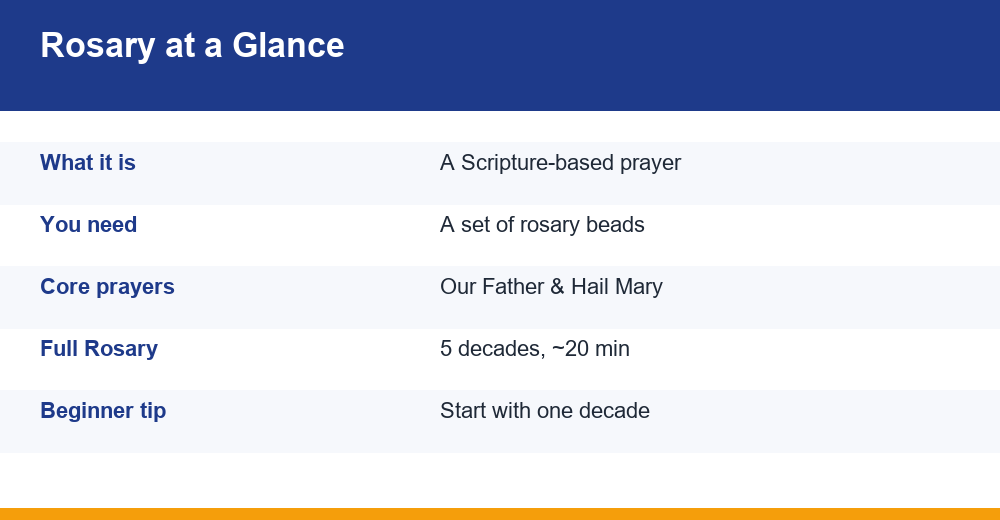
The Rosary for Beginners: What It Actually Is
At its heart, the Rosary weaves together a handful of short, familiar prayers with quiet meditation on the life of Jesus and Mary. As your fingers move along the beads, your hands keep count so that your mind and heart are free to reflect. Because of this, the Rosary is often called a Gospel in miniature — each decade opens a scene from Scripture for you to ponder.
Much of the appeal of the rosary for beginners is exactly this unhurried rhythm. The repeated words are not meant to be rushed or ticked off like a task; they slow you down and give a restless mind something to hold while your soul settles into prayer. Over time, the familiar phrases become a kind of home you can return to anywhere.
A question many newcomers ask is whether the Rosary worships Mary. It does not. Catholics worship God alone; in the Rosary we ask Mary to pray for us, much as we might ask a friend, while every mystery keeps its gaze fixed on her Son. Understanding this puts many hearts at ease before they ever begin.
The word rosary comes from a Latin term for a “crown of roses,” an image of offering Mary a bouquet of prayers. This devotion took shape gradually across many centuries, which is a quiet comfort in itself: you are stepping into a practice that generations before you also had to learn slowly, one prayer at a time.
What You Need to Begin (Just the Beads)
The good news is that you need very little to start. A simple set of rosary beads and a few quiet minutes are enough. You do not need an expensive, antique, or even blessed rosary to pray — a plain cord rosary works just as beautifully as a treasured heirloom.
- A five-decade rosary — or simply your ten fingers
- A quiet spot, even for just five minutes
- A printed or on-screen copy of the prayers while you learn
- An open, unhurried heart
If you would like, you can ask a priest to bless your rosary. It is a lovely custom that many treasure, though it is never required before you begin. Some people exploring the rosary for beginners prefer a single-decade “pocket” rosary or a rosary ring while they build the habit — anything that helps you actually pray is the right choice.
The Prayers You’ll Use
The Rosary is built from just a few prayers, most of which you may already know from Mass or from childhood. Do not feel that you must have them memorized before you start — it is perfectly acceptable to read from a card or a screen, and the words settle into memory naturally through quiet repetition.
- The Sign of the Cross
- The Apostles’ Creed
- The Our Father (the Lord’s Prayer)
- The Hail Mary
- The Glory Be
- The Fatima Prayer (“O my Jesus…”)
- The Hail, Holy Queen
The two prayers you will repeat most often are the Our Father and the Hail Mary, so those are the ones worth learning first. You can find the complete wording of each, along with the closing prayers, in our collection of prayers of the Rosary.
The short prayer said after each decade — “O my Jesus, forgive us our sins…” — comes from the apparitions at Fatima, which the Church has approved as a worthy private revelation rather than binding doctrine. It is a cherished and widely loved custom, but a beginner who leaves it out has still prayed the Rosary faithfully.
The Basic Structure, Step by Step
Here is the shape of a complete five-decade Rosary. Read through it once to get the lay of the land, then keep it beside you as a simple checklist the first few times you pray.
- Holding the crucifix, make the Sign of the Cross and pray the Apostles’ Creed.
- On the first bead, pray an Our Father.
- On the next three beads, pray a Hail Mary on each — traditionally for faith, hope, and love.
- Pray a Glory Be.
- Announce the first mystery, then pray an Our Father.
- On the ten beads of the decade, pray ten Hail Marys while quietly meditating on that mystery.
- Pray a Glory Be, followed by the Fatima Prayer if you wish.
- Repeat steps five through seven for the remaining four decades, then close with the Hail, Holy Queen and a final Sign of the Cross.
If you would like a slower walkthrough with every prayer written out in full and placed exactly where it belongs, see our detailed guide on how to pray the Rosary. For an official reference, the USCCB’s guide to the Rosary lays out this very same structure.
How One Decade Works
The decade is the heartbeat of the Rosary, and once you understand one, you understand the whole prayer. A decade is simply one Our Father, ten Hail Marys, and one Glory Be, all prayed while you picture a single scene from the Gospel.
Take the first Joyful Mystery, the Annunciation, as an example. As your lips pray the ten Hail Marys, let your mind rest on the angel Gabriel greeting Mary. The words carry you along while your imagination stays with the scene. If your thoughts wander — and they will — simply notice it and return to the mystery, without frustration or starting over.
The repetition is intentional. Much as a familiar lullaby can calm a child, the steady return of the Hail Mary quiets the noise of the day and frees you to dwell on the mystery rather than on finding the right words. Do not mistake the repetition for empty routine — it is the very thing that makes contemplation possible.
This is why a single decade makes such a fine beginning. It takes only a few minutes, it teaches you the rhythm of the whole Rosary, and it can be prayed almost anywhere: on a walk, in a waiting room, or in the last quiet moments before sleep.
The Mysteries and When to Pray Them
The mysteries are the meditations at the very heart of each decade — twenty scenes drawn from the lives of Jesus and Mary, gathered into four sets. Many Catholics pair each set with a day of the week, which gives prayer a steady rhythm, though you are always free to pray whichever set draws your heart.
| Day | Mysteries | Focus |
|---|---|---|
| Monday | Joyful | Christ’s coming |
| Tuesday | Sorrowful | Christ’s Passion |
| Wednesday | Glorious | Christ’s triumph |
| Thursday | Luminous | Christ’s ministry |
| Friday | Sorrowful | Christ’s Passion |
| Saturday | Joyful | Christ’s coming |
| Sunday | Glorious | Christ’s triumph |
During Advent, the Joyful Mysteries are often prayed on Sundays, and during Lent, the Sorrowful. The Luminous Mysteries, also called the Mysteries of Light, were added by Pope Saint John Paul II in 2002 to fill out the picture of Christ’s public life.
- Joyful — the Annunciation, Visitation, Nativity, Presentation, and Finding of Jesus in the Temple
- Sorrowful — the Agony in the Garden, Scourging, Crowning with Thorns, Carrying of the Cross, and Crucifixion
- Glorious — the Resurrection, Ascension, Descent of the Holy Spirit, Assumption, and Coronation of Mary
- Luminous — the Baptism in the Jordan, Wedding at Cana, Proclamation of the Kingdom, Transfiguration, and Institution of the Eucharist
Why Pray the Rosary?
People come to the Rosary for many reasons, and the graces it offers are always spiritual rather than magical. Meditating faithfully on the life of Christ draws the heart nearer to him, deepens our love of Scripture, and forms a steadying, unhurried peace. Saints across the centuries have cherished it as a school of prayer that quietly shapes the soul over time.
- A closer, more personal friendship with Jesus
- A deeper love for Sacred Scripture and the Gospel
- Growth in patience, humility, and trust in God
- A calmer heart and a settled habit of daily prayer
You may also come across lists of blessings linked to the Rosary, often called the fifteen promises. These belong to the Church’s devotional tradition rather than to defined doctrine, so it is best to receive them as pious encouragement, not as guarantees. The heart of the matter is simpler and more certain: prayer offered with love is never wasted.
Start Small and Be Gentle With Yourself
If five decades feel like a lot, begin with one. There is no rule that a newcomer must pray the entire Rosary in a single sitting. A single decade prayed faithfully each day will do far more for your soul than a full Rosary you dread and quietly abandon after a week.
The most common mistake among those praying the rosary for beginners is expecting perfection. You will lose count, forget a prayer, or drift off in the middle of a decade — and none of it undoes your prayer. God receives the offering of a willing heart, distractions and all.
- Pick a set time — after your morning coffee, on your commute, or before bed
- Keep your rosary somewhere you will see it and reach for it
- Read the prayers aloud until they slowly become your own
- Let the repetition slow you down instead of hurrying you along
Many people find that this quiet, repetitive prayer brings a genuine sense of peace at the close of a hard day. The Rosary offers real spiritual consolation — but it is not a replacement for professional care. If you are carrying heavy anxiety or grief, please reach out to a trusted doctor or counselor as well.
Whatever first drew you toward the rosary for beginners, take heart: countless saints and ordinary faithful have prayed these same words for centuries, and you are joining their company. Pick up the beads, make the Sign of the Cross, and simply begin. Mary will help you take it from there.
A Simple Plan for Your First Week
If you like a little structure, here is one easy way to ease in over your first week. Adjust it freely — the goal is a habit that lasts, not a schedule to feel guilty about.
- Days 1–2: Learn the Sign of the Cross and the Our Father, and pray a single decade.
- Days 3–4: Add the Hail Mary and the Glory Be, still praying just one decade.
- Day 5: Read through the mysteries and choose the set for the day.
- Day 6: Pray two or three decades, pausing briefly on each mystery.
- Day 7: If you feel ready, pray a full five-decade Rosary — and if not, that is perfectly fine too.
By the end of a week, the rhythm that once felt unfamiliar will already be settling into place. From there, growth comes naturally: a decade here, a full Rosary there, until the prayer becomes a quiet companion woven through your ordinary days.
Frequently Asked Questions
Do I need a blessed rosary to start?
No. Any set of beads — even your ten fingers — is enough to begin. Having a rosary blessed by a priest is a beautiful tradition that many treasure, but it is never required before you start praying. Begin with whatever you have today.
How long does it take to pray the Rosary?
A full five-decade Rosary usually takes about fifteen to twenty minutes when prayed unhurried. A single decade takes only three to five minutes, which makes it ideal for newcomers or for busy days. The quality of your attention matters far more than speed.
Which mysteries should I pray today?
Many Catholics follow the traditional weekly schedule: Joyful on Monday and Saturday, Sorrowful on Tuesday and Friday, Glorious on Wednesday and Sunday, and Luminous on Thursday. You are always free, though, to pray whichever set speaks most to your heart on a given day.
Is praying the Rosary worshiping Mary?
No. Catholics worship God alone. In the Rosary we ask Mary to pray for us, much as we ask a friend, while every mystery meditates on the life of Christ. The prayer is meant to draw us closer to Jesus through the eyes of his mother.