Category: Rosary Basics

Getting started with the Rosary

  • How to Bless a Rosary: 5 Essential Facts Catholics Should Know

    How to Bless a Rosary: 5 Essential Facts Catholics Should Know

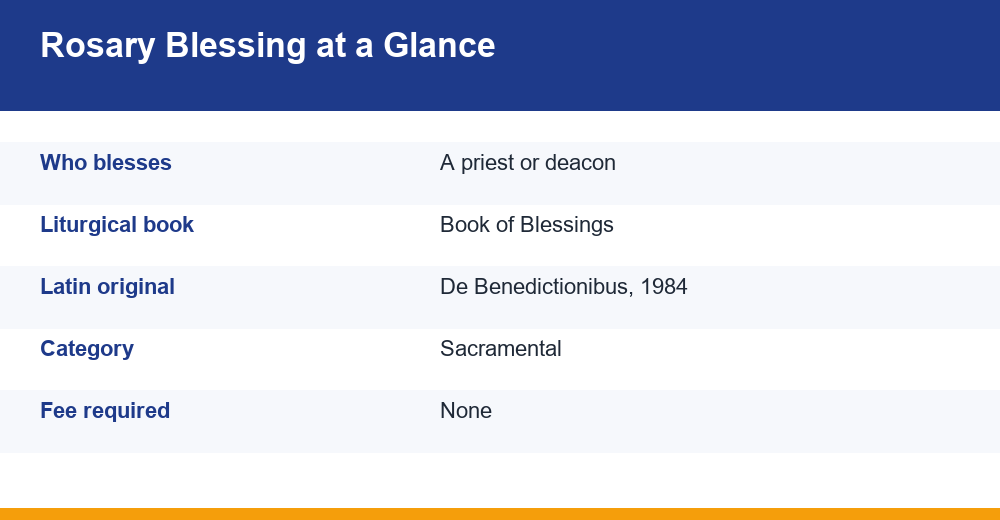
    If you want to know how to bless a rosary, the short answer is that you ask a priest or deacon, because the Church gives this blessing through her ordained ministers. The rest of this guide explains what the blessing is, what the rite contains, and what to do if you can’t find a priest, if the beads break, or if you are wondering whether a blessing is needed at all.

    how to bless a rosary — infographic

    What a Rosary Blessing Really Is

    A blessed rosary is a sacramental. The Catechism describes sacramentals as sacred signs, instituted by the Church, that bear a resemblance to the sacraments. Through the Church’s prayer they prepare us to receive grace and dispose us to cooperate with it. They are not sacraments themselves, and they do not work automatically.

    The Catechism also notes that sacramentals always include a prayer, often with a specific sign such as the sign of the cross or a sprinkling with holy water, which recalls Baptism. A rosary blessing follows that pattern: an ordained minister prays over the beads and the person who will use them, and traces the sign of the cross over them.

    What the blessing does, and what it does not do

    The blessing sets the rosary apart for prayer. From then on it is a sacred object meant for worship, not a piece of jewellery or a decoration. The Church’s prayer goes with it, asking God to bless the one who prays with it.

    What the blessing does not do matters just as much. It does not turn the beads into a charm, protect you mechanically from harm, or make your prayers “count” more than prayers on an unblessed rosary. Treating a sacramental like a lucky object is one of the common misunderstandings about the rosary that the Church has always corrected.

    • Sacrament: instituted by Christ, gives grace by the rite itself (for example, Baptism or the Eucharist).
    • Sacramental: instituted by the Church, disposes the person to grace through the Church’s prayer and the user’s faith.
    • Blessed rosary: a sacramental object whose value lies in the prayer it supports.

    Can a Deacon Bless a Rosary?

    Yes. A priest or a deacon can bless a rosary. The Code of Canon Law states that any priest can impart blessings except those reserved to the Pope or to bishops (canon 1169 §2), and that a deacon can impart only those blessings the law expressly permits to him (canon 1169 §3).

    The introductions in the Book of Blessings state, rite by rite, who may preside. Deacons are permitted to give many of them, including the blessing of devotional objects such as rosaries, medals and small crosses. So a deacon at your parish is a perfectly good person to ask.

    WhoCan bless a rosary?Notes
    BishopYesCan give any blessing a priest can, plus those reserved to bishops
    PriestYesAny priest may bless rosaries and other devotional objects
    DeaconYesPermitted by the Book of Blessings for devotional objects
    Religious brother or sister (not ordained)No liturgical blessingMay pray with and for you
    Lay CatholicNo liturgical blessingMay pray over the rosary personally; see below

    A bishop’s blessing carries one extra traditional feature. Under the current norms on indulgences, the faithful who devoutly use an object of piety blessed by the Pope or a bishop can gain a plenary indulgence on the Solemnity of Saints Peter and Paul (29 June), adding a profession of faith to the usual conditions: sacramental confession, Holy Communion and prayer for the Pope’s intentions.

    How to Bless a Rosary: The Church’s Rite

    The official answer to how to bless a rosary is found in the Book of Blessings, the English edition of the Latin De Benedictionibus, which was issued in 1984. It contains a dedicated order for the blessing of rosaries among the blessings of objects used in the devotions of the Christian people.

    The orders in the Book of Blessings generally follow a common shape. When time allows, especially when several people bring rosaries together, the full celebration looks like this:

    1. Introductory rites: the sign of the cross and a greeting from the minister.
    2. Brief introduction: the minister explains the meaning of the rosary and of the blessing.
    3. Reading of the Word of God: often a Gospel passage connected to Mary or the life of Christ.
    4. Intercessions: short petitions, which may be led together with those present.
    5. Prayer of blessing: the minister prays over the rosaries and those who will use them, making the sign of the cross.
    6. Sprinkling with holy water: optional, depending on the circumstances.
    7. Concluding rite: a final blessing and dismissal.

    The short form you will usually see

    In practice, most rosaries are blessed in a few seconds after Mass. The priest or deacon says a brief prayer of blessing over the beads, often asking God to bless both the rosary and the person who uses it, and makes the sign of the cross over it. That short form is just as truly the Church’s blessing as the longer celebration.

    Some priests use the older Roman Ritual, which has its own Latin formula for blessing rosaries. Either way, the rosary is blessed. If you have a preference, it is fine to mention it politely, but the choice belongs to the minister.

    ElementFull celebrationQuick blessing after Mass
    Sign of the cross and greetingYesSometimes
    Scripture readingYesUsually omitted
    IntercessionsYesUsually omitted
    Prayer of blessingYesYes
    Sign of the cross over the beadsYesYes
    Holy waterOptionalOptional

    How Do You Get a Rosary Blessed?

    Getting a rosary blessed is easy, and priests are generally glad to do it. Here is the practical side of how to bless a rosary when you are the one bringing it.

    1. Choose a moment. After Sunday or weekday Mass is the most common time. You can also ring the parish office and ask when a priest or deacon is available.
    2. Have the rosary ready. Take it out of its box or plastic bag and hold it in your open hand. If you have several, bring them together.
    3. Ask simply. “Father, would you bless my rosary, please?” or “Deacon, could you bless these rosaries?” is all you need to say.
    4. Pray along. Answer “Amen” at the end of the prayer and make the sign of the cross yourself.
    5. Say thank you. No payment is needed or expected.

    A blessing must never be bought. Charging for a spiritual good is the old sin of simony, which the Church condemns. If you want to make an offering to the parish, that is a free gift, not a fee.

    Other good opportunities

    • Parish missions, retreats and pilgrimages, where priests often bless religious items for the whole group.
    • First Communion or Confirmation days, when many families bring new rosaries.
    • Shrines and cathedrals, which often have priests available at set times.
    • Catholic schools and campus ministries, where a chaplain can usually help.

    A rosary bought online or received by post does not need any special handling before it is blessed. Simply keep it with care and bring it along the next time you go to Mass.

    If you are just starting to pray with your new beads, our guide to the rosary for beginners walks you through the prayers and the order of the decades.

    Can You Bless Your Own Rosary?

    Not in the liturgical sense. A layperson cannot give the Church’s blessing that makes a rosary a sacramental. That blessing is given by a priest or deacon, as the Book of Blessings provides.

    This is not a slight to the laity. The Catechism teaches that every baptized person is called to be a blessing and to bless, and that some blessings may be presided over by lay people. But it adds that the more a blessing concerns ecclesial and sacramental life, the more its administration is reserved to the ordained ministry: bishops, priests or deacons.

    The USCCB’s overview of sacramentals and blessings explains that lay people who give certain blessings do so by reason of the universal priesthood or a special office, such as parents blessing their children. Even then, the lay minister uses the rites and formulas designated for lay people, and the introduction to each rite says who may preside.

    What you can do yourself

    • Pray over your rosary and dedicate your use of it to God, for example by offering your first rosary on it for a particular intention.
    • Sprinkle it with holy water you already have at home, as an act of personal devotion.
    • Keep it in a clean, set-apart place until you can have it blessed.
    • Bless your children by tracing a cross on their foreheads, a lay blessing the Church encourages in families.

    If you were hoping to learn how to bless a rosary yourself, these acts are the right place to start. They are good and devout, but simply not the same thing as the Church’s official blessing, and it helps to call them what they are.

    Does a Rosary Need to Be Blessed?

    No. An unblessed rosary is a perfectly good tool for prayer. The rosary is a prayer first and a string of beads second; you can even pray it on your fingers. What gives the rosary its strength is meditation on the life of Christ with Mary, not the material of the beads.

    Every decade invites you to dwell on an event in the Gospel. If you are learning those events, our page on the mysteries of the rosary sets out all twenty with their scripture references.

    Why it is still worth having it blessed

    • The Church’s prayer: a blessing joins your devotion to the prayer of the whole Church.
    • A partial indulgence: the current norms grant a partial indulgence to the faithful who devoutly use a crucifix, cross, rosary, scapular or medal properly blessed by any priest or deacon.
    • Reverence: a blessed rosary reminds you that this object belongs to God and is for prayer.

    Separately, a plenary indulgence is attached to praying the Marian rosary in a church or oratory, or together as a family, religious community or pious association, under the usual conditions. That grant is tied to the prayer itself, not to whether the beads are blessed.

    QuestionUnblessed rosaryBlessed rosary
    Can I pray the rosary with it?YesYes
    Is it a sacramental?No, a devotional aidYes
    Partial indulgence for devout useNoYes
    Plenary indulgence for praying in church or as a familyYes, with usual conditionsYes, with usual conditions
    Must it be treated as a sacred object?Respect is fittingYes (canon 1171)

    What to Do With a Broken Blessed Rosary

    Rosaries break. Links open, cords fray, and crucifixes come loose. When that happens, you have two good options: repair it or dispose of it respectfully.

    Repairing it

    Many breaks are minor. A link that has opened can often be closed with small pliers, and replacement links and findings are inexpensive. A rosary with precious metal or stones may be worth taking to a jeweller. The common pastoral view is that a blessed rosary repaired in this way keeps its blessing, because it is still essentially the same object.

    If the rosary was rebuilt with mostly new parts, or you simply feel unsure, ask a priest or deacon to bless it again. It costs nothing and takes a moment.

    Disposing of it respectfully

    Canon 1171 asks that sacred objects, set apart for worship by dedication or blessing, be treated reverently and not put to profane or inappropriate use, even when privately owned. Church law does not prescribe a disposal method, but Catholic custom is clear: burn or bury blessed items rather than throwing them in the rubbish.

    Rosary materialTraditional optionPractical note
    Wood, cord or seedsBurn, then bury the ashesBurn small amounts safely, following local fire rules
    MetalBury, or take apart so it can’t be misusedSome parishes collect metal items
    Glass, plastic or stone beadsBury in clean groundTaking it apart first is acceptable
    Any materialTake it to your parishMany parishes will dispose of it for you

    If it is still usable, you can also pass it on to someone who will pray with it. Some groups collect old rosaries, repair them, and send them to missions and prisons.

    Treating a Blessed Rosary With Reverence

    Once you understand how to bless a rosary and what the blessing means, a few habits follow naturally. None of them are complicated; they are simply the ways Catholics have shown respect for holy things.

    • Keep it in a pouch, box or a clean pocket rather than loose in a bag with keys and coins.
    • Pray with it. A rosary that is used daily is honoured more than one kept untouched in a drawer.
    • Avoid wearing it as a fashion necklace; the Church’s tradition is to carry it, hang it, or pray with it.
    • Do not sell a rosary at a higher price because it is blessed. A blessing is not a commercial feature.
    • When giving one as a gift, you can have it blessed beforehand, or let the recipient bring it to their own priest.

    A rosary hanging from a car mirror or a bedpost is a long-standing custom in many Catholic homes. It is fine, as long as it is a reminder to pray and not a token believed to bring luck. The intention behind the use is what makes the difference.

    In the end, the blessing is the Church’s invitation to prayer. The best way to honour a blessed rosary is to take it in your hands, begin with the Creed, and keep going.

    Frequently Asked Questions

    How do you get a rosary blessed?

    Bring your rosary to a priest or deacon, most easily after Mass, and simply ask him to bless it. Take it out of its packaging and hold it in your open hand. He will say a short prayer of blessing and make the sign of the cross over it. Answer “Amen”. There is no fee, and none should ever be asked for a blessing.

    Can you bless your own rosary?

    Not with the Church’s liturgical blessing, which the Book of Blessings gives to priests and deacons. You can still pray over your rosary, dedicate your use of it to God and sprinkle it with holy water as personal devotion. These are good acts, but they do not replace the blessing given by an ordained minister.

    What do you do with a broken blessed rosary?

    If it can be fixed, repair it; a lightly repaired rosary is generally considered to keep its blessing, and a priest can bless it again if you are unsure. If it cannot be used, do not throw it in the rubbish. Burn or bury it respectfully, or take it to your parish, which will usually dispose of it for you.

    Can a deacon bless a rosary?

    Yes. Canon law lets deacons give the blessings the law expressly permits them, and the Book of Blessings includes the blessing of devotional objects such as rosaries, medals and small crosses among them. A deacon’s blessing is a real blessing of the Church, just like a priest’s, so asking your parish deacon is completely appropriate.
  • Sorrowful Mysteries: 5 Essential Reflections for Praying Them Well

    Sorrowful Mysteries: 5 Essential Reflections for Praying Them Well

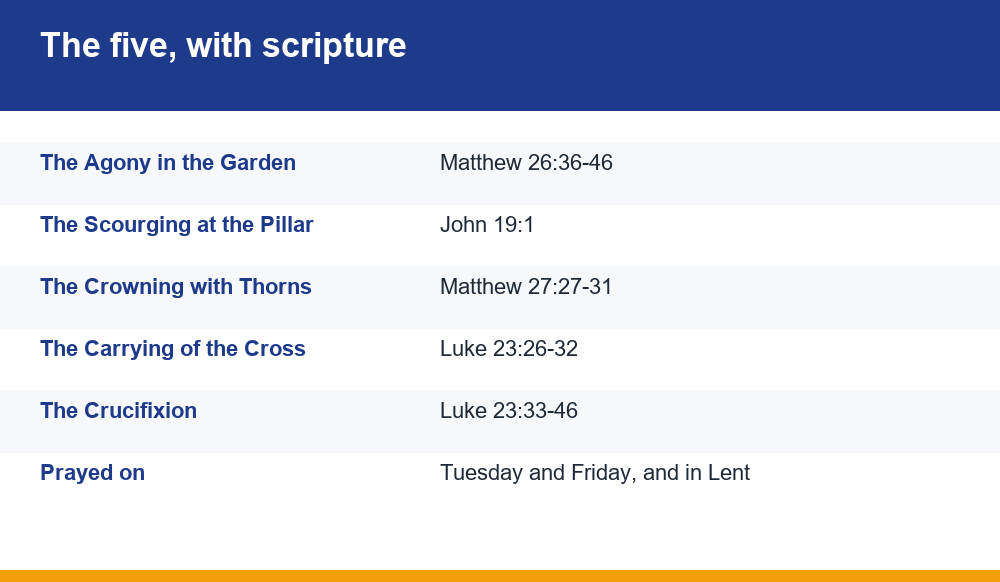
    The Sorrowful Mysteries are, by common admission, the most difficult set to pray attentively. The Joyful invite warmth and the Glorious invite hope, while these ask the person praying to stay with something painful for twenty minutes without looking away. The usual result is that the decades are completed and the mind has been elsewhere for most of them. That is not a failure of devotion so much as an ordinary consequence of how attention works, and there are remedies. What follows is the scripture for each mystery, a short reflection, the traditional fruit attached to it, and some practical help for the distraction that comes with them.

    sorrowful mysteries — infographic

    When the Sorrowful Mysteries are prayed

    They are prayed on Tuesdays and Fridays throughout the year, and on the Sundays of Lent. Friday carries the obvious association with the Passion; Tuesday has no symbolic reason beyond the distribution of the sets across the week.

    During Lent they frequently replace the Sunday set, which places them at the centre of the season rather than at its edges. Many people also return to them outside the schedule during illness, bereavement or difficulty, which is a long-standing instinct rather than an irregularity.

    A note on the week

    Since the Luminous Mysteries were proposed in 2002, Thursday carries those and the Sorrowful sit on Tuesday and Friday. Older books list a different arrangement, which causes occasional confusion when praying from an inherited pamphlet.

    The Agony in the Garden

    Matthew 26:36-46. Christ in Gethsemane, asking that the cup pass from him, and adding: not as I will, but as you will. The disciples sleep a short distance away.

    What distinguishes this mystery is that nothing has yet happened. No one has struck him. The suffering is entirely anticipatory, which is a form most people recognise immediately: the night before the diagnosis, the hours before a conversation that cannot be avoided.

    The detail worth sitting with is the request itself. He asks for it to be taken away. The prayer of submission that follows does not replace that asking; it comes after it, and it does not pretend the first part was not meant. That order is a considerable comfort to anyone who has felt that wanting relief is itself a failure of faith.

    The Scourging at the Pillar

    John 19:1, which records the event in a single sentence: Then Pilate took Jesus and had him flogged.

    The brevity is striking and worth noticing. The Gospels do not dwell on the physical detail, and the devotional tradition that does so at length is an addition to them rather than a reading of them. Praying this mystery does not require constructing the scene in anatomical detail, and for many people doing so becomes an obstacle rather than an aid.

    What the single verse holds is the procedural quality of it. The flogging is administered by men doing their work, under orders, without particular malice. Suffering inflicted by a system rather than by an enemy is harder to place and, for a great many people, more familiar.

    The Crowning with Thorns

    Matthew 27:27-31. The soldiers dress him in a scarlet cloak, press a crown of thorns onto his head, put a reed in his hand and kneel in mockery: Hail, King of the Jews.

    This mystery is about humiliation rather than pain, and the two are not the same. The thorns hurt; the kneeling is designed to degrade. It is the one scene in the Passion where the cruelty is recreational rather than functional.

    There is a particular bitterness in the mockery being accurate. They jeer at a claim to kingship that the Church holds to be true, and they are closer to the truth than they know. The tradition has long found in this the suggestion that contempt frequently lands on exactly what deserves honour, which is worth holding when praying for anyone who has been made small by others.

    The Carrying of the Cross

    Luke 23:26-32. Simon of Cyrene is compelled to carry the cross, and the women of Jerusalem weep as Christ tells them to weep instead for themselves and their children.

    Simon is the figure most people find themselves attending to here. He did not volunteer; he was pressed into it while passing. The tradition has always treated him generously, because help given under compulsion is still help, and most assistance any of us gives is somewhat less freely chosen than we would like to remember.

    This is also the mystery where the journey is extended deliberately. Nothing required the condemned man to carry the instrument through the streets. The distance is part of the punishment, and anyone praying through a difficulty that is simply taking a long time will recognise the specific weight of that.

    The Crucifixion

    Luke 23:33-46, with the words from the cross distributed across the Gospels: the forgiveness of the executioners, the promise to the thief, the cry of abandonment, and the final commendation into the Father’s hands.

    Most people find the cry of abandonment the hardest line in scripture, and it is worth not moving past it quickly. It is also the opening of Psalm 22, which a listener of the time would have recognised, and that psalm ends in vindication. Both readings are held together in the tradition: genuine desolation, and a psalm that does not end there.

    The promise to the thief is the other place to rest. It is made to someone with no time left to amend anything, and it is unconditional. For anyone praying for a person who died badly or late, that exchange is the single most consoling passage available in the whole of the Passion.

    The fruit traditionally attached to each

    Each mystery carries a virtue traditionally sought while praying it. The list varies slightly between sources, and the version below is the most widely printed.

    MysteryFruit
    The Agony in the GardenSorrow for sin, conformity to God’s will
    The Scourging at the PillarPurity, mortification of the senses
    The Crowning with ThornsMoral courage, contempt of the world
    The Carrying of the CrossPatience in bearing one’s own cross
    The CrucifixionPerseverance, and love for the dying

    These are intentions rather than instructions, and holding one in mind at the start of a decade is a simple way of giving the attention somewhere to settle. Those who find them distracting may leave them entirely; they are an aid, not a requirement.

    When the words run ahead of the mind

    This is the common experience with these mysteries and it is worth addressing directly rather than treating as a private failing. The decade ends, and you realise you have been thinking about tomorrow for most of it.

    The traditional counsel is reassuringly undramatic: notice it and return, without recrimination. The returning is the prayer. A rosary made up largely of returning is not a poor rosary, and treating each distraction as a fault simply adds a second distraction to the first.

    • Read the scripture passage aloud before beginning the decade
    • Hold one short phrase, a single line, through the ten
    • Pray more slowly than feels natural; speed drives distraction
    • Use the beads deliberately, since the hands help the mind
    • If the whole rosary is beyond you today, pray one decade well

    We set out the broader approach to this in our notes on the Luminous Mysteries, where the same difficulty arises in a gentler key.

    Praying them while suffering

    People reach for the Sorrowful Mysteries most often when something is wrong, and the experience is different from praying them on an ordinary Tuesday.

    Two things are worth saying. The first is that these mysteries do not explain suffering and were never intended to. They place a person beside someone who suffered, which is a different kind of help and frequently the only one that reaches anybody in the middle of it.

    The second is that it is entirely permissible to pray them badly at such times: distracted, angry, or barely at all. Christ in Gethsemane asked for the cup to be removed before he accepted it, and nothing in the tradition requires a person to arrive at acceptance faster than he did.

    For anyone sitting with someone who is ill or dying, the fifth mystery is the one most often returned to, and the promise to the thief is the sentence most worth carrying into that room.

    Praying them with children

    Families reach the Sorrowful Mysteries and hesitate, reasonably, over how much to say. The scenes are violent and children ask direct questions.

    The approach most parents settle on is to stay with what the Gospels actually say, which as noted above is remarkably restrained. The single verse on the scourging says what happened and no more. Children are generally better served by that brevity than by the elaborated descriptions found in some devotional material.

    It also helps to name what each mystery is about in one phrase before beginning: being afraid, being mocked, being helped by a stranger, being with someone as they die. Children follow those categories readily, and they are closer to what the mysteries are for than a catalogue of injuries.

    A shortened form is perfectly acceptable. One decade, prayed attentively, with a sentence of explanation beforehand, is better formation than five decades endured. The full rosary can wait; the habit is what is being built.

    Where a child is grieving, the fifth mystery tends to arrive differently, and many parents find it carries the conversation better than an explanation would. That is, in the end, what these mysteries have always been for.

    One practical note on where to pray them. The Sorrowful Mysteries ask more of the attention than the other sets, which makes the setting matter more than usual. A quiet room, or a church, or a walk alone will all sustain them better than a crowded kitchen with a phone within reach.

    Many people also find a physical crucifix or a single image helpful here in a way they do not with the Joyful Mysteries, because it gives the eyes somewhere to rest and keeps the mind from drifting into the day ahead. The beads themselves do a great deal of this work, which is part of why the devotion has survived in the form it has.

    And if you arrive at the end having been absent for most of it, pray them again tomorrow. The tradition has never suggested that a distracted rosary is wasted, only that it is ordinary.

    Frequently Asked Questions

    When are the Sorrowful Mysteries prayed?

    On Tuesdays and Fridays throughout the year, and on the Sundays of Lent. Friday carries the association with the Passion. Older pamphlets printed before the Luminous Mysteries were proposed in 2002 show a different weekly arrangement, which causes some confusion.

    What are the five Sorrowful Mysteries?

    The Agony in the Garden, the Scourging at the Pillar, the Crowning with Thorns, the Carrying of the Cross, and the Crucifixion. Each has a scripture passage and a traditional fruit or virtue sought while praying it.

    Why are these mysteries harder to pray?

    Because they ask the person praying to stay with something painful rather than something consoling, and attention naturally moves away from distress. Distraction here is ordinary rather than a failure, and the counsel is to notice it and return without recrimination.

    What is the fruit of the Carrying of the Cross?

    Patience in bearing one’s own cross. The figure of Simon of Cyrene is central to how this mystery is usually prayed, because he was compelled rather than volunteering, and help given under compulsion is still treated by the tradition as help.

    Can I pray them outside Tuesday and Friday?

    Yes. Many people return to them during illness, bereavement or difficulty regardless of the day, and this is a long-standing practice rather than an irregularity. The weekly scheme is an ordering of the devotion, not a restriction on it.

  • Rosary Mysteries by Day: The Easy 2026 Weekly Schedule

    Rosary Mysteries by Day: The Easy 2026 Weekly Schedule

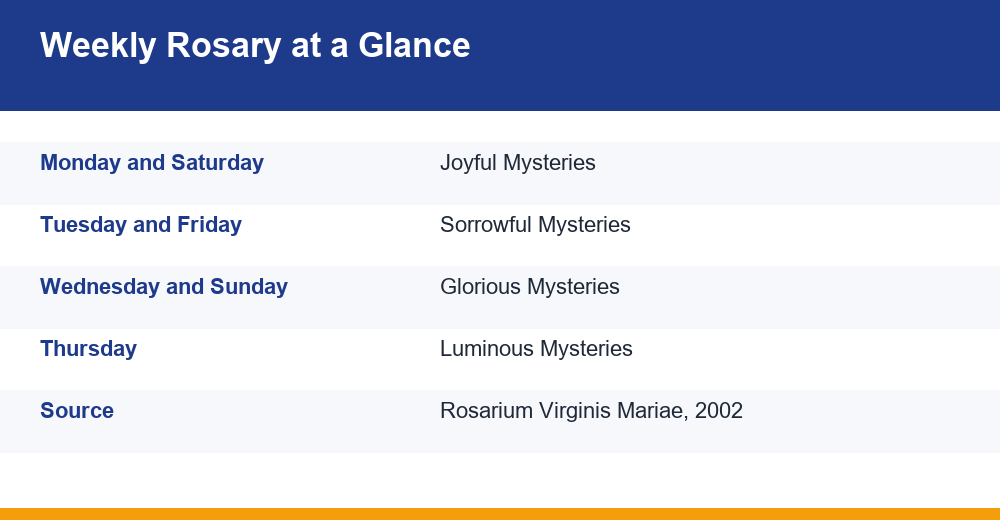
    The rosary mysteries by day follow a simple weekly pattern: Joyful on Monday and Saturday, Sorrowful on Tuesday and Friday, Glorious on Wednesday and Sunday, and Luminous on Thursday. That is the chart most people know. What most charts leave out is how the Sundays of Advent and Lent change it, where the schedule came from, and the Church’s own reminder that it is a guide, not a law.

    rosary mysteries by day — infographic

    Rosary Mysteries by Day: The Weekly Chart

    The Rosary has twenty mysteries, grouped into four sets of five. Each set is one full Rosary of five decades. Since 2002 the Church has suggested a weekly rotation that spreads all four sets across the seven days, so that over a week you walk through the whole life of Christ with Mary.

    Here is the standard weekly chart, as given by the Holy See and the U.S. bishops. If you only need the quick answer to which mysteries are prayed on each day, this table is it.

    DayMysteriesFocus
    MondayJoyfulThe Incarnation and Christ’s childhood
    TuesdaySorrowfulThe Passion and death of Jesus
    WednesdayGloriousThe Resurrection and its fruits
    ThursdayLuminousChrist’s public ministry
    FridaySorrowfulThe Passion and death of Jesus
    SaturdayJoyfulThe Incarnation and Christ’s childhood
    SundayGlorious (Joyful in Advent, Sorrowful in Lent)The Resurrection, the Lord’s Day

    Notice the pattern. The Sorrowful Mysteries fall on Friday, the day of the Crucifixion. The Glorious Mysteries fall on Sunday, the day of the Resurrection. Thursday, the day the Eucharist was instituted at the Last Supper, holds the Luminous Mysteries, whose fifth mystery is the Institution of the Eucharist.

    For a full list of the twenty mysteries with Scripture references for each, see our guide to the mysteries of the Rosary. Below is a short reminder of what each set contains.

    • Joyful: the Annunciation, the Visitation, the Nativity, the Presentation in the Temple, the Finding of Jesus in the Temple.
    • Luminous: the Baptism in the Jordan, the Wedding at Cana, the Proclamation of the Kingdom, the Transfiguration, the Institution of the Eucharist.
    • Sorrowful: the Agony in the Garden, the Scourging at the Pillar, the Crowning with Thorns, the Carrying of the Cross, the Crucifixion.
    • Glorious: the Resurrection, the Ascension, the Descent of the Holy Spirit, the Assumption, the Coronation of Mary.

    Where the Weekly Schedule Comes From

    The current rotation was proposed by Saint John Paul II in his apostolic letter Rosarium Virginis Mariae, signed on 16 October 2002 at the start of his 25th year as pope. In the same letter he opened a Year of the Rosary, running from October 2002 to October 2003, and added a new set of five mysteries.

    Those new mysteries are the Luminous Mysteries, or Mysteries of Light. They fill the gap between the hidden life of Jesus in Nazareth and his Passion, focusing on his public ministry. Our article on the Luminous Mysteries explained goes through each one and the reasons John Paul II gave for adding them.

    Adding a fourth set meant the old weekly rotation no longer fit. Paragraph 38 of the letter sets out the new distribution. You can read the full text on the Holy See’s website: Rosarium Virginis Mariae (vatican.va).

    The schedule before 2002

    Before the Luminous Mysteries existed, the Rosary had fifteen mysteries in three sets. The customary rotation looked like this, and you will still find it in older prayer books.

    DayBefore 2002Since 2002
    MondayJoyfulJoyful
    TuesdaySorrowfulSorrowful
    WednesdayGloriousGlorious
    ThursdayJoyfulLuminous
    FridaySorrowfulSorrowful
    SaturdayGloriousJoyful
    SundayGloriousGlorious

    Only two days changed. Thursday became the day for the Luminous Mysteries, and the second weekly meditation on the Joyful Mysteries moved from Thursday to Saturday. Some Catholics, especially those attached to older devotional books, still pray the fifteen-mystery Rosary. That is a legitimate choice, since the Luminous Mysteries were proposed, not imposed.

    Which Mysteries Are Prayed on Sunday?

    Of all the rosary mysteries by day, Sunday is the one that shifts with the seasons. For most of the year, Sunday belongs to the Glorious Mysteries. Every Sunday is a little Easter, the weekly celebration of the Resurrection, so meditating on the risen Christ, his Ascension, Pentecost, and Mary’s Assumption and Coronation fits the day naturally.

    The U.S. Conference of Catholic Bishops gives two seasonal exceptions that many families follow:

    • Sundays of Advent: the Joyful Mysteries, which centre on the coming of Christ.
    • Sundays of Lent: the Sorrowful Mysteries, which centre on the Passion.
    • All other Sundays: the Glorious Mysteries.

    Paragraph 38 of Rosarium Virginis Mariae itself simply assigns the Glorious Mysteries to Sunday and says nothing about seasonal variations. Both approaches are fine. The seasonal Sunday custom is a pious tradition that helps the Rosary breathe with the liturgical year, not an obligation.

    Some people also pray the Joyful Mysteries on the Sundays of the Christmas season, between Christmas Day and the Baptism of the Lord. This is a common devotional habit rather than an official rubric, but it follows the same logic as the Advent custom.

    What Mysteries Do You Pray During Lent and Advent?

    When the rosary mysteries by day meet the liturgical seasons, only the Sunday changes. Weekdays keep their normal assignment. So in Lent you would still pray the Joyful Mysteries on Monday and the Luminous on Thursday, and in Advent the Sorrowful Mysteries still fall on Friday.

    SeasonSunday mysteriesWeekdaysDates (approximate span)
    Advent 2026JoyfulNormal rotation29 Nov to 24 Dec 2026
    Christmas seasonJoyful (custom) or GloriousNormal rotation25 Dec 2026 to Baptism of the Lord
    Lent 2027SorrowfulNormal rotation10 Feb 2027 (Ash Wednesday) to Holy Thursday
    Easter seasonGloriousNormal rotation28 Mar to 16 May 2027 (Pentecost)
    Ordinary TimeGloriousNormal rotationRest of the year

    Why these choices? Advent prepares for the Nativity, and the Joyful Mysteries walk through exactly those events: the Annunciation, the Visitation, the birth of Jesus. Lent prepares for Good Friday and Easter, and the Sorrowful Mysteries keep the Passion before your eyes through the forty days.

    Holy Week and the Triduum

    Holy Week is a natural time to lean into the Sorrowful Mysteries more often, even on days when the chart says otherwise. Many people pray them on Holy Thursday evening and Good Friday. On Easter Sunday the Glorious Mysteries return with full force, and they remain the Sunday set right through the fifty days to Pentecost.

    If you follow the pre-2002 fifteen-mystery Rosary, the same seasonal Sunday customs apply. The only difference is your Thursday and Saturday.

    Why Are the Joyful Mysteries Prayed on Saturday?

    This is one of the most common questions, because Saturday used to be a Glorious day. The answer comes straight from paragraph 38 of Rosarium Virginis Mariae.

    John Paul II needed a free weekday for the new Luminous Mysteries. He chose Thursday, which meant moving the Joyful Mysteries that had been prayed on that day. He placed them on Saturday, explaining that Saturday has a special Marian character and that Mary’s presence is especially pronounced in the Joyful Mysteries.

    The link between Saturday and Our Lady is old. For centuries the Church has dedicated Saturday to Mary, and the liturgy offers an optional memorial of the Blessed Virgin Mary on Saturdays in Ordinary Time when no other celebration takes precedence. The First Saturday devotion associated with Fatima reinforces the same connection.

    • Mary is the central human figure in every Joyful Mystery, from the Annunciation to the Finding in the Temple.
    • Saturday is traditionally Mary’s day in Catholic devotion.
    • Moving the Joyful Mysteries there freed Thursday for the Luminous Mysteries and the Eucharist.

    So the Saturday assignment is not arbitrary. It joins the most Marian of the mysteries to the most Marian day of the week.

    Can You Pray Any Mystery on Any Day?

    Yes. This is the honest answer that many charts omit. The weekly rotation is a recommendation, and John Paul II said so in the very paragraph that introduced it. He wrote that the schedule is “not intended to limit a rightful freedom in personal and community prayer.”

    He added that spiritual and pastoral needs, and particular liturgical celebrations, may call for suitable adaptations. In other words, the rosary mysteries by day exist to help you, not to bind you. Praying the Sorrowful Mysteries on a Wednesday is not a mistake, and it is certainly not a sin.

    Good reasons to step outside the chart

    • You are grieving, ill, or facing a hard trial, and the Sorrowful Mysteries speak to you.
    • A new baby has arrived in the family, and the Joyful Mysteries feel right.
    • Someone you love has died, and you want to rest in the hope of the Glorious Mysteries.
    • You are preparing for Confession or First Communion and want to meditate on the Luminous Mysteries.
    • Your parish or prayer group has chosen a particular set for a novena or event.

    Some people pray all four sets in one day, which is the complete Rosary of twenty decades. Others pray one decade at a time across the day. Both are rooted in the tradition. What matters most is attentive, unhurried meditation on Christ with Mary, rather than ticking the correct box.

    If you pray with a group, it is courteous to follow whatever set the leader announces. In private prayer, you have the freedom the Church itself describes.

    Adapting the Schedule for Feasts and Life Events

    Because paragraph 38 explicitly mentions liturgical celebrations, many Catholics choose the mysteries that match a feast falling on that day. This is entirely optional, and it shows the rosary mysteries by day working as a starting point rather than a fixed rule. It can also make the Rosary feel connected to the Church’s calendar.

    Feast or occasionUsual dateFitting mysteries
    Annunciation25 March (5 April in 2027)Joyful
    Transfiguration6 AugustLuminous
    Assumption15 AugustGlorious
    Our Lady of the Rosary7 OctoberAny; many pray all four sets
    Christmas Day25 DecemberJoyful
    Good FridayFriday before EasterSorrowful
    PentecostSeventh Sunday after EasterGlorious

    Christmas Day 2026 falls on a Friday, normally a Sorrowful day. Most people will naturally pray the Joyful Mysteries instead, and that is exactly the kind of adaptation the letter has in mind. Note also that in 2027 the Annunciation falls in Holy Week, so the feast moves to Monday 5 April.

    Personal anniversaries can guide the choice too. A wedding anniversary might suggest the Wedding at Cana in the Luminous Mysteries. The anniversary of a death might suggest the Glorious Mysteries and the hope of the Resurrection.

    Making the Schedule Work in Daily Prayer

    The real value of the weekly chart is that it removes one decision. You do not have to wonder each morning which set to pray, and over a week you cover the whole Gospel story. For many people, following the rosary mysteries by day is what turns occasional prayer into a steady rhythm.

    If you are trying to build that rhythm, our guide to forming a daily rosary habit has practical advice on timing, place and keeping going when life gets busy. A few simple tips help with the schedule itself:

    1. Keep a small card with the weekly chart in your rosary pouch or prayer book.
    2. Set a reminder in your phone that names the day’s mysteries.
    3. Read the Gospel passage for each mystery before you begin the decade.
    4. Mark the first Sunday of Advent and Ash Wednesday on your calendar, so you remember the Sunday change.
    5. When a feast or personal need calls for it, change the set without hesitation.

    Above all, remember the purpose. The Rosary is a Gospel prayer, a way of contemplating the face of Christ through the eyes of his Mother. The chart serves that contemplation. Follow it gladly, adapt it freely, and let it lead you deeper into prayer.

    Frequently Asked Questions

    What mysteries of the rosary are prayed on each day?

    The standard schedule is Joyful Mysteries on Monday and Saturday, Sorrowful on Tuesday and Friday, Glorious on Wednesday and Sunday, and Luminous on Thursday. This distribution comes from paragraph 38 of Saint John Paul II’s 2002 letter Rosarium Virginis Mariae, which added the Luminous Mysteries and reorganised the week around them.

    Which mysteries are prayed on Sunday?

    The Glorious Mysteries are prayed on most Sundays, because Sunday celebrates the Resurrection. The U.S. bishops note two seasonal customs: the Joyful Mysteries on the Sundays of Advent and the Sorrowful Mysteries on the Sundays of Lent. Weekdays keep their usual assignment during both seasons.

    Can you pray any mystery on any day?

    Yes. The rosary mysteries by day are a recommendation, not a rule. Rosarium Virginis Mariae states that the weekly schedule is not meant to limit freedom in personal and community prayer, and allows adaptation for spiritual needs and liturgical celebrations. Choosing a different set is never wrong.

    Why are the Joyful Mysteries prayed on Saturday?

    When John Paul II added the Luminous Mysteries for Thursday, he moved the second weekly Joyful meditation to Saturday. He explained that Saturday has a special Marian character, and Mary’s presence is especially pronounced in the Joyful Mysteries, so the two belong together.

  • Mysteries of the Rosary: The Complete Guide to All 20 (2026)

    Mysteries of the Rosary: The Complete Guide to All 20 (2026)

    The mysteries of the rosary are twenty moments from the lives of Jesus and Mary, grouped into four sets of five, that we hold in our hearts while praying the decades. This guide brings all twenty together in one place, with the Scripture behind each mystery, the fruit traditionally asked for, and a short meditation you can use tonight.

    mysteries of the rosary — infographic

    What Are the Mysteries of the Rosary?

    In Catholic prayer a mystery is not a puzzle to solve. It is an event of salvation, something God has done in Christ, that we are invited to enter more deeply. The Rosary takes these events one at a time and lets the repeated Hail Marys become a quiet background while the mind and heart rest on the scene.

    Each decade of the Rosary is paired with one mystery. You announce it, pray one Our Father, ten Hail Marys and one Glory Be, and keep the mystery before you throughout. Five decades make up one full set.

    How many mysteries are in the Rosary?

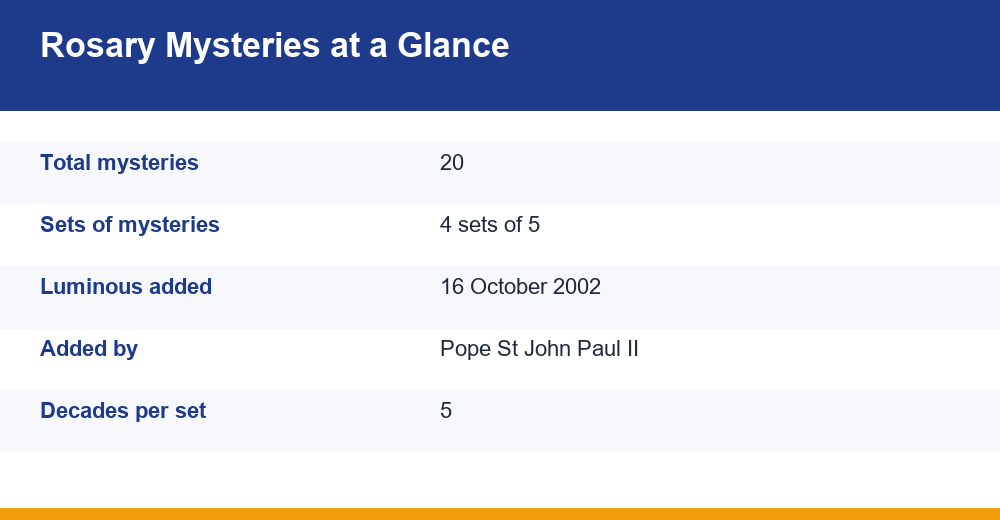
    There are 20 mysteries in total. For centuries the Rosary had 15, arranged in three sets that corresponded loosely to the 150 psalms. In 2002 Pope St John Paul II proposed a fourth set of five, bringing the number to twenty. Praying all four sets in a day would mean twenty decades, though most people pray one set of five each day.

    What are the 4 sets?

    • Joyful Mysteries: the Incarnation and the hidden childhood of Jesus.
    • Luminous Mysteries: the public ministry of Jesus, from his Baptism to the Last Supper.
    • Sorrowful Mysteries: the Passion and death of the Lord.
    • Glorious Mysteries: the Resurrection, the gift of the Spirit and Mary’s share in her Son’s glory.

    Taken together, the four sets walk through the whole Gospel story. That is why St John Paul II called the Rosary a compendium of the Gospel: in praying it, we look at Christ through the eyes of his Mother.

    The Joyful Mysteries

    The Joyful Mysteries cover the announcement of the Saviour’s coming through to the boy Jesus in the Temple. Their keynote is the joy of the Incarnation, a joy that already carries hints of the Cross.

    1. The Annunciation (Luke 1:26-38)

    Gabriel greets Mary, and she answers, “Let it be done to me according to your word.” Fruit: humility. Meditation: Mary does not demand a full explanation before saying yes. Where is God asking me for trust before clarity?

    2. The Visitation (Luke 1:39-56)

    Mary hurries to help her older cousin Elizabeth, and John leaps in the womb. Fruit: love of neighbour. Meditation: carrying Christ makes Mary go out to serve. Who near me needs a visit this week?

    3. The Nativity (Luke 2:1-20)

    The Son of God is born in poverty and laid in a manger, and shepherds come to adore. Fruit: poverty of spirit, or detachment from worldly things. Meditation: God chose to arrive with nothing. What possession or comfort holds me back from him?

    4. The Presentation (Luke 2:22-38)

    Mary and Joseph offer Jesus in the Temple according to the Law, and Simeon foretells a sword that will pierce Mary’s soul. Fruit: obedience (some prayer books say purity). Meditation: the Holy Family keeps the ordinary rules faithfully. Can I accept the small duties of today as an offering?

    5. The Finding of Jesus in the Temple (Luke 2:41-52)

    After three anxious days, Mary and Joseph find the twelve-year-old Jesus among the teachers. Fruit: joy in finding Jesus, or piety. Meditation: when Jesus seems lost to me, do I search for him as they did?

    The Luminous Mysteries

    The Luminous Mysteries, also called the Mysteries of Light, fill the gap between the childhood of Jesus and his Passion. Each shows a moment when the Kingdom breaks into the world through Christ’s public ministry. For a fuller study of this set, see our guide to the Luminous Mysteries explained.

    Because this set is recent, its fruits were not fixed by centuries of custom. The fruits below are those most commonly used in Catholic prayer books today.

    1. The Baptism in the Jordan (Matthew 3:13-17)

    The sinless Christ goes down into the water, the heavens open and the Father declares, “This is my beloved Son.” Fruit: openness to the Holy Spirit. Meditation: I too was named a beloved child at my baptism. Do I live from that identity?

    2. The Wedding at Cana (John 2:1-12)

    At Mary’s request, Jesus turns water into wine and his disciples begin to believe. Fruit: to Jesus through Mary. Meditation: Mary tells the servants, “Do whatever he tells you.” What is he telling me?

    3. The Proclamation of the Kingdom (Mark 1:14-15)

    Jesus preaches, “The kingdom of God is at hand; repent, and believe in the gospel.” Fruit: repentance and trust in God. Meditation: conversion is not a single event. Which habit am I being called to turn from now?

    4. The Transfiguration (Luke 9:28-36)

    On the mountain, the face of Jesus shines, and the Father says, “Listen to him.” Fruit: desire for holiness. Meditation: the glory shown to Peter, James and John was meant to strengthen them for the Cross. Where do I need that strength?

    5. The Institution of the Eucharist (Luke 22:14-20)

    At the Last Supper, Jesus gives his Body and Blood under the signs of bread and wine. Fruit: adoration. Meditation: he remains with us in every tabernacle. How can I receive him more attentively at my next Mass?

    The Sorrowful Mysteries

    The Sorrowful Mysteries follow Jesus from Gethsemane to Calvary. They are the heart of the Gospel’s message of redemptive love, and many Catholics find them especially consoling in times of suffering.

    1. The Agony in the Garden (Matthew 26:36-46)

    Jesus prays in anguish, “Not as I will, but as you will,” while his friends sleep. Fruit: sorrow for sin and conformity to God’s will. Meditation: can I stay awake one hour with him, bringing my own fears into his prayer?

    2. The Scourging at the Pillar (John 19:1)

    Pilate has Jesus scourged. Fruit: purity and mortification of the senses. Meditation: his body was wounded for the sins of the flesh. Where do I need to bring my body under the rule of love?

    3. The Crowning with Thorns (Matthew 27:27-31)

    Soldiers mock the King of Kings with a scarlet cloak and a crown of thorns. Fruit: moral courage, sometimes given as contempt for the world. Meditation: he bore ridicule in silence. Am I willing to be thought foolish for the truth?

    4. The Carrying of the Cross (Luke 23:26-32)

    Jesus carries the cross toward Golgotha, helped by Simon of Cyrene and met by weeping women. Fruit: patience. Meditation: whose cross can I help carry, and what burden of my own must I take up without complaint?

    5. The Crucifixion and Death (John 19:17-30)

    Jesus is nailed to the cross, entrusts Mary to the beloved disciple, and gives up his spirit. Fruit: perseverance and the salvation of souls. Meditation: “It is finished.” At the foot of the cross, I receive Mary as my mother too.

    The Glorious Mysteries

    The Glorious Mysteries move from the empty tomb to Mary crowned in heaven. They show where the whole story is heading: the victory of Christ and the hope of our own resurrection.

    1. The Resurrection (Luke 24:1-12)

    The women find the tomb empty and hear, “Why do you seek the living among the dead?” Fruit: faith. Meditation: death does not have the last word. Which part of my life looks like a sealed tomb that I need to hand to the risen Lord?

    2. The Ascension (Acts 1:6-11)

    Forty days after Easter, Jesus is taken up into heaven before his disciples. Fruit: hope and desire for heaven. Meditation: he goes ahead to prepare a place for us. Do my choices show that heaven is my home?

    3. The Descent of the Holy Spirit (Acts 2:1-13)

    At Pentecost the Spirit comes upon the apostles as tongues of fire; Acts 1:14 places Mary among them in prayer. Fruit: love of God, wisdom and zeal. Meditation: the frightened apostles became bold witnesses. What gift of the Spirit do I most need to ask for?

    4. The Assumption of Mary

    At the end of her earthly life, Mary is taken body and soul into heavenly glory, as Pope Pius XII defined in 1950. The Assumption is not narrated in Scripture; the Church reads it in light of passages such as Revelation 12 and the promise of resurrection. Fruit: the grace of a happy death and devotion to Mary. Meditation: what God did for Mary, he promises to all who belong to Christ.

    5. The Coronation of Mary (Revelation 12:1)

    Mary is honoured as Queen of Heaven and Earth, linked in Catholic reading with the “woman clothed with the sun.” Fruit: trust in Mary’s intercession and final perseverance. Meditation: a queen mother pleads for her people. Which intention will I place in her hands today?

    All 20 Mysteries of the Rosary: Scripture and Fruits

    This table gathers the twenty mysteries of the rosary in one view, with a principal Scripture reference and the fruit most often associated with each. Fruits of the Luminous set are modern and vary between prayer books.

    SetMysteryScriptureTraditional fruit
    JoyfulAnnunciationLuke 1:26-38Humility
    JoyfulVisitationLuke 1:39-56Love of neighbour
    JoyfulNativityLuke 2:1-20Poverty of spirit
    JoyfulPresentationLuke 2:22-38Obedience
    JoyfulFinding in the TempleLuke 2:41-52Joy in finding Jesus
    LuminousBaptism in the JordanMatthew 3:13-17Openness to the Spirit
    LuminousWedding at CanaJohn 2:1-12To Jesus through Mary
    LuminousProclamation of the KingdomMark 1:14-15Repentance, trust
    LuminousTransfigurationLuke 9:28-36Desire for holiness
    LuminousInstitution of the EucharistLuke 22:14-20Adoration
    SorrowfulAgony in the GardenMatthew 26:36-46Sorrow for sin
    SorrowfulScourging at the PillarJohn 19:1Purity
    SorrowfulCrowning with ThornsMatthew 27:27-31Moral courage
    SorrowfulCarrying of the CrossLuke 23:26-32Patience
    SorrowfulCrucifixionJohn 19:17-30Perseverance
    GloriousResurrectionLuke 24:1-12Faith
    GloriousAscensionActs 1:6-11Hope
    GloriousDescent of the Holy SpiritActs 2:1-13Love of God, wisdom
    GloriousAssumptionTradition (cf. Rev 12)Grace of a happy death
    GloriousCoronationTradition (cf. Rev 12:1)Trust in Mary

    Where are the mysteries of the rosary found in the Bible?

    Eighteen of the twenty come straight from the Gospels and the Acts of the Apostles. Luke’s infancy narrative supplies all five Joyful Mysteries, told largely from Mary’s point of view. The Assumption and Coronation rest on the Church’s living Tradition, read alongside Revelation 12 and the wider biblical promise that those united with Christ will share his glory.

    Which day for which set?

    The customary schedule is Joyful on Monday and Saturday, Sorrowful on Tuesday and Friday, Glorious on Wednesday and Sunday, and Luminous on Thursday. St John Paul II also suggested the Joyful set on Sundays of Advent and Christmas and the Sorrowful set on Sundays of Lent. Our guide to the rosary mysteries by day sets this out week by week, with notes for feast days.

    Why the Luminous Mysteries Were Added

    On 16 October 2002, at the start of the twenty-fifth year of his pontificate, Pope St John Paul II signed the apostolic letter Rosarium Virginis Mariae. In it he proposed the five Luminous Mysteries and declared October 2002 to October 2003 a Year of the Rosary.

    His reasoning was simple. The traditional 15 mysteries passed straight from the boy Jesus in the Temple to the Agony in the Garden, skipping the years of public ministry. Adding the Mysteries of Light, he wrote, would bring out more fully the Christological depth of the Rosary, so that it could truly be a compendium of the Gospel.

    Key points from the letter

    • The new mysteries were proposed, not imposed; the Pope left their use to the freedom of individuals and communities.
    • He kept the traditional structure intact and simply inserted the new set between the Joyful and Sorrowful Mysteries.
    • He suggested praying the Luminous set on Thursday, moving the Joyful set to Saturday because of that day’s Marian character.
    • He stressed that the Rosary, though Marian in character, is at heart a Christ-centred prayer.

    Not every Catholic has taken up the new set. Some communities that use older liturgical books keep to the fifteen traditional mysteries, which remains entirely permissible. For most of the Church, however, the four-set pattern is now standard and appears in official guides such as the US bishops’ page on how to pray the Rosary.

    A short history before 2002

    The Rosary grew over the Middle Ages from the practice of praying 150 Hail Marys in place of the 150 psalms. Attaching a Gospel scene to each decade developed gradually, and the familiar pattern of fifteen mysteries was confirmed by Pope St Pius V in 1569. The 2002 addition was the first change to that set of mysteries in more than four centuries.

    How to Meditate on Each Mystery

    Knowing the names is the easy part. The real work is letting the mysteries of the rosary shape how you pray, so that the words do not run on while the mind drifts. Our longer guide on how to meditate on the Rosary goes into depth; here is a practical starting method.

    1. Announce the mystery and pause for a breath before the Our Father.
    2. Read or recall one verse of Scripture from the passage in the table above.
    3. Picture the scene: the place, the people, what they say and feel.
    4. Name the fruit and ask for it simply, in your own words.
    5. Pray the decade, returning to the scene whenever your attention wanders.
    6. Close with a resolution, one small concrete act connected to the fruit.

    Helpful additions from tradition

    • St John Paul II recommended adding a short phrase after the name of Jesus in each Hail Mary, such as “who was baptised in the Jordan,” to anchor attention on the mystery.
    • He also recommended a brief pause of silence after the mystery is announced, so the scene can settle before the vocal prayer starts.
    • Praying with an image or icon of the mystery, where you have one, can steady a restless imagination.
    • Families can take turns reading the verse and naming an intention for each decade.

    Common difficulties

    Distraction is normal and not a failure. When you notice the mind has wandered, return gently to the mystery without frustration. If a full set feels too long, pray one decade with real attention rather than five in a hurry. The aim is contemplation, not a completed checklist.

    Frequently Asked Questions

    What are the 4 mysteries of the rosary?

    The four sets are the Joyful, Luminous, Sorrowful and Glorious Mysteries. The Joyful cover the Incarnation and childhood of Jesus, the Luminous his public ministry, the Sorrowful his Passion and death, and the Glorious his Resurrection, the gift of the Spirit and Mary’s Assumption and Coronation. Each set has five mysteries, one for each decade.

    How many mysteries are in the rosary?

    There are 20 mysteries, in four sets of five. For centuries the Rosary had 15, in the Joyful, Sorrowful and Glorious sets. In October 2002 Pope St John Paul II proposed the five Luminous Mysteries in Rosarium Virginis Mariae, bringing the total to twenty. Most Catholics pray one set of five decades each day.

    What are the fruits of each mystery of the rosary?

    Each mystery is linked to a virtue or grace to ask for. Examples include humility for the Annunciation, love of neighbour for the Visitation, patience for the Carrying of the Cross and faith for the Resurrection. These fruits come from devotional tradition rather than Church definition, and those for the newer Luminous set vary between prayer books.

    Why were the Luminous Mysteries added?

    Pope St John Paul II added them in 2002 to cover Christ’s public ministry, which the traditional fifteen mysteries skipped between the Finding in the Temple and the Agony in the Garden. He wanted the Rosary to show its Christ-centred depth more fully and to be a true compendium of the Gospel. Their use remains optional.

  • Rosary for Beginners: A Complete Simple Guide (2026)

    Rosary for Beginners: A Complete Simple Guide (2026)

    If you have ever held a set of beads and wondered where to begin, this guide to the rosary for beginners is for you. The Rosary is a gentle, Scripture-rooted prayer that anyone can learn, one small step at a time. You do not need to memorize everything today — you need only the willingness to begin.

    rosary for beginners — infographic

    The Rosary for Beginners: What It Actually Is

    At its heart, the Rosary weaves together a handful of short, familiar prayers with quiet meditation on the life of Jesus and Mary. As your fingers move along the beads, your hands keep count so that your mind and heart are free to reflect. Because of this, the Rosary is often called a Gospel in miniature — each decade opens a scene from Scripture for you to ponder.

    Much of the appeal of the rosary for beginners is exactly this unhurried rhythm. The repeated words are not meant to be rushed or ticked off like a task; they slow you down and give a restless mind something to hold while your soul settles into prayer. Over time, the familiar phrases become a kind of home you can return to anywhere.

    A question many newcomers ask is whether the Rosary worships Mary. It does not. Catholics worship God alone; in the Rosary we ask Mary to pray for us, much as we might ask a friend, while every mystery keeps its gaze fixed on her Son. Understanding this puts many hearts at ease before they ever begin.

    The word rosary comes from a Latin term for a “crown of roses,” an image of offering Mary a bouquet of prayers. This devotion took shape gradually across many centuries, which is a quiet comfort in itself: you are stepping into a practice that generations before you also had to learn slowly, one prayer at a time.

    What You Need to Begin (Just the Beads)

    The good news is that you need very little to start. A simple set of rosary beads and a few quiet minutes are enough. You do not need an expensive, antique, or even blessed rosary to pray — a plain cord rosary works just as beautifully as a treasured heirloom.

    • A five-decade rosary — or simply your ten fingers
    • A quiet spot, even for just five minutes
    • A printed or on-screen copy of the prayers while you learn
    • An open, unhurried heart

    If you would like, you can ask a priest to bless your rosary. It is a lovely custom that many treasure, though it is never required before you begin. Some people exploring the rosary for beginners prefer a single-decade “pocket” rosary or a rosary ring while they build the habit — anything that helps you actually pray is the right choice.

    The Prayers You’ll Use

    The Rosary is built from just a few prayers, most of which you may already know from Mass or from childhood. Do not feel that you must have them memorized before you start — it is perfectly acceptable to read from a card or a screen, and the words settle into memory naturally through quiet repetition.

    • The Sign of the Cross
    • The Apostles’ Creed
    • The Our Father (the Lord’s Prayer)
    • The Hail Mary
    • The Glory Be
    • The Fatima Prayer (“O my Jesus…”)
    • The Hail, Holy Queen

    The two prayers you will repeat most often are the Our Father and the Hail Mary, so those are the ones worth learning first. You can find the complete wording of each, along with the closing prayers, in our collection of prayers of the Rosary.

    The short prayer said after each decade — “O my Jesus, forgive us our sins…” — comes from the apparitions at Fatima, which the Church has approved as a worthy private revelation rather than binding doctrine. It is a cherished and widely loved custom, but a beginner who leaves it out has still prayed the Rosary faithfully.

    The Basic Structure, Step by Step

    Here is the shape of a complete five-decade Rosary. Read through it once to get the lay of the land, then keep it beside you as a simple checklist the first few times you pray.

    1. Holding the crucifix, make the Sign of the Cross and pray the Apostles’ Creed.
    2. On the first bead, pray an Our Father.
    3. On the next three beads, pray a Hail Mary on each — traditionally for faith, hope, and love.
    4. Pray a Glory Be.
    5. Announce the first mystery, then pray an Our Father.
    6. On the ten beads of the decade, pray ten Hail Marys while quietly meditating on that mystery.
    7. Pray a Glory Be, followed by the Fatima Prayer if you wish.
    8. Repeat steps five through seven for the remaining four decades, then close with the Hail, Holy Queen and a final Sign of the Cross.

    If you would like a slower walkthrough with every prayer written out in full and placed exactly where it belongs, see our detailed guide on how to pray the Rosary. For an official reference, the USCCB’s guide to the Rosary lays out this very same structure.

    How One Decade Works

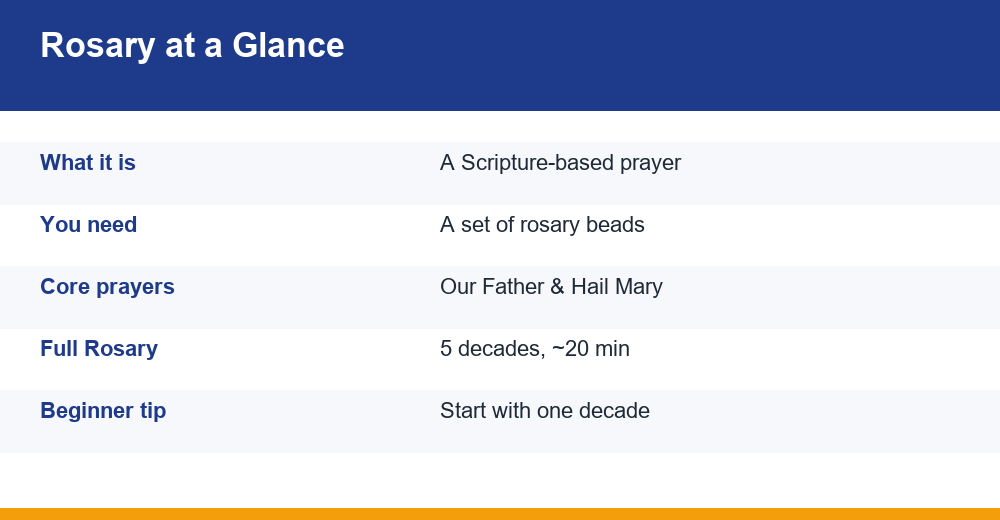
    The decade is the heartbeat of the Rosary, and once you understand one, you understand the whole prayer. A decade is simply one Our Father, ten Hail Marys, and one Glory Be, all prayed while you picture a single scene from the Gospel.

    Take the first Joyful Mystery, the Annunciation, as an example. As your lips pray the ten Hail Marys, let your mind rest on the angel Gabriel greeting Mary. The words carry you along while your imagination stays with the scene. If your thoughts wander — and they will — simply notice it and return to the mystery, without frustration or starting over.

    The repetition is intentional. Much as a familiar lullaby can calm a child, the steady return of the Hail Mary quiets the noise of the day and frees you to dwell on the mystery rather than on finding the right words. Do not mistake the repetition for empty routine — it is the very thing that makes contemplation possible.

    This is why a single decade makes such a fine beginning. It takes only a few minutes, it teaches you the rhythm of the whole Rosary, and it can be prayed almost anywhere: on a walk, in a waiting room, or in the last quiet moments before sleep.

    The Mysteries and When to Pray Them

    The mysteries are the meditations at the very heart of each decade — twenty scenes drawn from the lives of Jesus and Mary, gathered into four sets. Many Catholics pair each set with a day of the week, which gives prayer a steady rhythm, though you are always free to pray whichever set draws your heart.

    DayMysteriesFocus
    MondayJoyfulChrist’s coming
    TuesdaySorrowfulChrist’s Passion
    WednesdayGloriousChrist’s triumph
    ThursdayLuminousChrist’s ministry
    FridaySorrowfulChrist’s Passion
    SaturdayJoyfulChrist’s coming
    SundayGloriousChrist’s triumph

    During Advent, the Joyful Mysteries are often prayed on Sundays, and during Lent, the Sorrowful. The Luminous Mysteries, also called the Mysteries of Light, were added by Pope Saint John Paul II in 2002 to fill out the picture of Christ’s public life.

    • Joyful — the Annunciation, Visitation, Nativity, Presentation, and Finding of Jesus in the Temple
    • Sorrowful — the Agony in the Garden, Scourging, Crowning with Thorns, Carrying of the Cross, and Crucifixion
    • Glorious — the Resurrection, Ascension, Descent of the Holy Spirit, Assumption, and Coronation of Mary
    • Luminous — the Baptism in the Jordan, Wedding at Cana, Proclamation of the Kingdom, Transfiguration, and Institution of the Eucharist

    Why Pray the Rosary?

    People come to the Rosary for many reasons, and the graces it offers are always spiritual rather than magical. Meditating faithfully on the life of Christ draws the heart nearer to him, deepens our love of Scripture, and forms a steadying, unhurried peace. Saints across the centuries have cherished it as a school of prayer that quietly shapes the soul over time.

    • A closer, more personal friendship with Jesus
    • A deeper love for Sacred Scripture and the Gospel
    • Growth in patience, humility, and trust in God
    • A calmer heart and a settled habit of daily prayer

    You may also come across lists of blessings linked to the Rosary, often called the fifteen promises. These belong to the Church’s devotional tradition rather than to defined doctrine, so it is best to receive them as pious encouragement, not as guarantees. The heart of the matter is simpler and more certain: prayer offered with love is never wasted.

    Start Small and Be Gentle With Yourself

    If five decades feel like a lot, begin with one. There is no rule that a newcomer must pray the entire Rosary in a single sitting. A single decade prayed faithfully each day will do far more for your soul than a full Rosary you dread and quietly abandon after a week.

    The most common mistake among those praying the rosary for beginners is expecting perfection. You will lose count, forget a prayer, or drift off in the middle of a decade — and none of it undoes your prayer. God receives the offering of a willing heart, distractions and all.

    • Pick a set time — after your morning coffee, on your commute, or before bed
    • Keep your rosary somewhere you will see it and reach for it
    • Read the prayers aloud until they slowly become your own
    • Let the repetition slow you down instead of hurrying you along

    Many people find that this quiet, repetitive prayer brings a genuine sense of peace at the close of a hard day. The Rosary offers real spiritual consolation — but it is not a replacement for professional care. If you are carrying heavy anxiety or grief, please reach out to a trusted doctor or counselor as well.

    Whatever first drew you toward the rosary for beginners, take heart: countless saints and ordinary faithful have prayed these same words for centuries, and you are joining their company. Pick up the beads, make the Sign of the Cross, and simply begin. Mary will help you take it from there.

    A Simple Plan for Your First Week

    If you like a little structure, here is one easy way to ease in over your first week. Adjust it freely — the goal is a habit that lasts, not a schedule to feel guilty about.

    1. Days 1–2: Learn the Sign of the Cross and the Our Father, and pray a single decade.
    2. Days 3–4: Add the Hail Mary and the Glory Be, still praying just one decade.
    3. Day 5: Read through the mysteries and choose the set for the day.
    4. Day 6: Pray two or three decades, pausing briefly on each mystery.
    5. Day 7: If you feel ready, pray a full five-decade Rosary — and if not, that is perfectly fine too.

    By the end of a week, the rhythm that once felt unfamiliar will already be settling into place. From there, growth comes naturally: a decade here, a full Rosary there, until the prayer becomes a quiet companion woven through your ordinary days.

    Frequently Asked Questions

    Do I need a blessed rosary to start?

    No. Any set of beads — even your ten fingers — is enough to begin. Having a rosary blessed by a priest is a beautiful tradition that many treasure, but it is never required before you start praying. Begin with whatever you have today.

    How long does it take to pray the Rosary?

    A full five-decade Rosary usually takes about fifteen to twenty minutes when prayed unhurried. A single decade takes only three to five minutes, which makes it ideal for newcomers or for busy days. The quality of your attention matters far more than speed.

    Which mysteries should I pray today?

    Many Catholics follow the traditional weekly schedule: Joyful on Monday and Saturday, Sorrowful on Tuesday and Friday, Glorious on Wednesday and Sunday, and Luminous on Thursday. You are always free, though, to pray whichever set speaks most to your heart on a given day.

    Is praying the Rosary worshiping Mary?

    No. Catholics worship God alone. In the Rosary we ask Mary to pray for us, much as we ask a friend, while every mystery meditates on the life of Christ. The prayer is meant to draw us closer to Jesus through the eyes of his mother.