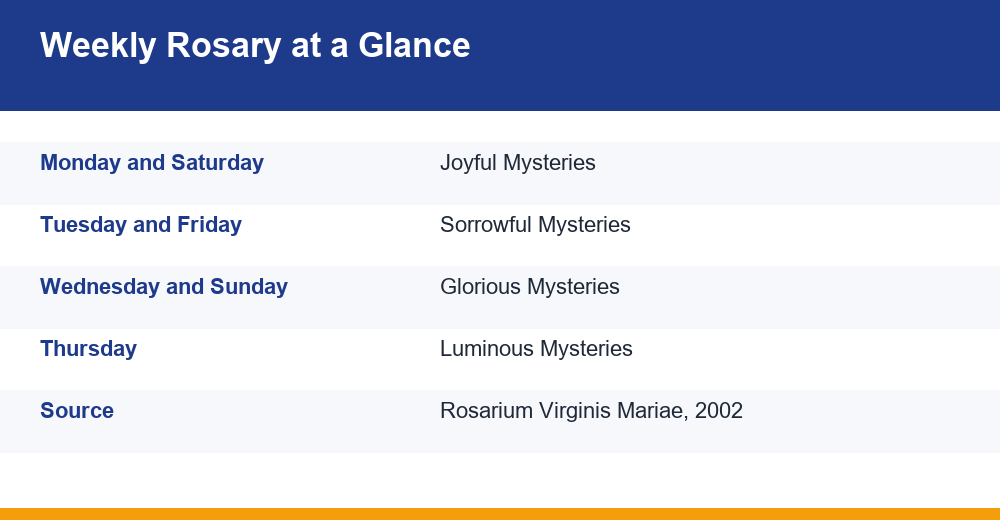
The rosary mysteries by day follow a simple weekly pattern: Joyful on Monday and Saturday, Sorrowful on Tuesday and Friday, Glorious on Wednesday and Sunday, and Luminous on Thursday. That is the chart most people know. What most charts leave out is how the Sundays of Advent and Lent change it, where the schedule came from, and the Church’s own reminder that it is a guide, not a law.
Table of Contents
Rosary Mysteries by Day: The Weekly Chart
The Rosary has twenty mysteries, grouped into four sets of five. Each set is one full Rosary of five decades. Since 2002 the Church has suggested a weekly rotation that spreads all four sets across the seven days, so that over a week you walk through the whole life of Christ with Mary.
Here is the standard weekly chart, as given by the Holy See and the U.S. bishops. If you only need the quick answer to which mysteries are prayed on each day, this table is it.
| Day | Mysteries | Focus |
|---|---|---|
| Monday | Joyful | The Incarnation and Christ’s childhood |
| Tuesday | Sorrowful | The Passion and death of Jesus |
| Wednesday | Glorious | The Resurrection and its fruits |
| Thursday | Luminous | Christ’s public ministry |
| Friday | Sorrowful | The Passion and death of Jesus |
| Saturday | Joyful | The Incarnation and Christ’s childhood |
| Sunday | Glorious (Joyful in Advent, Sorrowful in Lent) | The Resurrection, the Lord’s Day |
Notice the pattern. The Sorrowful Mysteries fall on Friday, the day of the Crucifixion. The Glorious Mysteries fall on Sunday, the day of the Resurrection. Thursday, the day the Eucharist was instituted at the Last Supper, holds the Luminous Mysteries, whose fifth mystery is the Institution of the Eucharist.
For a full list of the twenty mysteries with Scripture references for each, see our guide to the mysteries of the Rosary. Below is a short reminder of what each set contains.
- Joyful: the Annunciation, the Visitation, the Nativity, the Presentation in the Temple, the Finding of Jesus in the Temple.
- Luminous: the Baptism in the Jordan, the Wedding at Cana, the Proclamation of the Kingdom, the Transfiguration, the Institution of the Eucharist.
- Sorrowful: the Agony in the Garden, the Scourging at the Pillar, the Crowning with Thorns, the Carrying of the Cross, the Crucifixion.
- Glorious: the Resurrection, the Ascension, the Descent of the Holy Spirit, the Assumption, the Coronation of Mary.
Where the Weekly Schedule Comes From
The current rotation was proposed by Saint John Paul II in his apostolic letter Rosarium Virginis Mariae, signed on 16 October 2002 at the start of his 25th year as pope. In the same letter he opened a Year of the Rosary, running from October 2002 to October 2003, and added a new set of five mysteries.
Those new mysteries are the Luminous Mysteries, or Mysteries of Light. They fill the gap between the hidden life of Jesus in Nazareth and his Passion, focusing on his public ministry. Our article on the Luminous Mysteries explained goes through each one and the reasons John Paul II gave for adding them.
Adding a fourth set meant the old weekly rotation no longer fit. Paragraph 38 of the letter sets out the new distribution. You can read the full text on the Holy See’s website: Rosarium Virginis Mariae (vatican.va).
The schedule before 2002
Before the Luminous Mysteries existed, the Rosary had fifteen mysteries in three sets. The customary rotation looked like this, and you will still find it in older prayer books.
| Day | Before 2002 | Since 2002 |
|---|---|---|
| Monday | Joyful | Joyful |
| Tuesday | Sorrowful | Sorrowful |
| Wednesday | Glorious | Glorious |
| Thursday | Joyful | Luminous |
| Friday | Sorrowful | Sorrowful |
| Saturday | Glorious | Joyful |
| Sunday | Glorious | Glorious |
Only two days changed. Thursday became the day for the Luminous Mysteries, and the second weekly meditation on the Joyful Mysteries moved from Thursday to Saturday. Some Catholics, especially those attached to older devotional books, still pray the fifteen-mystery Rosary. That is a legitimate choice, since the Luminous Mysteries were proposed, not imposed.
Which Mysteries Are Prayed on Sunday?
Of all the rosary mysteries by day, Sunday is the one that shifts with the seasons. For most of the year, Sunday belongs to the Glorious Mysteries. Every Sunday is a little Easter, the weekly celebration of the Resurrection, so meditating on the risen Christ, his Ascension, Pentecost, and Mary’s Assumption and Coronation fits the day naturally.
The U.S. Conference of Catholic Bishops gives two seasonal exceptions that many families follow:
- Sundays of Advent: the Joyful Mysteries, which centre on the coming of Christ.
- Sundays of Lent: the Sorrowful Mysteries, which centre on the Passion.
- All other Sundays: the Glorious Mysteries.
Paragraph 38 of Rosarium Virginis Mariae itself simply assigns the Glorious Mysteries to Sunday and says nothing about seasonal variations. Both approaches are fine. The seasonal Sunday custom is a pious tradition that helps the Rosary breathe with the liturgical year, not an obligation.
Some people also pray the Joyful Mysteries on the Sundays of the Christmas season, between Christmas Day and the Baptism of the Lord. This is a common devotional habit rather than an official rubric, but it follows the same logic as the Advent custom.
What Mysteries Do You Pray During Lent and Advent?
When the rosary mysteries by day meet the liturgical seasons, only the Sunday changes. Weekdays keep their normal assignment. So in Lent you would still pray the Joyful Mysteries on Monday and the Luminous on Thursday, and in Advent the Sorrowful Mysteries still fall on Friday.
| Season | Sunday mysteries | Weekdays | Dates (approximate span) |
|---|---|---|---|
| Advent 2026 | Joyful | Normal rotation | 29 Nov to 24 Dec 2026 |
| Christmas season | Joyful (custom) or Glorious | Normal rotation | 25 Dec 2026 to Baptism of the Lord |
| Lent 2027 | Sorrowful | Normal rotation | 10 Feb 2027 (Ash Wednesday) to Holy Thursday |
| Easter season | Glorious | Normal rotation | 28 Mar to 16 May 2027 (Pentecost) |
| Ordinary Time | Glorious | Normal rotation | Rest of the year |
Why these choices? Advent prepares for the Nativity, and the Joyful Mysteries walk through exactly those events: the Annunciation, the Visitation, the birth of Jesus. Lent prepares for Good Friday and Easter, and the Sorrowful Mysteries keep the Passion before your eyes through the forty days.
Holy Week and the Triduum
Holy Week is a natural time to lean into the Sorrowful Mysteries more often, even on days when the chart says otherwise. Many people pray them on Holy Thursday evening and Good Friday. On Easter Sunday the Glorious Mysteries return with full force, and they remain the Sunday set right through the fifty days to Pentecost.
If you follow the pre-2002 fifteen-mystery Rosary, the same seasonal Sunday customs apply. The only difference is your Thursday and Saturday.
Why Are the Joyful Mysteries Prayed on Saturday?
This is one of the most common questions, because Saturday used to be a Glorious day. The answer comes straight from paragraph 38 of Rosarium Virginis Mariae.
John Paul II needed a free weekday for the new Luminous Mysteries. He chose Thursday, which meant moving the Joyful Mysteries that had been prayed on that day. He placed them on Saturday, explaining that Saturday has a special Marian character and that Mary’s presence is especially pronounced in the Joyful Mysteries.
The link between Saturday and Our Lady is old. For centuries the Church has dedicated Saturday to Mary, and the liturgy offers an optional memorial of the Blessed Virgin Mary on Saturdays in Ordinary Time when no other celebration takes precedence. The First Saturday devotion associated with Fatima reinforces the same connection.
- Mary is the central human figure in every Joyful Mystery, from the Annunciation to the Finding in the Temple.
- Saturday is traditionally Mary’s day in Catholic devotion.
- Moving the Joyful Mysteries there freed Thursday for the Luminous Mysteries and the Eucharist.
So the Saturday assignment is not arbitrary. It joins the most Marian of the mysteries to the most Marian day of the week.
Can You Pray Any Mystery on Any Day?
Yes. This is the honest answer that many charts omit. The weekly rotation is a recommendation, and John Paul II said so in the very paragraph that introduced it. He wrote that the schedule is “not intended to limit a rightful freedom in personal and community prayer.”
He added that spiritual and pastoral needs, and particular liturgical celebrations, may call for suitable adaptations. In other words, the rosary mysteries by day exist to help you, not to bind you. Praying the Sorrowful Mysteries on a Wednesday is not a mistake, and it is certainly not a sin.
Good reasons to step outside the chart
- You are grieving, ill, or facing a hard trial, and the Sorrowful Mysteries speak to you.
- A new baby has arrived in the family, and the Joyful Mysteries feel right.
- Someone you love has died, and you want to rest in the hope of the Glorious Mysteries.
- You are preparing for Confession or First Communion and want to meditate on the Luminous Mysteries.
- Your parish or prayer group has chosen a particular set for a novena or event.
Some people pray all four sets in one day, which is the complete Rosary of twenty decades. Others pray one decade at a time across the day. Both are rooted in the tradition. What matters most is attentive, unhurried meditation on Christ with Mary, rather than ticking the correct box.
If you pray with a group, it is courteous to follow whatever set the leader announces. In private prayer, you have the freedom the Church itself describes.
Adapting the Schedule for Feasts and Life Events
Because paragraph 38 explicitly mentions liturgical celebrations, many Catholics choose the mysteries that match a feast falling on that day. This is entirely optional, and it shows the rosary mysteries by day working as a starting point rather than a fixed rule. It can also make the Rosary feel connected to the Church’s calendar.
| Feast or occasion | Usual date | Fitting mysteries |
|---|---|---|
| Annunciation | 25 March (5 April in 2027) | Joyful |
| Transfiguration | 6 August | Luminous |
| Assumption | 15 August | Glorious |
| Our Lady of the Rosary | 7 October | Any; many pray all four sets |
| Christmas Day | 25 December | Joyful |
| Good Friday | Friday before Easter | Sorrowful |
| Pentecost | Seventh Sunday after Easter | Glorious |
Christmas Day 2026 falls on a Friday, normally a Sorrowful day. Most people will naturally pray the Joyful Mysteries instead, and that is exactly the kind of adaptation the letter has in mind. Note also that in 2027 the Annunciation falls in Holy Week, so the feast moves to Monday 5 April.
Personal anniversaries can guide the choice too. A wedding anniversary might suggest the Wedding at Cana in the Luminous Mysteries. The anniversary of a death might suggest the Glorious Mysteries and the hope of the Resurrection.
Making the Schedule Work in Daily Prayer
The real value of the weekly chart is that it removes one decision. You do not have to wonder each morning which set to pray, and over a week you cover the whole Gospel story. For many people, following the rosary mysteries by day is what turns occasional prayer into a steady rhythm.
If you are trying to build that rhythm, our guide to forming a daily rosary habit has practical advice on timing, place and keeping going when life gets busy. A few simple tips help with the schedule itself:
- Keep a small card with the weekly chart in your rosary pouch or prayer book.
- Set a reminder in your phone that names the day’s mysteries.
- Read the Gospel passage for each mystery before you begin the decade.
- Mark the first Sunday of Advent and Ash Wednesday on your calendar, so you remember the Sunday change.
- When a feast or personal need calls for it, change the set without hesitation.
Above all, remember the purpose. The Rosary is a Gospel prayer, a way of contemplating the face of Christ through the eyes of his Mother. The chart serves that contemplation. Follow it gladly, adapt it freely, and let it lead you deeper into prayer.
Frequently Asked Questions
What mysteries of the rosary are prayed on each day?
The standard schedule is Joyful Mysteries on Monday and Saturday, Sorrowful on Tuesday and Friday, Glorious on Wednesday and Sunday, and Luminous on Thursday. This distribution comes from paragraph 38 of Saint John Paul II’s 2002 letter Rosarium Virginis Mariae, which added the Luminous Mysteries and reorganised the week around them.
Which mysteries are prayed on Sunday?
The Glorious Mysteries are prayed on most Sundays, because Sunday celebrates the Resurrection. The U.S. bishops note two seasonal customs: the Joyful Mysteries on the Sundays of Advent and the Sorrowful Mysteries on the Sundays of Lent. Weekdays keep their usual assignment during both seasons.
Can you pray any mystery on any day?
Yes. The rosary mysteries by day are a recommendation, not a rule. Rosarium Virginis Mariae states that the weekly schedule is not meant to limit freedom in personal and community prayer, and allows adaptation for spiritual needs and liturgical celebrations. Choosing a different set is never wrong.
Why are the Joyful Mysteries prayed on Saturday?
When John Paul II added the Luminous Mysteries for Thursday, he moved the second weekly Joyful meditation to Saturday. He explained that Saturday has a special Marian character, and Mary’s presence is especially pronounced in the Joyful Mysteries, so the two belong together.