The mysteries of the rosary are twenty moments from the lives of Jesus and Mary, grouped into four sets of five, that we hold in our hearts while praying the decades. This guide brings all twenty together in one place, with the Scripture behind each mystery, the fruit traditionally asked for, and a short meditation you can use tonight.
Table of Contents
What Are the Mysteries of the Rosary?
In Catholic prayer a mystery is not a puzzle to solve. It is an event of salvation, something God has done in Christ, that we are invited to enter more deeply. The Rosary takes these events one at a time and lets the repeated Hail Marys become a quiet background while the mind and heart rest on the scene.
Each decade of the Rosary is paired with one mystery. You announce it, pray one Our Father, ten Hail Marys and one Glory Be, and keep the mystery before you throughout. Five decades make up one full set.
How many mysteries are in the Rosary?
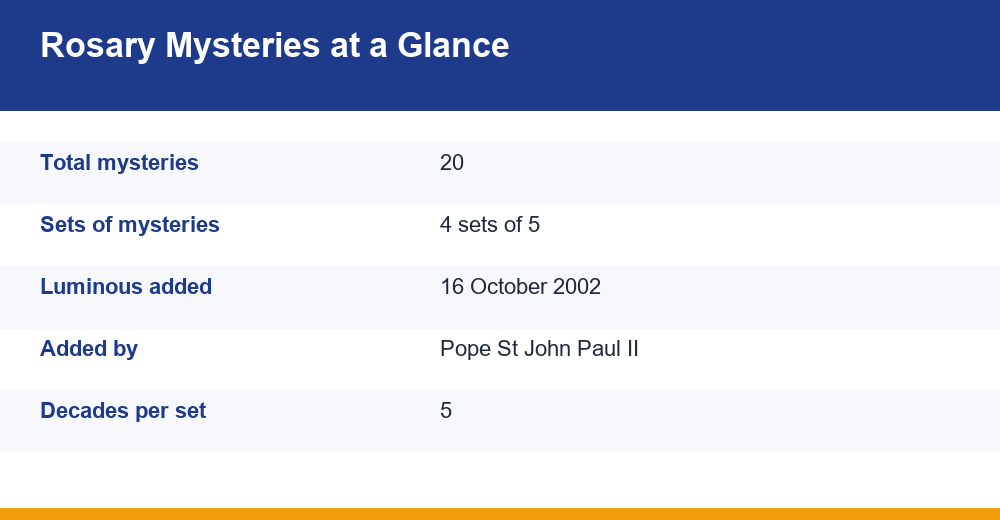
There are 20 mysteries in total. For centuries the Rosary had 15, arranged in three sets that corresponded loosely to the 150 psalms. In 2002 Pope St John Paul II proposed a fourth set of five, bringing the number to twenty. Praying all four sets in a day would mean twenty decades, though most people pray one set of five each day.
What are the 4 sets?
- Joyful Mysteries: the Incarnation and the hidden childhood of Jesus.
- Luminous Mysteries: the public ministry of Jesus, from his Baptism to the Last Supper.
- Sorrowful Mysteries: the Passion and death of the Lord.
- Glorious Mysteries: the Resurrection, the gift of the Spirit and Mary’s share in her Son’s glory.
Taken together, the four sets walk through the whole Gospel story. That is why St John Paul II called the Rosary a compendium of the Gospel: in praying it, we look at Christ through the eyes of his Mother.
The Joyful Mysteries
The Joyful Mysteries cover the announcement of the Saviour’s coming through to the boy Jesus in the Temple. Their keynote is the joy of the Incarnation, a joy that already carries hints of the Cross.
1. The Annunciation (Luke 1:26-38)
Gabriel greets Mary, and she answers, “Let it be done to me according to your word.” Fruit: humility. Meditation: Mary does not demand a full explanation before saying yes. Where is God asking me for trust before clarity?
2. The Visitation (Luke 1:39-56)
Mary hurries to help her older cousin Elizabeth, and John leaps in the womb. Fruit: love of neighbour. Meditation: carrying Christ makes Mary go out to serve. Who near me needs a visit this week?
3. The Nativity (Luke 2:1-20)
The Son of God is born in poverty and laid in a manger, and shepherds come to adore. Fruit: poverty of spirit, or detachment from worldly things. Meditation: God chose to arrive with nothing. What possession or comfort holds me back from him?
4. The Presentation (Luke 2:22-38)
Mary and Joseph offer Jesus in the Temple according to the Law, and Simeon foretells a sword that will pierce Mary’s soul. Fruit: obedience (some prayer books say purity). Meditation: the Holy Family keeps the ordinary rules faithfully. Can I accept the small duties of today as an offering?
5. The Finding of Jesus in the Temple (Luke 2:41-52)
After three anxious days, Mary and Joseph find the twelve-year-old Jesus among the teachers. Fruit: joy in finding Jesus, or piety. Meditation: when Jesus seems lost to me, do I search for him as they did?
The Luminous Mysteries
The Luminous Mysteries, also called the Mysteries of Light, fill the gap between the childhood of Jesus and his Passion. Each shows a moment when the Kingdom breaks into the world through Christ’s public ministry. For a fuller study of this set, see our guide to the Luminous Mysteries explained.
Because this set is recent, its fruits were not fixed by centuries of custom. The fruits below are those most commonly used in Catholic prayer books today.
1. The Baptism in the Jordan (Matthew 3:13-17)
The sinless Christ goes down into the water, the heavens open and the Father declares, “This is my beloved Son.” Fruit: openness to the Holy Spirit. Meditation: I too was named a beloved child at my baptism. Do I live from that identity?
2. The Wedding at Cana (John 2:1-12)
At Mary’s request, Jesus turns water into wine and his disciples begin to believe. Fruit: to Jesus through Mary. Meditation: Mary tells the servants, “Do whatever he tells you.” What is he telling me?
3. The Proclamation of the Kingdom (Mark 1:14-15)
Jesus preaches, “The kingdom of God is at hand; repent, and believe in the gospel.” Fruit: repentance and trust in God. Meditation: conversion is not a single event. Which habit am I being called to turn from now?
4. The Transfiguration (Luke 9:28-36)
On the mountain, the face of Jesus shines, and the Father says, “Listen to him.” Fruit: desire for holiness. Meditation: the glory shown to Peter, James and John was meant to strengthen them for the Cross. Where do I need that strength?
5. The Institution of the Eucharist (Luke 22:14-20)
At the Last Supper, Jesus gives his Body and Blood under the signs of bread and wine. Fruit: adoration. Meditation: he remains with us in every tabernacle. How can I receive him more attentively at my next Mass?
The Sorrowful Mysteries
The Sorrowful Mysteries follow Jesus from Gethsemane to Calvary. They are the heart of the Gospel’s message of redemptive love, and many Catholics find them especially consoling in times of suffering.
1. The Agony in the Garden (Matthew 26:36-46)
Jesus prays in anguish, “Not as I will, but as you will,” while his friends sleep. Fruit: sorrow for sin and conformity to God’s will. Meditation: can I stay awake one hour with him, bringing my own fears into his prayer?
2. The Scourging at the Pillar (John 19:1)
Pilate has Jesus scourged. Fruit: purity and mortification of the senses. Meditation: his body was wounded for the sins of the flesh. Where do I need to bring my body under the rule of love?
3. The Crowning with Thorns (Matthew 27:27-31)
Soldiers mock the King of Kings with a scarlet cloak and a crown of thorns. Fruit: moral courage, sometimes given as contempt for the world. Meditation: he bore ridicule in silence. Am I willing to be thought foolish for the truth?
4. The Carrying of the Cross (Luke 23:26-32)
Jesus carries the cross toward Golgotha, helped by Simon of Cyrene and met by weeping women. Fruit: patience. Meditation: whose cross can I help carry, and what burden of my own must I take up without complaint?
5. The Crucifixion and Death (John 19:17-30)
Jesus is nailed to the cross, entrusts Mary to the beloved disciple, and gives up his spirit. Fruit: perseverance and the salvation of souls. Meditation: “It is finished.” At the foot of the cross, I receive Mary as my mother too.
The Glorious Mysteries
The Glorious Mysteries move from the empty tomb to Mary crowned in heaven. They show where the whole story is heading: the victory of Christ and the hope of our own resurrection.
1. The Resurrection (Luke 24:1-12)
The women find the tomb empty and hear, “Why do you seek the living among the dead?” Fruit: faith. Meditation: death does not have the last word. Which part of my life looks like a sealed tomb that I need to hand to the risen Lord?
2. The Ascension (Acts 1:6-11)
Forty days after Easter, Jesus is taken up into heaven before his disciples. Fruit: hope and desire for heaven. Meditation: he goes ahead to prepare a place for us. Do my choices show that heaven is my home?
3. The Descent of the Holy Spirit (Acts 2:1-13)
At Pentecost the Spirit comes upon the apostles as tongues of fire; Acts 1:14 places Mary among them in prayer. Fruit: love of God, wisdom and zeal. Meditation: the frightened apostles became bold witnesses. What gift of the Spirit do I most need to ask for?
4. The Assumption of Mary
At the end of her earthly life, Mary is taken body and soul into heavenly glory, as Pope Pius XII defined in 1950. The Assumption is not narrated in Scripture; the Church reads it in light of passages such as Revelation 12 and the promise of resurrection. Fruit: the grace of a happy death and devotion to Mary. Meditation: what God did for Mary, he promises to all who belong to Christ.
5. The Coronation of Mary (Revelation 12:1)
Mary is honoured as Queen of Heaven and Earth, linked in Catholic reading with the “woman clothed with the sun.” Fruit: trust in Mary’s intercession and final perseverance. Meditation: a queen mother pleads for her people. Which intention will I place in her hands today?
All 20 Mysteries of the Rosary: Scripture and Fruits
This table gathers the twenty mysteries of the rosary in one view, with a principal Scripture reference and the fruit most often associated with each. Fruits of the Luminous set are modern and vary between prayer books.
| Set | Mystery | Scripture | Traditional fruit |
|---|---|---|---|
| Joyful | Annunciation | Luke 1:26-38 | Humility |
| Joyful | Visitation | Luke 1:39-56 | Love of neighbour |
| Joyful | Nativity | Luke 2:1-20 | Poverty of spirit |
| Joyful | Presentation | Luke 2:22-38 | Obedience |
| Joyful | Finding in the Temple | Luke 2:41-52 | Joy in finding Jesus |
| Luminous | Baptism in the Jordan | Matthew 3:13-17 | Openness to the Spirit |
| Luminous | Wedding at Cana | John 2:1-12 | To Jesus through Mary |
| Luminous | Proclamation of the Kingdom | Mark 1:14-15 | Repentance, trust |
| Luminous | Transfiguration | Luke 9:28-36 | Desire for holiness |
| Luminous | Institution of the Eucharist | Luke 22:14-20 | Adoration |
| Sorrowful | Agony in the Garden | Matthew 26:36-46 | Sorrow for sin |
| Sorrowful | Scourging at the Pillar | John 19:1 | Purity |
| Sorrowful | Crowning with Thorns | Matthew 27:27-31 | Moral courage |
| Sorrowful | Carrying of the Cross | Luke 23:26-32 | Patience |
| Sorrowful | Crucifixion | John 19:17-30 | Perseverance |
| Glorious | Resurrection | Luke 24:1-12 | Faith |
| Glorious | Ascension | Acts 1:6-11 | Hope |
| Glorious | Descent of the Holy Spirit | Acts 2:1-13 | Love of God, wisdom |
| Glorious | Assumption | Tradition (cf. Rev 12) | Grace of a happy death |
| Glorious | Coronation | Tradition (cf. Rev 12:1) | Trust in Mary |
Where are the mysteries of the rosary found in the Bible?
Eighteen of the twenty come straight from the Gospels and the Acts of the Apostles. Luke’s infancy narrative supplies all five Joyful Mysteries, told largely from Mary’s point of view. The Assumption and Coronation rest on the Church’s living Tradition, read alongside Revelation 12 and the wider biblical promise that those united with Christ will share his glory.
Which day for which set?
The customary schedule is Joyful on Monday and Saturday, Sorrowful on Tuesday and Friday, Glorious on Wednesday and Sunday, and Luminous on Thursday. St John Paul II also suggested the Joyful set on Sundays of Advent and Christmas and the Sorrowful set on Sundays of Lent. Our guide to the rosary mysteries by day sets this out week by week, with notes for feast days.
Why the Luminous Mysteries Were Added
On 16 October 2002, at the start of the twenty-fifth year of his pontificate, Pope St John Paul II signed the apostolic letter Rosarium Virginis Mariae. In it he proposed the five Luminous Mysteries and declared October 2002 to October 2003 a Year of the Rosary.
His reasoning was simple. The traditional 15 mysteries passed straight from the boy Jesus in the Temple to the Agony in the Garden, skipping the years of public ministry. Adding the Mysteries of Light, he wrote, would bring out more fully the Christological depth of the Rosary, so that it could truly be a compendium of the Gospel.
Key points from the letter
- The new mysteries were proposed, not imposed; the Pope left their use to the freedom of individuals and communities.
- He kept the traditional structure intact and simply inserted the new set between the Joyful and Sorrowful Mysteries.
- He suggested praying the Luminous set on Thursday, moving the Joyful set to Saturday because of that day’s Marian character.
- He stressed that the Rosary, though Marian in character, is at heart a Christ-centred prayer.
Not every Catholic has taken up the new set. Some communities that use older liturgical books keep to the fifteen traditional mysteries, which remains entirely permissible. For most of the Church, however, the four-set pattern is now standard and appears in official guides such as the US bishops’ page on how to pray the Rosary.
A short history before 2002
The Rosary grew over the Middle Ages from the practice of praying 150 Hail Marys in place of the 150 psalms. Attaching a Gospel scene to each decade developed gradually, and the familiar pattern of fifteen mysteries was confirmed by Pope St Pius V in 1569. The 2002 addition was the first change to that set of mysteries in more than four centuries.
How to Meditate on Each Mystery
Knowing the names is the easy part. The real work is letting the mysteries of the rosary shape how you pray, so that the words do not run on while the mind drifts. Our longer guide on how to meditate on the Rosary goes into depth; here is a practical starting method.
- Announce the mystery and pause for a breath before the Our Father.
- Read or recall one verse of Scripture from the passage in the table above.
- Picture the scene: the place, the people, what they say and feel.
- Name the fruit and ask for it simply, in your own words.
- Pray the decade, returning to the scene whenever your attention wanders.
- Close with a resolution, one small concrete act connected to the fruit.
Helpful additions from tradition
- St John Paul II recommended adding a short phrase after the name of Jesus in each Hail Mary, such as “who was baptised in the Jordan,” to anchor attention on the mystery.
- He also recommended a brief pause of silence after the mystery is announced, so the scene can settle before the vocal prayer starts.
- Praying with an image or icon of the mystery, where you have one, can steady a restless imagination.
- Families can take turns reading the verse and naming an intention for each decade.
Common difficulties
Distraction is normal and not a failure. When you notice the mind has wandered, return gently to the mystery without frustration. If a full set feels too long, pray one decade with real attention rather than five in a hurry. The aim is contemplation, not a completed checklist.
Frequently Asked Questions
What are the 4 mysteries of the rosary?
The four sets are the Joyful, Luminous, Sorrowful and Glorious Mysteries. The Joyful cover the Incarnation and childhood of Jesus, the Luminous his public ministry, the Sorrowful his Passion and death, and the Glorious his Resurrection, the gift of the Spirit and Mary’s Assumption and Coronation. Each set has five mysteries, one for each decade.
How many mysteries are in the rosary?
There are 20 mysteries, in four sets of five. For centuries the Rosary had 15, in the Joyful, Sorrowful and Glorious sets. In October 2002 Pope St John Paul II proposed the five Luminous Mysteries in Rosarium Virginis Mariae, bringing the total to twenty. Most Catholics pray one set of five decades each day.
What are the fruits of each mystery of the rosary?
Each mystery is linked to a virtue or grace to ask for. Examples include humility for the Annunciation, love of neighbour for the Visitation, patience for the Carrying of the Cross and faith for the Resurrection. These fruits come from devotional tradition rather than Church definition, and those for the newer Luminous set vary between prayer books.
Why were the Luminous Mysteries added?
Pope St John Paul II added them in 2002 to cover Christ’s public ministry, which the traditional fifteen mysteries skipped between the Finding in the Temple and the Agony in the Garden. He wanted the Rosary to show its Christ-centred depth more fully and to be a true compendium of the Gospel. Their use remains optional.