Author: Holy Rosary Editorial

  • Rosary for Peace: An Essential Guide for Anxious Times (2026)

    Rosary for Peace: An Essential Guide for Anxious Times (2026)

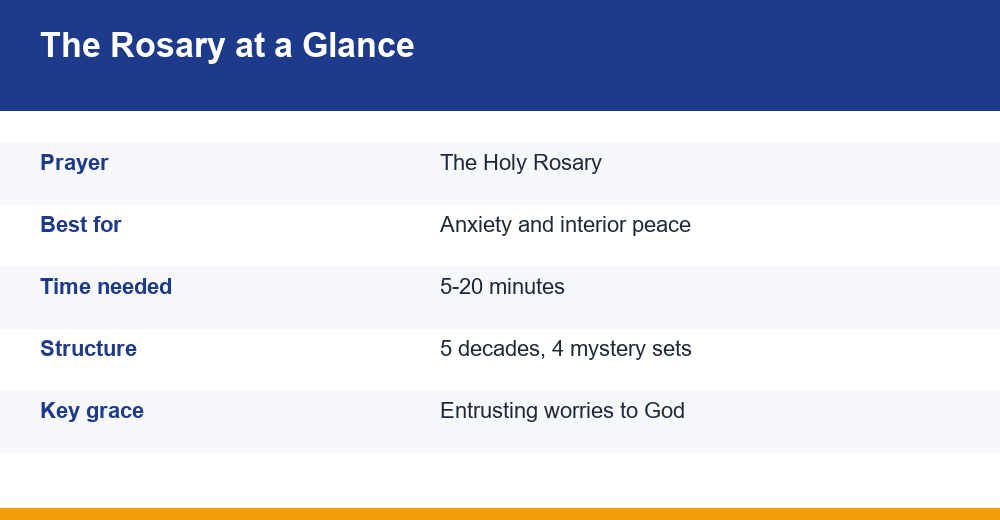
    When the world feels loud and your own thoughts will not settle, the rosary for peace offers something rare: a quiet place to rest your heart in God. It is an ancient, unhurried prayer that lets you hand your worries to Christ through the hands of his Mother, one bead at a time. This guide will show you how that steady rhythm can become a source of hope and interior calm, whatever storm you are facing.

    rosary for peace — infographie

    Why the Rosary Calms an Anxious Heart

    Anxiety thrives on speed. It races ahead into tomorrow, replays yesterday, and rarely lets us stand still in the present moment. The Rosary works in the opposite direction. Its slow, familiar pattern gently pulls a scattered mind back to one thing at a time.

    Saint John Paul II, who cherished this prayer, encouraged an unhurried, contemplative pace rather than a rushed recital. That calm cadence is not mindless repetition. It is closer to the rhythm of waves, or a mother’s lullaby, a sound so steady that the body begins to unclench and the soul at last grows quiet.

    Some worry that repeating the same words is empty. But repetition is how we soothe children, memorize what we love, and steady ourselves under pressure. The words of the Hail Mary are drawn largely from Scripture, so with every bead you are, in a sense, praying the Bible back to God.

    There is a deeper movement here too. To pray the Rosary is to entrust your burdens to the merciful hearts of Jesus and Mary. Each bead becomes a small act of trust: I cannot carry this alone, so I place it in your hands.

    For many people, this is where relief begins. The problem may not vanish, but you are no longer facing it by yourself. That shift, from isolation to companionship, is quietly powerful.

    The Peace Christ Promises

    Christian peace is not merely the absence of trouble. On the night before he died, Jesus promised his friends, ‘Peace I leave with you; my peace I give to you’ (John 14:27). This is the peace the Rosary seeks: not a guarantee that nothing will go wrong, but the steady nearness of Christ within whatever comes.

    Because that peace is a gift, we can only receive it; we cannot manufacture it. This is quietly freeing. You do not have to argue yourself into calm or perform your way to serenity. You simply keep company with the Lord, bead by bead, and let him give what only he can give.

    Where you long for peaceA short intention
    In your heartLord, quiet my restless mind
    In your homeBless and reconcile my family
    In your workFree me from anxious striving
    In the worldComfort the suffering and end all war
    In your soulDraw me back into your mercy

    Notice that none of these intentions demand a particular outcome. They ask, above all, for God himself. That is the secret of a peaceful prayer: we seek the Giver more than the gift, and in seeking him we often find the calm we were chasing all along.

    Bring one of these longings to your Rosary today. Name it before the first bead, then return to it gently whenever your mind drifts, offering the same simple request again and again.

    How to Pray the Rosary for Peace

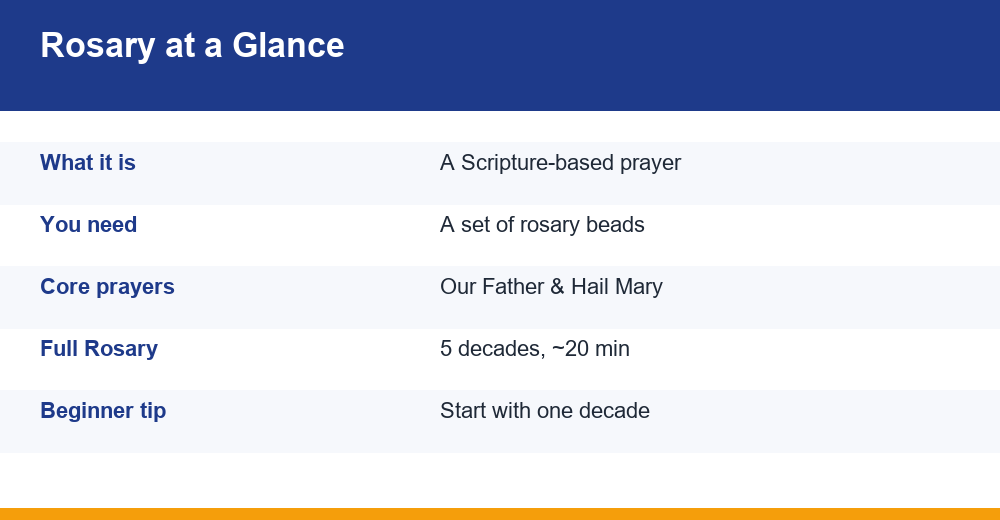
    You do not need to be an expert to begin. The rosary for peace is meant to be simple enough for a child and deep enough for a lifetime. If you own a set of beads, hold them; if not, your ten fingers work just as well.

    Before you start, name your intention quietly. You might offer this prayer for calm in your home, for someone you love who is suffering, or simply for a settled heart of your own.

    1. Make the Sign of the Cross and pray the Apostles’ Creed.
    2. On the first bead, pray the Our Father.
    3. On the next three beads, pray a Hail Mary on each, asking for a deepening of faith, hope, and love.
    4. Pray the Glory Be.
    5. Announce the first mystery, pray an Our Father, then ten Hail Marys while gently picturing that moment in the life of Christ.
    6. Close the decade with the Glory Be, and if you wish, the Fatima Prayer. Repeat for all five decades.
    7. Finish with the Hail, Holy Queen and the Sign of the Cross.

    Do not worry about praying it perfectly. If your attention wanders to the very worry you are carrying, gently return to the words. The wandering is not failure; the returning is the prayer.

    Choosing Mysteries That Meet Your Fear

    Each Rosary invites us to meditate on a set of mysteries, key scenes from the lives of Jesus and Mary. There are four sets, traditionally prayed on set days, and different scenes speak to different burdens.

    DayMysteriesConsolation for the anxious
    Monday, SaturdayJoyfulGod’s care hidden in small beginnings
    Tuesday, FridaySorrowfulChrist beside us in fear and pain
    Wednesday, SundayGloriousHope that darkness does not win
    ThursdayLuminousLight for ordinary choices and days

    If you carry dread, the Agony in the Garden may become your closest companion. There Jesus himself trembles, sweats, and asks the Father to take the cup away, yet he keeps praying. He does not shame our fear. He shares it.

    On brighter days, the Joyful Mysteries can rekindle gratitude, while the Glorious Mysteries lift the eyes toward a hope no headline can cancel. Let your season guide your choice; there is no wrong door.

    Try not to rush. You are not performing a task or hitting a word count. You are keeping company with Christ and his Mother, letting a scene from the Gospel sink slowly into the places where fear usually lives.

    Joining the Church’s Prayer for the World

    Interior calm is not the whole story. From its earliest centuries, the Church has reached for this prayer in times of danger, and popes have entrusted the cause of peace among nations to it again and again.

    That trust runs deep. The feast of Our Lady of the Rosary, kept each October 7, grew from the Church’s long habit of turning to Mary’s intercession in seasons of crisis. Ordinary Catholics have prayed these beads through wars, plagues, and famine, confident that heaven hears the humble.

    Saint John Paul II taught that the Rosary is by its nature a prayer for peace, and he asked the faithful to pray it for an end to conflict and for the good of families. You can read his reflections in the apostolic letter Rosarium Virginis Mariae.

    The message of Fatima, which the Church recognizes as private revelation worthy of belief rather than a required article of faith, likewise urged the daily Rosary for a world wounded by war. Whatever we make of the details, its heart is simple: peacemakers are first made peaceful within.

    So when you pray the rosary for peace in Ukraine, the Holy Land, or your own divided family, you are not praying alone. You join a chorus that spans continents and centuries, asking God to still the storms we cannot calm ourselves.

    This wider view can itself be healing. When your own troubles feel all-consuming, praying for a suffering world gently widens the horizon and reminds you that you belong to something far larger than your fear.

    Praying for Peace Together

    Peace has a way of spreading. When one anxious heart grows quieter, a whole household often breathes a little easier. This is why the Church has long encouraged families to pray the Rosary together, gathering children and grandparents around the same handful of beads.

    A family Rosary need not be long or polished. Even a single decade after dinner, with interruptions and wandering toddlers, plants something durable. Children learn that God can be spoken to plainly, that worries can be handed over, and that home is a place where prayer belongs.

    If praying aloud with others feels awkward at first, begin gently. Take turns leading, keep it brief, and let the rhythm do its patient work. Over time, this shared prayer becomes a quiet school of peace that outlasts any single hard day.

    Making Room When You Feel Too Restless to Pray

    Anxiety often whispers that you have no time, or that you are too scattered to pray well. Both claims are worth ignoring. A Rosary prayed poorly is still prayed, and God receives the effort of a distracted heart with great tenderness.

    • Pray a single decade when the full five feel like too much.
    • Match the beads to your breath: inhale through the first half of the Hail Mary, exhale through the second.
    • Walk while you pray, since gentle movement can settle a restless body.
    • Keep beads in your pocket, your car, or on the nightstand as a quiet reminder.
    • Let a recorded or app-guided Rosary lead you when your own focus fails.

    If your days already feel overloaded, our guide to praying the Rosary in a busy life offers honest, workable ways to begin. And if you long for steadiness, building a daily Rosary habit can turn an occasional prayer into an anchor you reach for every day.

    Consistency matters more than length. Five faithful minutes, repeated, will do more for an anxious soul than one hour attempted once and then abandoned.

    Spiritual Consolation, Not a Substitute for Care

    Honesty matters here. The rosary for peace is a true gift of faith and a source of genuine spiritual consolation, but it is not a medical or psychological treatment, and it was never meant to replace one.

    Anxiety can have real physical, emotional, and chemical roots. If worry is stealing your sleep, straining your relationships, or making daily life hard to manage, please reach out to a doctor, counselor, or another trusted professional. Seeking help is not a lack of faith; it is good stewardship of the life God gave you.

    Nor is it selfish to pray for your own peace. A soul at rest in God has more to give, not less. As you grow calmer, you become a steadier friend, a gentler parent, and a more patient neighbor, and in that quiet way your prayer begins to bless the very world you carry to God.

    Grace and good care work together, not against each other. Many people find that prayer steadies them for the harder work of healing, and that healing, in turn, opens fresh room for prayer.

    A Gentle Way to Begin Today

    You do not have to feel peaceful to pray for peace. Come as you are, anxious, tired, unsure of the words, and let the prayer do its slow, patient work in you.

    Start small. Choose one mystery, sit somewhere quiet, and pray a single decade. Notice your breath. Picture the scene. Offer whatever weighs on you, and then let it rest in God’s hands rather than snatching it back.

    However you begin, let the rosary for peace be less a task to master and more a hand you reach for in the dark. Mary has held the fearful before, and she will hold you too.

    Frequently Asked Questions

    Can praying the Rosary really reduce anxiety?

    The Rosary can bring genuine spiritual consolation and a sense of calm through its meditative rhythm and its trust in God. It is not a medical treatment, however. If anxiety is severe or persistent, please also seek help from a doctor or counselor.

    Which mysteries are best when I feel afraid?

    Many find the Sorrowful Mysteries comforting, especially the Agony in the Garden, where Christ shares our fear. The Glorious Mysteries offer hope beyond suffering. There is no wrong choice; pray whichever set matches your day and your heart.

    How long does it take to pray the Rosary?

    A full five-decade Rosary usually takes about twenty minutes, though it can be shorter or longer depending on your pace. When time is tight, praying a single decade of ten Hail Marys is a faithful and worthy way to begin.

    Are the Rosary’s famous promises official Church teaching?

    The traditional fifteen promises attached to the Rosary are a cherished part of Catholic piety, but they belong to private devotional tradition rather than defined dogma. The Church wholeheartedly commends the Rosary itself while encouraging a mature, trusting faith.
  • Rosary and Fatima: The Complete Story and Message (2026)

    Rosary and Fatima: The Complete Story and Message (2026)

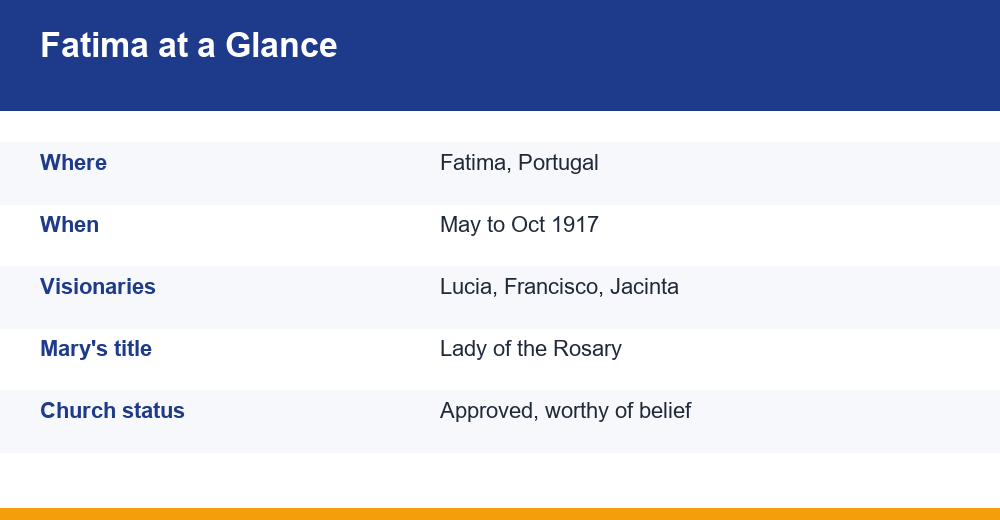
    The connection between the rosary and Fatima is one of the most beloved threads in modern Catholic devotion. In 1917, in a quiet Portuguese valley, the Blessed Virgin Mary appeared to three shepherd children and asked them, again and again, to pray the Rosary every day for peace. What follows is the accurate history, the heart of the message, and how the Church came to recognize it.

    rosary and fatima — infographie

    The Story Behind the Rosary and Fatima

    In the spring of 1917, the First World War was grinding across Europe, and few places felt further from world events than the hills of central Portugal. Near the town of Fatima, in a hamlet called Aljustrel, three cousins spent their days watching over the family’s sheep.

    They were Lucia dos Santos, then ten years old, and her younger cousins Francisco and Jacinta Marto, aged nine and seven. They were poor, unschooled, and entirely unremarkable, which is part of what makes their story so striking.

    The year before, the children later recounted, an Angel of Peace had visited them three times, teaching them to adore God and to pray for sinners. Then, on 13 May 1917, they described seeing a radiant woman above a small holm oak in a rocky pasture called the Cova da Iria.

    From that first meeting, one request ran through everything she said. The heart of the rosary and Fatima story is not a secret or a spectacle, but a gentle, insistent invitation: pray the Rosary every day, for peace.

    The Six Apparitions of 1917

    Between May and October of 1917, the children reported six encounters with the Blessed Mother, always on the thirteenth of the month, with one exception. Each visit deepened the same message.

    1. 13 May — Our Lady first appears, asking the children to pray the Rosary daily and to return on the thirteenth of each month.
    2. 13 June — She again urges daily prayer of the Rosary and speaks of her Immaculate Heart.
    3. 13 July — The children are shown a vision of the reality of hell and are given a short prayer to add after each decade of the Rosary.
    4. 19 August — Detained on the thirteenth by a local anticlerical official, the children meet Our Lady days later, and she asks for prayer and sacrifice for sinners.
    5. 13 September — Mary asks that the Rosary be prayed for an end to the war.
    6. 13 October — She names herself the Lady of the Rosary and asks that a chapel be built; a large crowd witnesses the Miracle of the Sun.

    By October, word had spread and a vast crowd gathered in the rain. Believers and skeptics alike later reported the sun appearing to spin and change color, an event remembered as the Miracle of the Sun.

    Mary’s Repeated Call to Pray the Rosary

    It would be easy to fix on the drama of Fatima and miss its plainest lesson. In every apparition, Our Lady asked for the same thing: the daily praying of the Rosary.

    On 13 October, in her final visit, she gave herself a name. According to Lucia’s account, she said, “I am the Lady of the Rosary,” and asked that a chapel be built on the spot. This is where the ancient title Our Lady of the Rosary takes on fresh and personal meaning.

    In July she had also given the children a brief prayer to say after each decade. By long-standing devotional custom it is now known as the Fatima Prayer: “O my Jesus, forgive us our sins, save us from the fires of hell, lead all souls to Heaven, especially those most in need of Thy mercy.”

    This prayer is a cherished pious tradition rather than a required part of the Rosary, yet countless Catholics now include it, precisely because of Fatima.

    Fatima also gave rise to related devotions, such as the First Saturdays, a pious practice of reparation to the Immaculate Heart of Mary. Like the Fatima Prayer, these are treasured customs offered freely, not obligations of the faith.

    How the Church Approved the Fatima Message

    The Church is careful, even slow, when weighing claims of the supernatural, and rightly so. Reports of apparitions are tested over years before any judgment is offered.

    After a formal canonical inquiry, the Bishop of Leiria, Dom Jose Alves Correia da Silva, declared the visions worthy of belief on 13 October 1930. Devotion at Fatima has been encouraged by popes ever since.

    It helps to understand what this approval means. Fatima is an approved private revelation. The Church teaches that public revelation ended with the apostles, so no Catholic is bound to accept a private revelation as an article of faith. Approval means only that the message holds nothing contrary to faith and can genuinely help the faithful. You can read the Church’s own reflection in the Vatican’s account of the Message of Fatima.

    Papal devotion has at times been strikingly personal. Saint John Paul II credited Our Lady with saving his life when he was shot on 13 May 1981, the anniversary of the first apparition, and afterward had one of the bullets placed in the crown of the Fatima statue.

    The children themselves became figures of holiness. Francisco and Jacinta, who both died young in the influenza pandemic that followed the war, were beatified in 2000 and canonized by Pope Francis on 13 May 2017, the centenary of the first apparition. Lucia became a Carmelite nun and lived until 2005; her own cause for sainthood has since been opened.

    Why the Rosary and Fatima Still Speak Today

    A message about peace, given as the deadliest war the world had yet seen raged on, has lost none of its urgency. If anything, the pairing of the rosary and Fatima feels newly relevant in a restless, anxious age.

    The appeal is strikingly humble. Mary did not ask for grand gestures or great learning. She asked ordinary children, and through them ordinary people, to take up a simple string of beads and pray.

    That is a large part of why the Rosary still matters a century later: it places the Gospel, meditated through Mary’s eyes, within reach of anyone, in any circumstance, without cost or condition.

    The Fifteen Promises of the Rosary

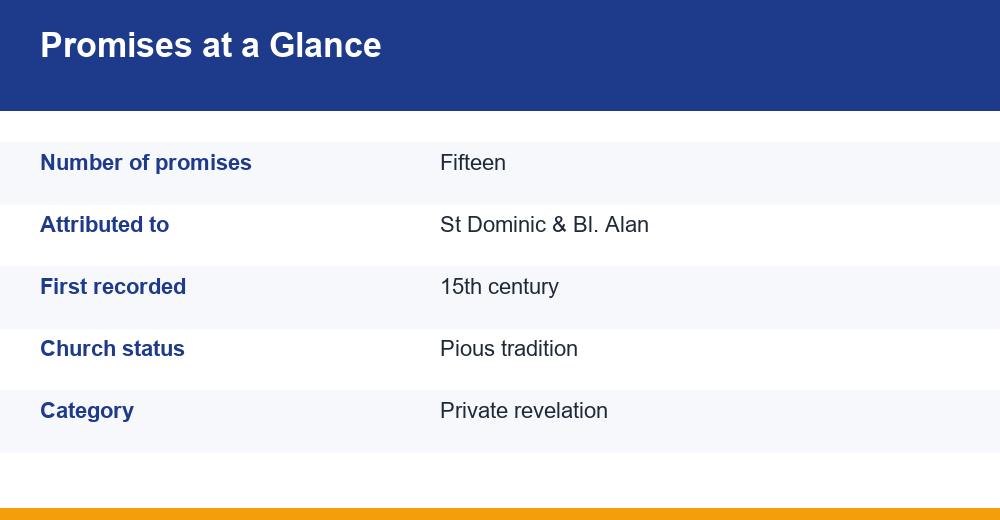
    Alongside Fatima, many Catholics have heard of the Fifteen Promises of the Rosary. These are traditionally associated with Our Lady’s encouragement to Saint Dominic and, centuries later, to Blessed Alan de la Roche, who helped renew the devotion in the fifteenth century.

    It is important to hold them gently. The Fifteen Promises are a cherished pious tradition, not a defined teaching of the Church. They are best received as warm encouragements to faithful prayer rather than guarantees of any particular result.

    • A deeper share in God’s grace for those who pray the Rosary faithfully.
    • Abundant blessings for those who lovingly spread the devotion to others.
    • Growth in virtue and a steadier love of God for the devout.
    • Mary’s tender help and intercession, especially at the hour of death.
    • The Rosary as a sure school for meditating on the life of Christ.

    Understood this way, the promises point in the same direction as Fatima. They call us not to a spiritual shortcut, but to a steady, trusting friendship with Christ, formed through his Mother’s prayer over a lifetime.

    How to Pray the Rosary as Fatima Asked

    You do not need anything elaborate to answer Our Lady’s request. If the devotion is new to you, begin gently and let it grow.

    1. Hold a Rosary or simply use your fingers. Begin with the Sign of the Cross and the Apostles’ Creed.
    2. Pray an Our Father, three Hail Marys, and a Glory Be for an increase of faith, hope, and love.
    3. For each of the five decades, announce the mystery, then pray one Our Father, ten Hail Marys, and a Glory Be while quietly picturing that scene from the life of Christ.
    4. Add the Fatima Prayer after the Glory Be of each decade, as Our Lady requested.
    5. Close with the Hail Holy Queen and a short prayer for peace in the world and in your own heart.

    Fatima’s counsel was never about rushing through words. Mary asked for daily, unhurried prayer offered with love, even if that means only a single decade on a busy day.

    The Mysteries and a Weekly Rosary Schedule

    The Rosary is arranged in four sets of mysteries, each a window onto the life of Jesus and Mary. Many Catholics follow a simple weekly pattern so that, across seven days, they walk through the whole of the Gospel story.

    Set of MysteriesTraditional DaysExample Scenes
    JoyfulMonday, SaturdayThe Annunciation; the Nativity
    SorrowfulTuesday, FridayThe Agony in the Garden; the Crucifixion
    GloriousWednesday, SundayThe Resurrection; the Ascension
    LuminousThursdayThe Baptism of Jesus; the Wedding at Cana

    The Luminous Mysteries were proposed by Saint John Paul II in 2002; the other three sets are far older. Whichever day it is, the aim is the same as at Fatima: to keep company with Christ through the prayers of his Mother.

    Living the Message with Peace of Heart

    The peace Our Lady spoke of at Fatima begins in the heart before it ever reaches the world. Many people find that praying the Rosary slowly, breathing with its rhythm, quiets anxiety and gathers a scattered mind.

    It is best to receive that as a spiritual gift rather than a cure. The Rosary can be a real source of consolation in hard seasons, yet it is not a substitute for medical or psychological care. If you are carrying serious distress, please reach out to a trusted doctor, counselor, or priest as well.

    Understood rightly, the message is an invitation, not a burden. To pick up the beads today, even for a few minutes, is to answer the same gentle request that three children heard in a Portuguese field more than a century ago.

    The Church formally recognised the Fatima apparitions as worthy of belief in 1930, when the local bishop declared them credible after careful investigation. Later popes honoured the message, and St John Paul II attributed his survival of a 1981 assassination attempt to Our Lady of Fatima. Even so, an approved apparition remains private revelation: it adds nothing to the deposit of faith and binds no one, yet its central request could not be simpler or more urgent — pray the Rosary, and pray for peace.

    Frequently Asked Questions

    Why did Our Lady of Fatima ask for the Rosary?

    In each of the six apparitions of 1917, Mary asked the children to pray the Rosary daily for peace as the First World War raged. She offered it as a simple, powerful way for ordinary people to draw near to God and intercede for a wounded world.

    Do Catholics have to believe in the Fatima apparitions?

    No. Fatima is an approved private revelation, declared worthy of belief by the Church in 1930. Public revelation ended with the apostles, so no one is bound to accept a private revelation as an article of faith, though many find it a genuine help to their devotion.

    What is the Fatima Prayer added to the Rosary?

    It is the short prayer, “O my Jesus, forgive us our sins, save us from the fires of hell, lead all souls to Heaven, especially those most in need of Thy mercy.” By devotional custom, many Catholics say it after the Glory Be of each decade.

    Are the Fatima visionaries saints?

    Two of them are. Francisco and Jacinta Marto were canonized by Pope Francis in 2017, the centenary of the apparitions. Their cousin Lucia dos Santos became a Carmelite nun, died in 2005, and has been proposed for sainthood, with her cause now underway.

  • Our Lady of the Rosary: The Complete Feast-Day Guide (2026)

    Our Lady of the Rosary: The Complete Feast-Day Guide (2026)

    The feast of Our Lady of the Rosary, celebrated each year on 7 October, gathers the Church to give thanks for a gift that seems almost too simple: a string of beads and a few prayers that carry us through the life of Christ. It grew out of a moment of real danger and hope in the sixteenth century, and it has shaped Catholic prayer ever since. This guide explains where the feast came from, what it means, and how to pray and keep it well in 2026.

    our lady of the rosary — infographie

    Who Is Our Lady of the Rosary?

    The title Our Lady of the Rosary does not name a different Mary from the one we meet in the Gospels. It honours the same Blessed Virgin under one particular aspect of her care for us: her constant invitation to contemplate her Son through the prayer the Church simply calls the Rosary.

    When Catholics keep this feast, then, they are not celebrating the beads themselves. They are celebrating Mary as the one who takes us by the hand and leads us, decade by decade, into the mysteries of Christ’s life, death, and resurrection.

    This is also why the feast has never competed with the worship due to God alone. Mary points away from herself and toward her Son, just as she did at Cana: ‘Do whatever he tells you.’ To take her hand in the Rosary is simply to let her lead us where she has always pointed.

    That is why the Rosary has often been described as a compendium of the Gospel, a phrase Pope St John Paul II drew on to explain how the entire story of salvation unfolds within it. To honour Mary under this title is, at heart, a way of honouring the Lord whose face we behold at her side.

    The Battle of Lepanto and the Birth of a Feast

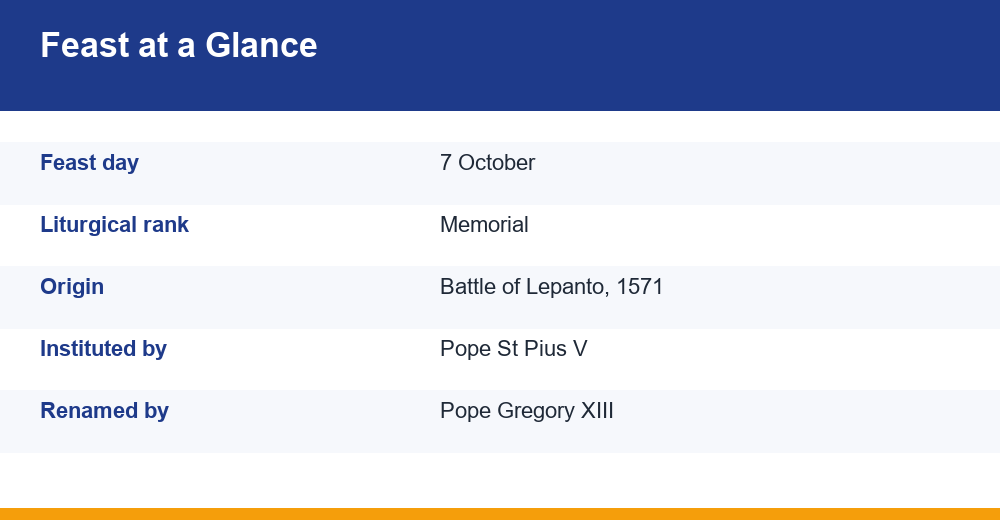
    In the autumn of 1571, Christian Europe faced the powerful navy of the Ottoman Empire in the Mediterranean. A coalition of Catholic states known as the Holy League assembled a fleet to meet it. Pope St Pius V, a Dominican deeply devoted to the beads, asked the faithful across Europe to take up the Rosary and pray for the outcome.

    On 7 October 1571, the two fleets met near Lepanto, in the Gulf of Corinth. Against considerable odds, the Holy League won a decisive victory. The pope and countless Christians credited the triumph to the intercession of the Blessed Virgin, invoked through the Rosary. A long-standing tradition even holds that Pius V knew of the victory in prayer before any messenger could have reached Rome.

    In thanksgiving, the pope established a feast under the title Our Lady of Victory. By that point the Rosary was already a much-loved devotion with centuries of gradual development behind it; you can follow that longer story in our history of the Rosary.

    From ‘Our Lady of Victory’ to the Holy Rosary

    The feast we keep today did not arrive all at once. It was shaped by several popes over more than three centuries, each of whom drew out its meaning a little further.

    YearPopeWhat changed
    1571Pope St Pius VFeast instituted as ‘Our Lady of Victory’
    1573Pope Gregory XIIIRenamed the Feast of the Holy Rosary
    1716Pope Clement XIExtended to the universal Church
    1913Pope St Pius XFixed the date as 7 October
    1969Calendar reformRetained as an obligatory memorial

    The most significant change came early. Pope Gregory XIII renamed it, and the feast has been known as Our Lady of the Rosary ever since, so that its purpose would be unmistakable: to recognise that the grace of Lepanto came through Mary’s intercession and the prayer of ordinary believers.

    Later, Pope Clement XI extended the celebration to the whole Church, and Pope St Pius X gave it the fixed date of 7 October that we still keep. Today it holds the rank of an obligatory memorial in the Church’s calendar.

    The Meaning of the Feast

    The word rosary comes from the Latin rosarium, meaning a ‘crown of roses.’ Each Hail Mary was pictured as a single rose offered to the Mother of God, and the whole prayer as a garland laid at her feet. The feast, in a sense, presents that garland to Mary on behalf of the entire Church.

    It is worth being clear about what the day is not. It is not a celebration of warfare, nor a boast over any people. What the Church saw at Lepanto, and what she still marks, is something quieter and more enduring: that humble, united, persevering prayer is never wasted, and that God hears the poor who call on him through his Mother.

    Pope St John Paul II reflected on this at length in his 2002 apostolic letter Rosarium Virginis Mariae, describing the Rosary as a school of contemplation with the face of Christ at its centre. That is the real heart of the feast: not a memory of the past, but an invitation to keep gazing on the Lord.

    The Mysteries We Pray

    The Rosary is prayed in sets of mysteries, each a scene from the life of Christ and his Mother that we hold in mind while the Hail Marys are recited. There are four sets, traditionally spread across the days of the week.

    Each decade pairs vocal prayer with quiet meditation. The repeated Hail Marys form a gentle background, almost like music, while the mind rests on the scene being contemplated. This union of word and image is what gives the Rosary its unhurried, prayerful rhythm and keeps it from becoming mere repetition.

    Set of mysteriesWhat we contemplateTraditional day
    JoyfulThe Incarnation and Christ’s early lifeMonday, Saturday
    SorrowfulThe Passion and death of ChristTuesday, Friday
    GloriousThe Resurrection and the glory of heavenWednesday, Sunday
    LuminousChrist’s public ministryThursday

    The first three sets are ancient. The Luminous Mysteries, which contemplate Christ’s baptism, the wedding at Cana, his preaching of the Kingdom, the Transfiguration, and the institution of the Eucharist, were proposed by Pope St John Paul II in 2002 as an optional enrichment. You are always free to pray any set on any day; the weekly pattern is a gentle custom, not a rule.

    How to Pray the Rosary

    If the feast draws you to pick up the beads, the method is simple and quickly learned. The Rosary is prayed in five decades, each a set of ten Hail Marys framed by other familiar prayers and joined to a single mystery. Here is the traditional pattern, step by step.

    1. Make the Sign of the Cross and, holding the crucifix, pray the Apostles’ Creed.
    2. On the first bead pray the Our Father, then a Hail Mary on each of the next three beads, followed by the Glory Be.
    3. Announce the first mystery and pray the Our Father.
    4. Pray ten Hail Marys while quietly picturing that mystery, then close the decade with the Glory Be.
    5. Many add the Fatima Prayer, ‘O my Jesus, forgive us our sins,’ before beginning the next decade.
    6. Announce each following mystery in turn and repeat until all five decades are complete.
    7. Finish with the Hail Holy Queen and the Sign of the Cross.

    Do not worry about doing it flawlessly. The words are meant to steady the mind while the heart rests on Christ, and even a single decade prayed with love is a whole and worthy prayer. The method always serves the meditation, never the other way round.

    How the Feast Is Celebrated on 7 October

    As an obligatory memorial, the day is marked first of all at Mass, with its own opening prayer and readings that turn our hearts toward Mary and her Son. Parishes named for Our Lady of the Rosary, and Dominican communities in particular, often keep the day with special solemnity, since the Order of Preachers has long been entrusted with spreading this devotion.

    Beyond the liturgy, the feast is a wonderful day to pray the Rosary with unusual care. A few simple ways to keep it well:

    • Pray at least one set of mysteries slowly, letting each scene settle before moving on.
    • Gather the household for a family Rosary in the evening, even a single decade with the children.
    • Attend Mass and offer the day’s prayers for a particular need, as Pius V once asked all of Europe to do.
    • Join or renew your place in a Rosary confraternity, a Living Rosary group, or a parish prayer chain.
    • Take a few minutes with Scripture on the mystery you are praying, so the words and the images meet.

    Because the memorial falls on the same day the world over, it also joins us to a vast, unseen company: religious communities in choir, families at the kitchen table, and the sick and housebound with beads in hand. On 7 October the whole Church prays, in a sense, as one.

    None of this needs to be elaborate. The feast rewards attention far more than activity, and a short Rosary prayed with love honours Mary more than a long one rushed through.

    October, the Month of the Rosary

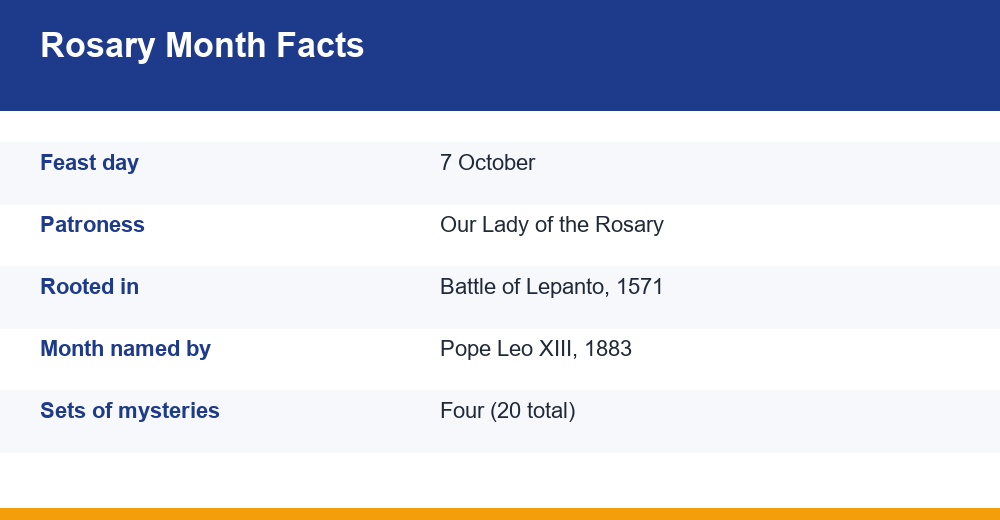
    The feast does not stand alone. It sits at the very heart of a whole month that the Church has come to associate with this prayer. Pope Leo XIII, so devoted to the beads that he is sometimes called the ‘Rosary Pope,’ warmly encouraged Catholics to pray the Rosary each day throughout October, and the custom has endured for well over a century.

    In many places the season carries its own gentle customs: parishes gather to pray the Rosary before evening Mass, families keep a small home shrine to Mary with a candle and fresh flowers, and children are taught their first decades. None of these are required, yet together they give October a recognisable warmth.

    So 7 October is best understood as a high point rather than an isolated day: a single, radiant feast set within thirty-one days of steady, unhurried prayer. If you would like a simple plan and daily encouragement for the season, see our guide to the month of the Rosary in October.

    Praying with Mary Today

    You do not need a feast day, or a perfect method, to begin. A single decade, prayed slowly, is a real and complete act of devotion. Mary has never asked for eloquence; she asks only that we come.

    Catholic piety also treasures the so-called fifteen promises of the Rosary, associated with the fifteenth-century Dominican Bl Alan de la Roche. These are held dear as a pious tradition rather than as defined dogma, and they are best received as encouragement to persevere, not as guarantees to be claimed.

    In 1917 at Fatima, in an apparition the Church has approved as worthy of belief while noting that private revelation binds no one’s faith, the Lady identified herself as the Lady of the Rosary and asked for its daily recitation. It was a striking echo of everything this feast already proclaims.

    Many people find that turning to Our Lady of the Rosary in seasons of worry brings genuine peace and consolation. Even so, the Rosary is a source of spiritual comfort, not a replacement for medical or professional care; anyone carrying heavy or lasting distress should also reach out to a doctor, counsellor, or a trusted person who can help.

    Whatever this October holds, the invitation stays the same one Mary has always offered: take up the beads, and let her lead you to her Son.

    Frequently Asked Questions

    What is the feast of Our Lady of the Rosary?

    It is a memorial in the Catholic calendar, kept on 7 October, honouring the Blessed Virgin Mary under her patronage of the Rosary. It gives thanks for the Christian victory at Lepanto in 1571 and invites the faithful to contemplate Christ through Mary’s prayer.

    Why is the feast celebrated on 7 October?

    The date recalls 7 October 1571, when the Holy League’s fleet defeated the Ottoman navy at Lepanto. The victory was credited to the intercession of Mary, sought through the Rosary, so the thanksgiving was later fixed by Pope St Pius X on that very day.

    How is the feast different from the month of the Rosary?

    They belong together. The feast is a single memorial on 7 October, while the whole of October is traditionally dedicated to the Rosary. Pope Leo XIII encouraged daily recitation through the month, so the feast becomes the high point of a longer season of prayer.

    Do I have to pray all four sets of mysteries?

    No. The long-standing custom is to pray one set each day, following the weekly pattern, so that all are prayed across the week. Praying even a single decade attentively is far better than rushing through more; the Church asks for love, not speed.

  • Month of the Rosary: Why October Is Special (Complete Guide 2026)

    Month of the Rosary: Why October Is Special (Complete Guide 2026)

    For Catholics the world over, the month of the rosary arrives each October, when the Church gently invites us to take up our beads with renewed love. It is a season woven from history, gratitude, and the quiet rhythm of Marian prayer. This guide explains why October holds such a special place, what stands behind it, and simple, faithful ways to live it well.

    month of the rosary — infographie

    Why October Is the Month of the Rosary

    October has been set apart for the rosary for well over a century, and the custom rests on two firm pillars. The first is the Church’s liturgy, which keeps the Feast of Our Lady of the Rosary on 7 October. The second is the steady encouragement of the popes, who for generations have urged the faithful to take up this prayer throughout the autumn weeks. Feast and papal exhortation together gave the whole of October its familiar Marian character.

    When we speak of the month of the rosary, then, we are naming a settled tradition of the whole Church, not a private enthusiasm. It is a yearly invitation to return to a prayer that countless believers before us have loved — a rope let down into the ordinary days of October to draw us gently back toward Christ through the hands of his Mother.

    It is a modest but generous invitation. No one is asked to pray perfectly; the Church simply opens a door and points to Mary, trusting that even a few faithful minutes each day will bear fruit no one can measure.

    The Feast of Our Lady of the Rosary (7 October)

    The feast we now keep on 7 October began under a different name. After a decisive Christian deliverance in 1571, Pope St. Pius V — a Dominican who loved the rosary deeply — established a commemoration he called Our Lady of Victory, in thanksgiving for Mary’s intercession. It was a pope’s way of teaching the whole Church where the credit truly belonged.

    The celebration soon grew. In 1573 Pope Gregory XIII gave it the enduring title Feast of the Holy Rosary, and in 1913 Pope St. Pius X fixed its date to 7 October, where it remains as an obligatory memorial in the Church’s calendar. You can explore the devotion more fully through Our Lady of the Rosary and the many titles under which the faithful honor her.

    From these Roman beginnings the feast gradually spread until it belonged to the whole Church. Today it stands each 7 October as a gentle summons to gratitude, honoring Mary under the title Our Lady of the Rosary and inviting every parish to take up the beads she so often commends. It is the bright center around which the rest of October gathers.

    The Battle of Lepanto and the Praying Church

    The story behind the feast is among the most cherished in Catholic memory. On 7 October 1571 the fleet of the Holy League met a greatly feared Ottoman navy near the Gulf of Corinth, in the waters off Lepanto. Much of Europe believed its freedom, and even the future of the faith on the continent, hung on the outcome of that single day.

    Pope Pius V had asked believers across Europe to pray the rosary and beg Our Lady’s help. As the sailors fought, rosary confraternities on land prayed their beads without ceasing. The victory that followed was received not as a triumph of arms alone but as a gift of grace, and the pope openly credited it to the intercession of the Blessed Virgin Mary.

    This, of course, is only one chapter in a much longer account. To see how the prayer itself grew — from the monastic psalms to the meditative beads we hold today — it helps to know the fuller history of the rosary, a story that stretches back long before Lepanto and continues in our own hands.

    Pope Leo XIII, the Rosary Pope

    If one figure shaped the month of the rosary as we now keep it, it is Pope Leo XIII. Beginning with his 1883 encyclical Supremi Apostolatus Officio, he asked that the whole of October be consecrated to the Queen of the Rosary, and that the prayer be offered both in church and within the home. What had centered on a single feast day now spread across an entire month.

    Leo XIII returned to this theme again and again — issuing eleven encyclicals on the rosary across his pontificate — so that he is remembered to this day as the Rosary Pope. His teaching, preserved among the papal encyclicals at the Vatican, gave October its lasting shape as a season devoted to Marian prayer for the universal Church.

    His confidence was not sentimental. Leo XIII saw the rosary as a school of the Gospel and a steadying help in the troubles of his age, and he trusted that a people who prayed together each October would be strengthened in faith, family, and charity. That conviction is the reason the custom still reaches us.

    Praying Through the Mysteries in October

    At the heart of the rosary lie the mysteries — key events in the lives of Jesus and Mary that we hold before the eye of the heart while our lips repeat the familiar prayers. For most of the rosary’s history there were three sets. In 2002, in his apostolic letter Rosarium Virginis Mariae, Pope St. John Paul II proposed a fourth, the Luminous Mysteries, drawn from Christ’s public ministry, so the rosary might more fully become a compendium of the Gospel.

    Many Catholics follow a traditional weekly pattern, letting each day carry its own set of mysteries. The table below shows the four groups, what each invites us to contemplate, and the days by custom assigned to them.

    Set of mysteriesWhat we contemplateTraditional days
    JoyfulThe Incarnation and childhood of JesusMonday, Saturday
    SorrowfulThe Passion and death of ChristTuesday, Friday
    GloriousThe Resurrection and the glory of heavenWednesday, Sunday
    LuminousChrist’s public ministry and teachingThursday

    This weekly arrangement is a helpful custom rather than a binding law. You are always free to pray whichever mysteries your heart most needs on a given day, and no grace is lost by choosing differently.

    To pray the mysteries is not to master a technique but to keep company with Jesus and Mary. Read the Gospel scene, picture it simply, and let one detail rest in your heart as the Hail Marys unfold. Distraction will come; when it does, return without discouragement. The rosary is patient, and so is the Lord who waits within it.

    Simple Ways to Observe the Month

    You need nothing elaborate to keep this holy month well. A single decade prayed with real attention is worth more than a full rosary rushed through distractedly. Here are a few gentle ways to begin, whether you are returning after years away or praying the beads for the very first time.

    • Pray one decade or a full rosary each day, alone or with your family.
    • Join a parish rosary before or after Mass, especially on 7 October.
    • Keep your beads somewhere visible — a pocket, the car, a bedside table — as a quiet invitation.
    • Pray a walking rosary, letting each step keep time with the prayers.
    • Offer each day’s rosary for one intention: a loved one, the Church, or peace in the world.

    If the whole rosary feels daunting, it may help to remember how simply a single decade unfolds:

    1. Announce the mystery and picture the scene in your imagination.
    2. Pray one Our Father.
    3. Pray ten Hail Marys slowly, resting on the mystery as you go.
    4. Close with the Glory Be, adding the Fatima Prayer if you wish.

    Families often find a short, shared rosary easier to sustain than a long one attempted alone. Choose a time that fits the household — after supper, on the drive to school, before bed — and let consistency, rather than length, carry you through the month.

    If you are just beginning, be gentle with yourself. Keep a small booklet or a trusted prayer guide nearby to recall the mysteries and the words, and do not worry if they feel unfamiliar at first. Devotion grows the way a friendship does — slowly, by simply showing up — and October is a fitting time to start.

    Pious Traditions and the Promises of the Rosary

    Across the centuries the rosary has gathered many beautiful devotional traditions. Among the most beloved are the fifteen promises said to be granted to those who pray the rosary faithfully, associated with St. Dominic and, later, with Blessed Alan de la Roche, who did much to spread the devotion in the fifteenth century.

    These promises have encouraged real and lasting devotion, and they deserve our respect. Yet it is worth holding them clearly: they belong to pious tradition, not to the Church’s defined dogma. We receive them with gratitude and gentle discretion, as encouragements to prayer rather than guarantees to be claimed.

    Other cherished customs have grown up alongside the beads. Rosary confraternities gather the faithful to pray for one another, and the First Saturday devotion, drawn from the message of Fatima, invites Confession, Communion, and the rosary on the first Saturday of five consecutive months. Like the promises, these are invitations to deeper prayer, embraced freely and never confused with binding doctrine.

    The same reverent care applies to the Marian apparitions often linked with the rosary, such as Fatima, where Our Lady is remembered as asking for its daily recitation. Approved apparitions are private revelation: the faithful are free to embrace them, while the unchanging foundation of our faith remains the Gospel handed down by the Church.

    The Quiet Fruit of a Faithful October

    Those who faithfully keep the month of the rosary often notice something quiet taking root: a steadier peace, a softening of old resentments, a sense of Mary’s nearness in the middle of ordinary life. The repetition that can seem dull from the outside becomes, from within, a resting place for a weary and busy soul.

    The rosary offers genuine spiritual consolation, and many find it a true comfort in seasons of worry or grief. It is not, however, a replacement for professional care. If you are carrying heavy anxiety or sorrow, please reach out to a trusted doctor or counselor as well — God’s grace and good human help are never rivals, but companions.

    However you pray this October — a full rosary in the evening, or a single Hail Mary whispered in the dark — you join a countless company stretching across the centuries. That is the real gift of the season: not flawless devotion, but the grace of returning, again and again, to the Mother who only ever leads us to her Son.

    Frequently Asked Questions

    Why is October the month of the rosary?

    October has been dedicated to the rosary since the nineteenth century, chiefly through Pope Leo XIII’s encyclicals beginning in 1883. October also holds the Feast of Our Lady of the Rosary on 7 October, which commemorates a Christian victory long attributed to Mary’s intercession through this prayer.

    What is the Feast of Our Lady of the Rosary?

    Kept on 7 October, it honors Mary under her title Queen of the Rosary. First called Our Lady of Victory by Pope St. Pius V after the Battle of Lepanto in 1571, it was renamed the Feast of the Holy Rosary in 1573 and remains an obligatory memorial today.

    How often should I pray the rosary in October?

    There is no obligation, only invitation. Many aim for a daily rosary, but even a single decade prayed attentively is a beautiful way to keep the month. Consistency matters more than length, so choose a rhythm you can sustain with peace rather than strain.

    Are the fifteen promises of the rosary official Church teaching?

    No. The fifteen promises, linked with St. Dominic and Blessed Alan de la Roche, are a cherished part of pious tradition, not defined dogma. Catholics may hold them with gratitude and devotion, while the heart of our faith rests on the Gospel handed on by the Church.

  • How to Meditate on the Rosary: A Complete Simple Guide (2026)

    How to Meditate on the Rosary: A Complete Simple Guide (2026)

    Learning how to meditate on the rosary is simpler than many people fear: at its heart it is spending quiet time with Jesus, guided by his mother, through the great scenes of the Gospel. You do not need special skill or lofty feelings, only a willingness to look, to listen, and to let the familiar prayers carry you. This guide walks you through the whole practice, one gentle step at a time.

    how to meditate on the rosary — infographie

    What It Means to Pray the Rosary as Meditation

    The Rosary can look, at first, like a long string of repeated words. But the repetition is not the point; it is the setting. Saint John Paul II described praying the Rosary as contemplating the face of Christ with Mary. The Hail Marys are meant to become a gentle background rhythm while your heart rests on a single scene from the life of Jesus.

    Think of it like music playing softly while you gaze at a painting. The melody steadies you; the painting holds your attention. In the Rosary, the vocal prayers are the melody and each mystery is the painting. This is why the Rosary is called meditative, or contemplative, prayer: the lips speak the familiar words while the heart quietly rests on Christ.

    So as you begin learning how to meditate on the rosary, you can set down the worry that you must say it perfectly. The words will keep flowing almost on their own. Your only real work is to turn the eyes of your heart, again and again, toward Christ, and to let Mary lead you to him.

    This is prayer anyone can grow into. A child can pray it; so can a saint. The same handful of scenes will keep opening to you across a whole lifetime, revealing something new each time you return with an attentive heart.

    Preparing Your Heart to Pray

    Meditation grows best in a little stillness, so it helps to prepare before you begin. Find a moment when you are unlikely to be interrupted, even if it is only ten minutes. A familiar spot, a chair by a window, or a corner with a crucifix or an image of Our Lady, gently signals to your heart that this is time set apart for God.

    Then settle your body so your soul can be still. Sit or kneel comfortably, breathe slowly for a moment, and make the Sign of the Cross without hurry. Tell the Lord, in a word or two, why you have come and for whom you wish to pray. This small act of intention gathers your scattered thoughts and turns the whole Rosary into a conversation begun in love.

    The Rosary itself opens with a few simple prayers, the Apostles’ Creed, an Our Father, and three Hail Marys, before the first mystery begins. Let these be a gentle threshold rather than a hurdle. Pray them slowly, and by the time you announce the first scene, your heart is already turned toward the Lord and ready to look.

    How to Meditate on the Rosary: The Four Simple Movements

    Meditating on a mystery is not a technique to master but a simple pattern you can lean on for the rest of your life. It has four movements, and they take only a moment to learn. You repeat them for each of the five decades.

    1. Announce the mystery. Before each decade, name the scene aloud or in your heart, for example, “The Annunciation.” This simply tells your mind where to go.
    2. Picture the scene. Let the Gospel moment come alive. See the angel before Mary, the shepherds at the manger, the cross on the hill. Imagination is a gift; here it serves your prayer.
    3. Draw a fruit. Ask for one grace the scene offers, a virtue such as humility, patience, or faith, and quietly desire it for your own life.
    4. Let the Hail Marys become rhythm. As you pray the ten Hail Marys, stop straining to think hard. Let the words flow beneath the scene, like waves beneath a boat.

    That pattern, announce, picture, draw a fruit, and rest in the rhythm, is the whole heart of how to meditate on the rosary. Everything else in this guide simply helps you live those four movements more deeply and more freely.

    If picturing a scene is hard for you, do not force it. You can instead hold a single word from the Gospel, gently repeat the name of Jesus, or simply stay aware that he is present with you. Meditation is about attention and love, not vivid mental pictures. Some of the holiest prayer is nearly wordless.

    The Four Sets of Mysteries at a Glance

    The Rosary gathers twenty mysteries from the life of Christ and his Mother, arranged in four sets of five. The first three sets, the Joyful, Sorrowful, and Glorious, have been prayed for centuries. The Luminous Mysteries were added by Saint John Paul II in 2002, in his apostolic letter Rosarium Virginis Mariae, to draw the years of Jesus’ public ministry into the prayer.

    Together the four sets tell a single story, from the coming of Christ to the glory of heaven. You do not pray all four in one sitting. You pray one set at a time, meditating on its five mysteries of the Rosary across five decades.

    SetThemeThe five mysteries
    JoyfulChrist’s comingAnnunciation, Visitation, Nativity, Presentation, Finding in the Temple
    LuminousChrist’s ministryBaptism, Wedding at Cana, Proclamation of the Kingdom, Transfiguration, Institution of the Eucharist
    SorrowfulChrist’s passionAgony in the Garden, Scourging, Crowning with Thorns, Carrying of the Cross, Crucifixion
    GloriousChrist’s victoryResurrection, Ascension, Descent of the Holy Spirit, Assumption, Coronation of Mary

    How to Meditate on Each Set of Mysteries

    The four movements stay the same in every set, but the mood of your prayer shifts with each one. Letting that mood gently color your meditation keeps the Rosary alive instead of routine. A short note before each set is offered here, along with a traditional fruit to seek, a cherished pious custom rather than a defined teaching, so feel free to ask for whatever grace the scene stirs in you.

    The Joyful Mysteries

    These scenes surround the coming of Christ, from the angel’s greeting to the boy Jesus found in the Temple. Meditate on them with wonder and gratitude. Traditional fruits to seek here include humility, love of neighbor, and a quiet trust in God’s unfolding plan for a life you cannot yet see.

    The Luminous Mysteries

    Also called the Mysteries of Light, these follow Jesus through his public ministry: his baptism, the wedding at Cana, his preaching of the Kingdom, the Transfiguration, and the Last Supper. Meditate on them as invitations to listen to Christ and to follow wherever he leads, asking for openness of heart and a deeper love of the Eucharist.

    The Sorrowful Mysteries

    Here you walk with Jesus through his suffering and death. Meditate slowly and tenderly; there is no need to manufacture strong emotion. Simply stay near him, ask for patience and true sorrow for sin, and let the depth of his love for you quietly sink in. These mysteries are a gift on your own hard days.

    The Glorious Mysteries

    These scenes carry you from the empty tomb to the crowning of Mary in heaven. Meditate on them with hope, especially when life feels heavy, and ask for a stronger faith and a real longing for the life God has promised. They remind you that sorrow does not have the last word.

    A Weekly Rhythm for Praying the Mysteries

    Many Catholics pray one set each day, following a traditional weekly pattern. It is a cherished custom, not a law, so you are free to follow the Church’s usual rhythm or to pray whichever set your heart needs on a given day.

    DayMysteries
    MondayJoyful
    TuesdaySorrowful
    WednesdayGlorious
    ThursdayLuminous
    FridaySorrowful
    SaturdayJoyful
    SundayGlorious

    Sundays shift a little with the seasons in the older custom: the Joyful Mysteries are often prayed on the Sundays of Advent and the Sorrowful on the Sundays of Lent. If you are just beginning, do not let the calendar become a burden. One faithful set a day, whichever it is, is a beautiful place to start.

    When Your Mind Wanders: Distractions and Dry Days

    Every person who prays the Rosary meets distraction. Your mind will drift to your to-do list, an old worry, or nothing in particular. This is not failure, and it is not a sign that you are praying badly. The saints wrestled with the very same wandering thoughts.

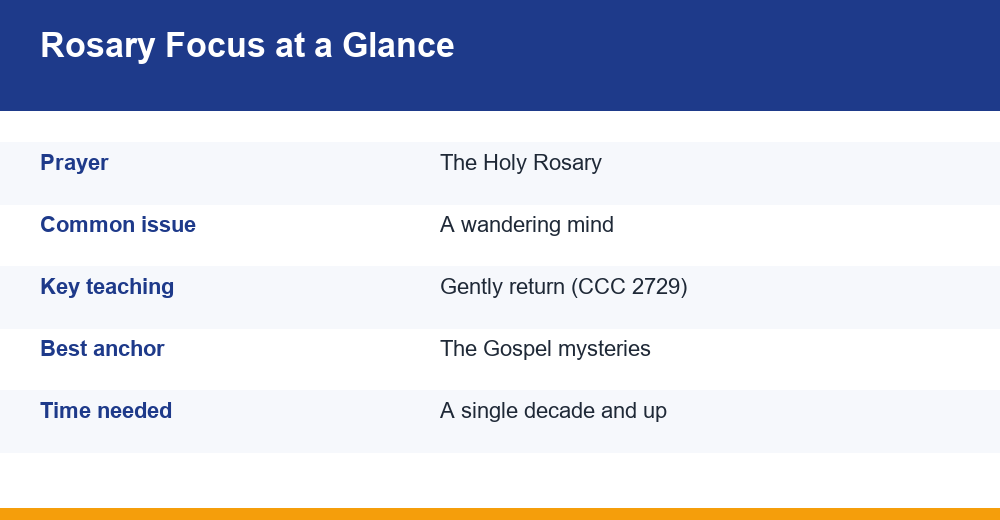
    When you notice you have drifted, do not scold yourself. Gently return to the mystery, as many times as it takes. That small, patient turning back is itself an act of love, and it is a large part of how to meditate on the rosary well over a lifetime.

    Some days prayer will feel warm and full; other days it will feel dry and empty. Both have real value. A Rosary offered in dryness, out of pure faithfulness, can be more pleasing to God than one carried along by good feelings. Keep showing up, and let consistency, not emotion, be your measure.

    The Rosary can bring real peace to an anxious heart, and many find it steadying in difficult seasons. It offers genuine spiritual consolation, though it is not a treatment. If you are carrying heavy anxiety, grief, or despair, please reach out to a trusted priest and to a qualified professional as well; seeking help is itself an act of hope.

    Simple Ways to Deepen Your Meditation

    Once the four movements feel natural, a few gentle habits can open the mysteries even wider. None of these are required. Add only what quietly helps, and leave the rest.

    • Read the Gospel passage first. Spend a moment with the Scripture behind a mystery before you pray its decade, so the scene is fresh in your mind.
    • Pray a scriptural Rosary, which pairs a short verse with each Hail Mary to keep the mystery gently before you.
    • Use sacred art. A simple icon or painting of the scene gives your eyes something to rest on as you pray.
    • Slow down. One decade prayed with real attention is worth far more than five decades rushed to the finish.
    • Pray at the same time and place each day, so the habit can take root and become second nature.

    Above all, be patient with yourself. Learning how to meditate on the rosary is the work of years, not days, and it grows slowly and quietly, like a friendship. Return to it faithfully, and you will find the mysteries becoming part of how you see your whole life, and Mary drawing you, day by day, closer to her Son.

    Frequently Asked Questions

    Do I have to picture the scene to meditate well?

    No. Imagining the scene is one path, not a rule. Some people reflect on a single Gospel word, rest quietly in a virtue, or simply stay aware of Jesus present with them. Choose whatever draws your heart toward him, and feel free to change it from day to day.

    What if I keep getting distracted while praying?

    Distraction is completely normal, even for the saints. When you notice your mind drifting, gently return to the mystery without frustration. The small act of turning back is itself part of the prayer. A distracted Rosary offered with love still pleases God and quietly forms the soul over time.

    How long does a meditative Rosary take?

    One set of five mysteries usually takes about twenty minutes when prayed slowly. If that feels long, begin with a single decade and one mystery. A short Rosary prayed with real attention is far richer than a longer one rushed only for the sake of finishing it.

    Are the fruits of the mysteries official Church teaching?

    The specific fruit attached to each mystery, such as humility or patience, is a cherished pious tradition rather than defined dogma. It is a helpful guide, not a binding rule. You are always free to draw whatever grace the scene stirs in you as you pray.

  • Rosary Distractions: 8 Proven Ways to Stay Focused (2026)

    Rosary Distractions: 8 Proven Ways to Stay Focused (2026)

    If your mind drifts the moment you pick up your beads, take heart: rosary distractions are among the most common experiences in the whole life of prayer, and they are no sign that you are praying badly. Even the greatest saints wrestled with a wandering mind. This guide offers eight gentle, time-tested ways to pray with more focus, along with the freeing truth that turning back to God is itself a prayer.

    rosary distractions — infographie

    Why Rosary Distractions Are Perfectly Normal

    The first thing to understand about rosary distractions is that they are utterly ordinary. The mind is restless by nature, leaping from thought to thought long before we ever pick up the beads. The Catechism of the Catholic Church treats this kind of distraction as the habitual difficulty of prayer, not a rare failure reserved for beginners, but a struggle shared by nearly everyone who prays.

    So when your attention scatters toward the grocery list, an old conversation, or tomorrow’s schedule, you have not ruined anything. You have simply discovered what every praying soul eventually learns: our focus is fragile, and it is grace, not sheer willpower, that steadies the heart.

    The Catechism also offers a gentle remedy. Rather than hunting our distractions down, it says, all that is necessary is to turn back to our heart. That quiet turning back, repeated as often as needed, is not an interruption of prayer, it is prayer. Each time you notice your mind has drifted and return to Jesus and Mary, you make a small, real act of love.

    Take comfort, too, in the company you keep. The great masters of prayer wrestled with the very same restlessness. St. Teresa of Avila wrote candidly of how the wandering imagination refuses to sit still, and St. Francis de Sales taught that even if we did nothing in prayer but bring our straying heart gently back a hundred times, our hour would be very well spent. If the saints struggled, we are in good company.

    What a Wandering Mind Is Really Telling You

    The Catechism goes further still and finds meaning in the wandering itself. A distraction, it teaches, quietly reveals what we are truly attached to, the worries, hopes, and desires that govern our hearts more than we realize. Seen this way, a scattered mind becomes a small window into what we most need to hand over to God.

    This reframes the entire struggle. Instead of scolding yourself, you can treat each stray thought as useful information and gently offer it back to the Lord:

    • A recurring worry? Hand it to God as an intention for that decade.
    • A person who keeps surfacing? Pray for them, and let them become part of your Rosary.
    • Restlessness or heavy tiredness? A gentle sign to slow down or shorten your prayer.

    The point is not to indulge every passing thought but to stop treating distraction as an enemy to be crushed. When you meet it with peace instead of panic, it loses much of its power, and the prayer quietly continues.

    This is very much in keeping with the spirit of St. Therese of Lisieux, whose ‘little way’ turned small interruptions into acts of love. When a person or a worry surfaces in your prayer, you can do the same: pray for whoever comes to mind, and let the distraction quietly become intercession.

    8 Practical Ways to Stay Focused

    None of these methods will silence your mind forever, and that is not the goal. They simply give your attention something good to hold on to. Try one or two at a time; the aim is not a flawless Rosary but a prayerful one, even a distracted one. Here are eight simple, time-tested approaches for praying through rosary distractions.

    1. Gently return, without frustration. The instant you notice you have drifted, come back to the words on your lips. Expect to do this many times in a single Rosary.
    2. Announce and picture each mystery. Say its name, then let your imagination place you inside the Gospel scene, the stable, the road to Calvary, the empty tomb.
    3. Pray the words aloud or in a whisper. Hearing your own voice gives the restless mind a sound to follow.
    4. Slow down. Rushing all but guarantees drifting; let each Hail Mary breathe.
    5. Fix your eyes on something holy — a crucifix, an icon, a lit candle, or a piece of sacred art.
    6. Offer the distraction as a prayer. Turn the intruding worry or person into your intention for that decade.
    7. Keep it short when you must. One attentive decade is worth more than five hurried ones.
    8. Prepare before you begin. Take a slow breath, quiet your surroundings, and consciously place yourself in God’s presence.

    Do not try to practice all eight at once. Choose the one or two that speak to you today, and let the rest wait for another time. A single method, used gently and returned to whenever the mind slips, will help far more than a whole toolkit taken up anxiously. The goal here is peace, not performance.

    Setting the Scene Before You Begin

    Much of our focus is won or lost before the first Hail Mary. A few moments of preparation can transform the prayer that follows. The spiritual masters have long counseled that we should not begin to speak to God while our thoughts are still scattered elsewhere; a short pause to recollect ourselves is always time well spent.

    You need not wait for perfect quiet, which rarely comes. But small, deliberate signals can tell the mind and body that something sacred is beginning:

    • Find the quietest corner and moment available to you, even a few stolen minutes.
    • Place a crucifix, an icon, or an image of the day’s mystery where your eyes can rest on it.
    • Light a candle, if you can, as a simple sign that prayer is beginning.
    • Take three slow breaths and ask the Holy Spirit to help you pray.

    The Church has long encouraged us to keep sacred images before us in prayer, so that whenever the mind wanders it has something holy to return to. The eyes often lead the heart, and a single beautiful image can carry an entire decade.

    Let the Mysteries Be Your Anchor

    The single most powerful cure for a drifting mind is also the most traditional: the mysteries themselves. In his 2002 apostolic letter Rosarium Virginis Mariae, St. John Paul II explained that naming each mystery opens up a scene for the mind to enter, directing the imagination toward a particular moment in the life of Christ.

    This is the key insight: the Rosary is at heart a contemplative prayer, a way of gazing on the face of Christ alongside his Mother. The beads are less a checklist to finish than a rhythm that frees the mind to picture, ponder, and love. When the imagination is busy with the Gospel, it has far less room to wander.

    Some find it helpful to pray a Scriptural Rosary, adding a short line of Scripture before each Hail Mary so that every bead carries the mind a step further into the scene. Others simply hold one detail, a word, a gesture, a face, for the whole decade. There is no single correct method; use whatever keeps your heart with Christ.

    If you would like to go deeper, our guide on how to meditate on the rosary walks through entering each scene step by step. Praying the set of mysteries assigned to each day also gives your week a gentle structure and your attention a clear focus:

    DayMysteriesAn anchor to hold
    Monday & SaturdayJoyfulThe wonder of the Incarnation
    Tuesday & FridaySorrowfulChrist’s love in his suffering
    Wednesday & SundayGloriousThe hope of the Resurrection
    ThursdayLuminousChrist revealed in his ministry

    Praying Aloud and Slowing the Pace

    Distraction thrives on two things: speed and a silent mouth. Two simple, physical habits push back against both. The first is to pray aloud, or at least in a low whisper. Giving the prayer a voice engages the body and hands the wandering mind a steady sound to follow.

    The second is simply to slow down. When we race to finish, the words blur together and the mind slips away between the beads. Let each bead be like a heartbeat, unhurried, steady, and given its full weight.

    • Whisper the words when you cannot pray fully aloud.
    • Pause for a single breath after you announce each mystery.
    • Let the second half of each Hail Mary be a touch slower than the first.
    • Pray along with a trusted recorded Rosary when you are tired and your focus falters.

    These are not mere tricks. They honor the truth that we are body and soul together: when the body prays, with voice, breath, and a slow, deliberate pace, the soul more easily follows it into stillness.

    Praying the Rosary in a Busy Life

    For many people, the deepest source of a wandering mind is simply a crowded life. When the day is packed with responsibilities, the noise follows us right into our prayer, and the beads can feel like one more task to finish before collapsing into bed.

    The remedy is rarely more silence than we can realistically find, but a Rosary that fits the day we actually have. Our reflections on praying the rosary in a busy life offer gentle rhythms for exactly this season:

    • Pray a single decade when a full Rosary feels out of reach.
    • Attach your prayer to a daily anchor, the commute, a walk, the washing-up.
    • Pray along with a recorded Rosary or a trusted app when your energy is low.
    • Let a child’s interruptions become part of a family Rosary rather than a defeat.

    A distracted Rosary prayed faithfully in a demanding season is worth far more than a perfect one that never gets started. Fidelity, not flawlessness, is what God asks of us.

    When Rosary Distractions Discourage You

    One of the subtlest dangers in the spiritual life is not the wandering mind itself but the discouragement that can follow it. It is easy to conclude that because we cannot concentrate, we cannot really pray, and so, little by little, to give up altogether.

    Take heart: rosary distractions cannot strip your prayer of its worth. God receives the offering of your time and your will, not a flawless performance. A Rosary you struggled through with love may please him more than one prayed with perfect ease.

    That said, be gentle with yourself. If your restlessness in prayer comes with persistent anxiety, intrusive thoughts, or distress that reaches well beyond your prayer time, it is wise to speak with a trusted priest or spiritual director, and, where needed, a qualified professional. Grace and good counsel work together, never against each other.

    Above all, keep beginning again. The saints were not those who were never distracted, but those who never stopped returning. Every fresh start is a small victory, and every return to God is already a prayer.

    Frequently Asked Questions

    Is it a sin to be distracted while praying the Rosary?

    No. Distraction that you do not choose is not a sin at all, but a normal weakness of the human mind. What matters is that you gently turn back to the prayer whenever you notice you have drifted. That simple act of returning is itself pleasing to God.

    How do I stop my mind from wandering during the Rosary?

    You probably cannot stop it completely, and you do not need to. Instead, give your mind something good to hold: picture each mystery, pray the words aloud, slow your pace, and rest your eyes on a crucifix or icon. Then return gently, as often as it takes.

    Does a distracted Rosary still count?

    Yes. God looks at the love and intention behind your prayer, not at a flawless performance. A Rosary prayed faithfully through many distractions can please him more than an effortless one. Offer him your very struggle, keep beginning again, and trust that your effort is received.

    What should I do with the thoughts that keep interrupting my prayer?

    Turn them into prayer. If a worry surfaces, hand it to God as your intention for that decade. If a person keeps coming to mind, pray for them. A recurring distraction often reveals what your heart is attached to and what most needs God’s grace.

  • 15 Promises of the Rosary: The Complete Explained Guide

    15 Promises of the Rosary: The Complete Explained Guide

    The 15 Promises of the Rosary are among the most treasured encouragements in Catholic devotional life, a set of graces that, according to a cherished tradition, the Blessed Virgin Mary offered to those who pray her Rosary faithfully. Handed down through the Dominican family, they are attributed to St Dominic and to Blessed Alan de la Roche. This guide explains each one reverently and accurately, and shows how to receive them the way the Church intends.

    15 promises of the rosary — infographie

    What Are the 15 Promises of the Rosary?

    The promises are fifteen assurances of grace, protection, and heavenly help that, in Catholic tradition, Our Lady made known to those who pray her Rosary with devotion. They are not magic words or guarantees to be claimed on demand. Read rightly, they are a mother’s tender encouragement to keep company with her Son through a prayer she loves.

    Taken together, they sketch what a faithful life of the Rosary tends to bear. There is grace for the present moment, strength against sin, growth in virtue, comfort at the hour of death, and the sure hope of heaven. Every promise finally points past the beads to Christ, whose mysteries we ponder as the prayers pass through our fingers.

    • Grace and protection in daily life
    • Strength against sin and temptation
    • Growth in virtue and love of God
    • Comfort at death and the hope of heaven

    Because they are so consoling, the promises deserve to be understood carefully—generously, but without exaggeration. The sections below set out where they came from, what each one says, and how to let them shape a genuine friendship with God.

    The Origin of the Promises

    Devotion to the Rosary grew slowly over many centuries. Long before the beads took their present form, monks prayed the one hundred and fifty psalms, and many of the faithful who could not read prayed one hundred and fifty Hail Marys in their place—a ‘Psalter of Mary.’ Meditation on the life of Christ was gradually woven in, and the Rosary as we know it took shape.

    Catholic tradition links the preaching of the Rosary to St Dominic in the thirteenth century, during the Church’s struggle against error in southern France. In the fifteenth century a Dominican friar, Blessed Alan de la Roche, revived the Rosary confraternity across Europe and recorded the fifteen promises, saying he had received them through private revelation. To trace this longer story, see our overview of the history of the Rosary.

    Historians debate the earliest details, and the Church has never claimed to settle them. What is beyond doubt is the enduring fruit of the devotion, which popes and saints have commended warmly for some eight hundred years.

    The Fifteen Promises, One by One

    Here are the fifteen promises in their traditional form, each with a brief word to help you receive it in the spirit of the Church.

    1. Signal graces. Those who faithfully serve Our Lady by praying the Rosary will receive singular, particular graces—help fitted to their needs and to the state of their soul.
    2. Special protection. Mary promises her protection and the greatest graces to all who recite the Rosary, keeping them close as a mother keeps her children.
    3. The Rosary is a powerful armour against hell; it destroys vice, lessens sin, and helps the Church overcome error and heresy in every age.
    4. The Rosary makes virtue and good works flourish. It draws down God’s abundant mercy and turns the heart away from worldly vanity toward the things that last forever.
    5. The soul that entrusts itself to Mary through the Rosary shall not perish—a promise of her constant intercession for those who seek her help.
    6. Those who pray the Rosary devoutly, meditating on its mysteries, will not be overwhelmed by misfortune or die unprepared; the just remain in God’s grace and grow worthy of eternal life.
    7. Those with a true devotion to the Rosary will not die without the sacraments of the Church, that great mercy at the end of life.
    8. The faithful will know God’s light and the fullness of his grace throughout life and at death, and will share at last in the merits of the blessed.
    9. Mary will help to free from purgatory the souls who were devoted to her Rosary, hastening them toward the vision of God.
    10. The faithful children of the Rosary will share a high degree of glory in heaven, their love for Mary blossoming into eternal joy.
    11. Whatever you ask through the Rosary, you shall obtain—always understood in keeping with God’s holy will and your true good.
    12. Those who spread devotion to the Rosary will be helped by Mary in all their necessities, for she is not outdone in generosity.
    13. She has obtained from her Son that the friends of the Rosary shall have the whole court of heaven as their intercessors in life and at death.
    14. All who pray the Rosary are Mary’s beloved children and, in Christ, the brothers and sisters of Jesus himself.
    15. Devotion to the Rosary is a great sign of predestination—a reason for hope in God’s mercy, never a guarantee that presumes upon it.

    Read as the Church reads them, these are words of maternal tenderness rather than a contract. The eleventh promise in particular simply echoes the Gospel: what we ask is granted according to God’s will and our salvation, not as a blank cheque for every passing wish. Trust, not calculation, is the right response.

    A Pious Tradition, Not Defined Dogma

    To value the promises well, it helps to know how the Church weighs such things. Public revelation—the deposit of faith—was completed with the death of the last Apostle, and nothing will be added to it. Private revelation may help the faithful in a particular time, yet it never belongs to the faith we are bound to believe.

    The 15 promises of the rosary belong to this second category. They reach us as pious tradition through Blessed Alan de la Roche, and the Church has never defined them as revealed doctrine. Even great approved apparitions, such as Fatima, remain private revelation; the promises rest on humbler ground still, and Catholics are free to embrace them with trust or to hold them lightly.

    What the Church does hold out to everyone is the Rosary itself. As Pope St John Paul II taught in Rosarium Virginis Mariae, it is at heart a Christ-centred prayer that leads us, in Mary’s company, to contemplate the face of her Son.

    Common Misunderstandings to Avoid

    Because the promises are so consoling, they are sometimes misread. A few gentle clarifications keep the devotion healthy and free of superstition, so that the Rosary remains what it is meant to be—a prayer of loving trust rather than a bargain struck with heaven.

    • They are not a spell: reciting a set number of Rosaries never compels God or Our Lady to act.
    • They do not replace the sacraments, sincere conversion, or a life of charity.
    • ‘Signal’ graces mean help suited to each soul, not a promise of worldly success or comfort.
    • A holy death is offered to the repentant, never claimed as a right by those who presume.

    Understood rightly, the 15 promises of the rosary never encourage presumption. They describe how God delights to reward humble, persevering prayer, while always leaving his freedom and our free response fully intact. The promise is real; the response of a faithful heart is what makes it fruitful.

    How to Receive These Graces Rightly

    Because the promises are so generous, it is worth saying plainly what they are not. They are not a transaction, as though a fixed number of prayers could oblige God to act. Grace is always his free gift, and the promises quietly presuppose the very things that make any devotion fruitful: faith, repentance, and a life turned toward charity.

    • Pray with attention, meditating on the mysteries rather than rushing the words
    • Stay in the state of grace, with regular recourse to Confession and the Eucharist
    • Let the Rosary reshape your life, drawing you away from sin toward love
    • Trust God’s will, especially when he answers differently than you had hoped

    Seen this way, the Rosary is less a lever than a school of the Gospel and a path of friendship with Christ. If you have ever asked why the Rosary still matters in a busy modern life, the promises answer gently: because, through Mary, it keeps drawing the soul back to her Son.

    Praying the Rosary Well

    The graces come through the prayer, so it is worth praying it well. The Rosary unfolds in four sets of mysteries—the Joyful, the Luminous, the Sorrowful, and the Glorious—each a window onto the life of Christ. Pope St John Paul II proposed the Luminous mysteries in 2002, and the weekly pattern below is now widely followed.

    A full Rosary is five decades. Each decade holds one Our Father, ten Hail Marys, and a Glory Be, framed by the opening prayers and the closing Hail Holy Queen. Announce a mystery for each decade and let the words carry your mind into the scene.

    DayMysteriesFocus of the mysteries
    MondayJoyfulThe Incarnation and Christ’s childhood
    TuesdaySorrowfulChrist’s Passion and death
    WednesdayGloriousThe Resurrection and heavenly glory
    ThursdayLuminousChrist’s public ministry
    FridaySorrowfulChrist’s Passion and death
    SaturdayJoyfulThe Incarnation and Christ’s childhood
    SundayGloriousThe Resurrection and heavenly glory

    Whatever the day, the heart of the Rosary is meditation, not speed. Picture each Gospel scene, and let the familiar prayers hold you within it. One decade prayed slowly and with love is worth more than a full Rosary rushed.

    The Quiet Fruits of a Faithful Rosary

    Ask those who pray the Rosary daily what it has given them, and you will usually hear not of dramatic favours but of a quiet steadiness—a day more ordered, a heart more at peace, a sense of never being alone. This is how the 15 promises of the rosary are most often fulfilled: gently, over years, in a soul slowly conformed to Christ.

    The consolation the Rosary brings is real, but it is spiritual rather than a remedy for every trouble. If you are carrying heavy anxiety, grief, or despair, please also reach out to a trusted doctor, counsellor, or priest; God commonly works through good human care alongside prayer.

    So begin simply. Take up the beads today, pray one decade with love, and let Our Lady lead you, one mystery at a time, closer to her Son.

    Frequently Asked Questions

    Are the 15 promises of the rosary official Church dogma?

    No. They are a pious tradition attributed to Blessed Alan de la Roche and are considered private revelation, not defined dogma. The Church commends the Rosary very highly, yet Catholics remain free to accept the promises or to set them aside without any fault.

    Who first recorded the promises?

    According to Dominican tradition, they were written down in the fifteenth century by Blessed Alan de la Roche, who linked them to St Dominic and to Our Lady herself. The historical details are debated, but the devotion has nourished the faithful for centuries and endures today.

    Does the promise ‘whatever you ask you shall obtain’ mean every request is granted?

    It must be read with the Gospel. God grants what we ask through the Rosary in keeping with his will and our salvation. He always answers, sometimes with something better than we requested, and always in his own good time rather than on demand.

    How often should I pray the Rosary to receive these graces?

    There is no fixed quota to unlock a reward. A daily Rosary is a beautiful goal, yet even a single decade prayed attentively pleases God. What matters is faithful, prayerful devotion carried on over time, offered with love rather than counted like a transaction.

  • Praying the Rosary as a Family: A Complete Guide (2026)

    Praying the Rosary as a Family: A Complete Guide (2026)

    Praying the rosary as a family is one of the oldest and most tender habits in Catholic life — a simple way to gather everyone, young and old, around Christ through the eyes of his Mother. It asks for no perfect house, no perfectly behaved children, and no flawless schedule, only a willing heart and a few minutes offered together each day. What follows is a warm, practical guide to weaving that prayer gently into the ordinary life of your home.

    praying the rosary as a family — infographie

    Why Praying the Rosary as a Family Matters

    The Church has long called the Christian home the domestic church — the very first place a child ever learns to speak to God. When a household prays together, the faith stops being an idea taught on Sundays and becomes something warm and lived, taking root right there at the kitchen table.

    Venerable Patrick Peyton, the Irish-American priest remembered as the Rosary Priest, built his whole ministry on a single conviction, often summed up in the words the family that prays together stays together. His Family Rosary Crusade reached millions across the world, yet its heart remained small and homely — parents and children, beads in hand, kneeling together before Our Lady.

    Praying the rosary as a family also gives everyone a shared rhythm that little else in modern life provides. In a week crowded with screens, separate schedules, and hurried meals, a decade or two of Hail Marys draws the whole household back into one room, one voice, and one intention. Children tend to remember these quiet evenings long after they have forgotten almost everything they were merely told.

    Getting Started Without the Stress

    If your family has never prayed together in this way, begin gently and without pressure. You do not need to know every prayer by heart, own beautiful beads, or manage a full five decades on the very first night. A single decade, prayed slowly and with a little attention, is already a beautiful and complete beginning that God receives with joy.

    Choose a time that fits your household’s natural rhythm — after dinner while everyone is still gathered at the table, or in the quiet just before bed. Keep the beads somewhere visible so the practice does not rest on memory alone. Above all, remember that praying the rosary as a family is a habit you slowly build, not a test you must pass.

    If you or your children are still learning the words and the order, our guide on how to pray the rosary walks through every step at a gentle pace. Start there, then simply pray what you can, and let the rest come with time.

    • Begin with one decade and add more only as everyone grows comfortable.
    • Keep a rosary for each person — colors and materials children enjoy holding help.
    • Let little ones hold the beads even before they can say the words.
    • Do not stop to correct every mistake; the aim is to pray, not to perform.

    Keeping It Short for Children

    Children pray with their bodies as much as with their words, and that is exactly as it should be. A wiggly toddler, a whispered question about the dog, a decade that dissolves into giggles — none of this ruins family prayer or offends God in the slightest. Such moments are simply joyful noises offered to the Lord, and he delights in them.

    When praying the rosary as a family with young children, match the length to the ages in the room. Little ones do well with a single decade; older children can happily carry more. It is far better to finish one decade in peace than to abandon all five in frustration and end the evening on a sour note.

    • Keep the whole prayer within your youngest child’s attention span.
    • Let a child light a candle or ring a small bell to mark the start.
    • Explain one mystery briefly, in your own words, before the decade.
    • End on time, even if it feels short — leave them wanting to return.

    Taking Turns and Sharing the Leading

    The rosary is not a solo performance by one parent while everyone else listens. When each person is given a real role, even the youngest begins to feel that the prayer truly belongs to them and not only to the grown-ups.

    Let family members take turns leading a decade, announcing the mystery, or offering an intention aloud. A child still too young to read can name someone to pray for — a grandparent, a sick friend, a neighbor, or even a beloved pet. Every voice adds something to the family’s prayer.

    • Rotate who leads each decade around the circle.
    • Invite each person to add one intention aloud.
    • Let an older child teach a younger sibling a prayer.
    • Give younger children a job, such as candle keeper or bead holder.

    Sharing the lead teaches the prayers almost by accident. Children who regularly take a turn soon know the Apostles’ Creed, the Hail, Holy Queen, and the names of the mysteries simply by praying them week after week. Years later, those same prayers will rise to their lips in moments of joy and sorrow, worn smooth by repetition and ready when they are needed most.

    Praying with Images of the Mysteries

    The rosary is often called a compendium of the Gospel, because each mystery invites us to picture a scene from the life of Christ and his Mother. For children especially, a real image makes a distant story suddenly present and easy to hold in the imagination.

    Keep a simple booklet, a set of holy cards, or a printed poster of the twenty mysteries where the family gathers to pray. Before each decade, hold up the picture and ask, “What do you see?” Their answers, honest and unhurried, often become the meditation the whole family needs.

    There are four sets of mysteries, each traditionally prayed on set days of the week:

    DaysMysteriesWhat they recall
    Monday and SaturdayJoyfulChrist’s coming and childhood
    Tuesday and FridaySorrowfulChrist’s passion and death
    Wednesday and SundayGloriousThe Resurrection and heaven
    ThursdayLuminousChrist’s public ministry

    The Luminous Mysteries were proposed by Saint John Paul II in 2002, while the older tradition spreads the Joyful, Sorrowful, and Glorious across the week. This arrangement is a cherished custom rather than a binding law, so your family is free to pray whichever mysteries you wish. Many households simply follow the day’s mysteries, letting the whole life of Christ unfold naturally over each week.

    Consistency Over Perfection

    The greatest obstacle to family prayer is rarely the chaos itself — it is the quiet belief that prayer must be done perfectly or not at all. Let that thought go completely. A short, imperfect, interrupted rosary prayed tonight is worth far more in God’s eyes than a flawless one endlessly imagined for some calmer day that never quite arrives.

    A rhythm is easiest to keep when it is attached to something you already do each day, such as the evening meal or the moment before bed. Over time, reaching for the beads becomes as ordinary as brushing teeth. If you would like help forming that rhythm, our reflections on building a daily rosary habit may encourage and steady you.

    Missing a night is inevitable; simply begin again the next day without a trace of guilt, because praying the rosary as a family is a long, patient work measured in years, not in single evenings. What matters is not an unbroken record but a family that keeps returning.

    WhenA simple way to pray
    WeeknightsOne decade after dinner
    SundaysA full five decades together
    Car ridesA decade on the school run
    Feast daysLight a candle; pray all five

    When Family Prayer Feels Hard

    Even devoted families run into friction. A teenager rolls their eyes, a parent comes home exhausted, a baby cries straight through the third Hail Mary. None of this means you should stop; each is simply part of praying in a real home, with real people, on ordinary days.

    With reluctant teenagers, avoid turning the rosary into a battle of wills. Invite rather than command, keep it genuinely short, and let them lead a decade or choose the intentions. Teens often warm to responsibility even when they resist mere obligation, and your own steady example will teach far more than any lecture ever could.

    When only one parent prays, or when a spouse does not share the faith, pray anyway with the children present. Grace is not measured by attendance figures. A single faithful parent praying beside a child quietly plants seeds that can go on growing for a lifetime, in ways you may never fully see.

    • Too tired? Pray one decade rather than skipping the night entirely.
    • Too busy? Pray in the car, on a walk, or while tidying up.
    • Too restless? Stand, kneel, or hold an image to help everyone focus.
    • Too discouraged? Offer the very difficulty itself to Our Lady.

    The Fruits of Family Prayer

    What grows in a home that prays together is seldom dramatic and almost always real. Children absorb the faith far less from lectures than from watching their parents kneel and pray. Spouses discover a shared stillness that ordinary days rarely allow, old tensions soften within the same repeated words, and the home slowly becomes a place where God, too, is at home.

    In his letter on the rosary, Rosarium Virginis Mariae, Saint John Paul II wrote warmly of families who turn to Mary together, seeing the rosary as a prayer that binds a household in peace. Countless Catholic families across the centuries have quietly discovered the same gift for themselves.

    There is also a well-loved tradition of the Fifteen Promises of the rosary, handed down through pious devotion. These are treasured spiritual encouragements rather than defined doctrines of the Church, and they are best received in exactly that gentle, trusting spirit, without treating them as guarantees.

    If your family carries a heavy burden — grief, illness, or deep worry — the rosary can be a genuine source of spiritual consolation and peace. It is never a replacement for medical or professional care, and reaching out for such help when it is needed is itself an act of trust in God’s loving providence, not a failure of faith.

    In the end, praying the rosary as a family is less about the beads than about the bond: your household, gathered before the Lord, learning together to say yes to God as Mary once did. Begin small, begin tonight, and let Our Lady lead your family the rest of the way.

    Frequently Asked Questions

    At what age can children start praying the rosary?

    There is no minimum age at all. Infants benefit simply from being held while the family prays, and toddlers can clutch the beads long before they can speak the words. Begin with a single decade suited to your youngest child, and let their capacity grow naturally over the years.

    How long should a family rosary take?

    It depends entirely on the ages gathered in your home. A single decade may last only three or four minutes, while a full five-decade rosary runs about twenty. With young children, keep it short and peaceful, remembering that one finished decade beats an abandoned rosary every time.

    Which mysteries do we pray on each day?

    By long custom, the Joyful mysteries fall on Monday and Saturday, the Sorrowful on Tuesday and Friday, the Glorious on Wednesday and Sunday, and the Luminous on Thursday. This schedule is a helpful tradition rather than a strict rule, so pray whichever mysteries best suit your family.

    What if our family rosary is always chaotic?

    Chaos is completely normal and never a failure. Wiggles, questions, and interruptions are simply part of praying with children. Keep the prayer short, begin again after every missed night, and trust that quiet consistency, not flawless performance, is what truly forms faith over the years.

  • Daily Rosary Habit: 7 Essential Steps to Pray Every Day

    Daily Rosary Habit: 7 Essential Steps to Pray Every Day

    A daily Rosary habit is one of the most quietly powerful practices a Catholic can take up, yet it rarely begins with grand resolutions; it begins with a single set of beads and a little perseverance. Praying the Rosary each day draws us, through Mary, into the life of her Son, turning ordinary minutes into meditation on the Gospel. The seven steps below are gentle and realistic, meant for real lives with real interruptions.

    daily rosary habit — infographie

    Why Build a Daily Rosary Habit

    The Rosary is not a magic formula or a race to the finish line. Saint John Paul II described it as a compendium of the Gospel, a way of contemplating the face of Christ with the heart of his Mother. When we pray it every day, we are not simply repeating words; we are keeping steady company with Jesus through the Joyful, Luminous, Sorrowful, and Glorious mysteries.

    At its heart, the Rosary weaves together a few prayers we already know: the Our Father, the Hail Mary, and the Glory Be. As our lips repeat these familiar words, our minds are freed to picture the scenes of the Gospel. This quiet union of vocal and mental prayer is what makes the Rosary so restful; the voice keeps time while the heart contemplates Christ.

    In his apostolic letter Rosarium Virginis Mariae, Saint John Paul II encouraged the faithful to make the Rosary a daily rhythm, and in 2002 he added the five Luminous Mysteries drawn from Christ’s public ministry. That gives us twenty mysteries in all, spread naturally across the week.

    Why aim for consistency rather than the occasional long prayer? Because a daily Rosary habit forms the heart slowly, the way patient water shapes stone. A few faithful minutes each day do more for the soul than an hour prayed once a month and then quietly forgotten.

    The great fruit of this prayer is not a feeling but a friendship. Some days you will be flooded with consolation; many days you will feel nothing at all, distracted and dry. That is entirely normal, and it is not a failure. Fidelity in dryness is itself an act of love, and the Church has long treasured the Rosary as a school of quiet, persevering faith.

    A simple weekly pattern helps you know what to contemplate each day:

    DayMysteriesWhat we contemplate
    MondayJoyfulChrist’s coming among us
    TuesdaySorrowfulChrist’s passion and cross
    WednesdayGloriousThe Resurrection and glory
    ThursdayLuminousChrist’s public ministry
    FridaySorrowfulChrist’s passion and cross
    SaturdayJoyfulChrist’s coming among us
    SundayGloriousThe Resurrection and glory

    This arrangement follows the one Saint John Paul II proposed. During Advent and Lent, some prefer to pray the Joyful or Sorrowful mysteries on Sunday. Either way, the aim is not rigidity but rhythm.

    You may also hear of the fifteen promises linked to the Rosary, or of Our Lady’s request at Fatima that we pray it daily. These belong to the Church’s rich devotional tradition and to approved private revelation; they are treasured encouragements to prayer rather than defined doctrines. Welcome them as gifts that draw you toward Christ, never as burdens.

    Step 1: Choose a Fixed Time

    The single greatest predictor of whether a devotion survives is whether it has a home in your day. Decide when you will pray, whether first thing in the morning, on your lunch break, or before bed, and treat that slot as an appointment you keep with the Lord and his Mother.

    Mornings suit many people because the day has not yet crowded in. Others find the stillness of evening more natural. There is no holier hour on the clock; the best time is the one you will actually keep.

    • Write the time into your calendar or set a quiet daily reminder.
    • Keep your rosary where you will see it at that hour: a bedside table, a coat pocket, the car.
    • Guard the slot from your phone; consider praying before you open any screens.

    Step 2: Anchor It to Your Routine

    Habits hold best when they lean on something you already do without thinking. Pair the Rosary with an existing anchor: a cup of coffee, the commute home, the walk to the mailbox, or the quiet minutes after you brush your teeth. The old routine becomes the cue for the new one.

    This is sometimes called habit stacking, and it works because you are not summoning brand-new willpower each day; you are borrowing a rhythm your body already knows. The Rosary slips into the gap that was already there.

    • After I pour my morning coffee, I pray a decade.
    • When I sit down on the train, I take out my beads.
    • Once the children are in bed, we pray together.

    Step 3: Start With One Decade

    Many people abandon the Rosary because they imagine they must pray all five decades perfectly or not at all. That is a trap. Begin instead with a single decade, one Our Father, ten Hail Marys, and a Glory Be while you meditate on one mystery, and let it grow from there.

    If you are new to this prayer or returning after years away, take heart: the Rosary is meant to be learned slowly. Our guide to praying the Rosary for beginners walks through each prayer and bead so nothing feels unfamiliar.

    To meditate on a mystery, simply picture the scene as if you were present: the angel greeting Mary, the child laid in the manger, the empty tomb at dawn. There is no need for lofty thoughts. A single word, image, or quiet glance of the heart toward Jesus is enough to make the decade a true meditation rather than mere recitation.

    Here is the simple shape of the full Rosary, for when you are ready to pray more than one decade:

    1. Make the Sign of the Cross and pray the Apostles’ Creed on the crucifix.
    2. Pray an Our Father, then three Hail Marys, then a Glory Be.
    3. Announce the first mystery, then pray an Our Father, ten Hail Marys, and a Glory Be.
    4. Repeat for all five mysteries of the day.
    5. Close with the Hail, Holy Queen and the Sign of the Cross.

    Consistency matters more than length. One faithful decade prayed daily is worth far more than a full Rosary you dread and skip.

    Step 4: Pray on a Walk or Commute

    The Rosary was made for movement. It fits the rhythm of footsteps and the hum of a train as easily as the hush of a chapel. If your day feels impossibly full, remember that this devotion travels with you and asks for no special silence.

    For more practical ideas on fitting the Rosary into a busy life, a walk or commute is often the answer. Praying while you move can sustain a daily Rosary habit on the very days when sitting still seems impossible.

    • Pray a decade during a morning walk, one mystery per block or lap.
    • Turn a commute, whether driving, walking, or riding, into sacred time instead of scrolling.
    • Use a Rosary app or audio recording to keep pace when your hands are busy.

    One caution: if you are driving, keep your eyes and attention on the road. Pray from memory rather than handling beads, and never let the prayer become a distraction from safety.

    Step 5: Pray as a Family

    Praying together binds a household to God and to one another. A family Rosary need not be long or polished. Children’s wiggles and small interruptions are part of the offering, not a failure of it, and the Lord receives the whole noisy gift with joy.

    Start with a single decade after dinner or before bed. Let different members take turns to lead, announce the mystery, or hold a picture that illustrates it. Small hands learn reverence best by imitation, not by lectures.

    • Keep it short at first; one decade is a real family Rosary.
    • Let young children announce a mystery or lead a Hail Mary.
    • Offer the prayer for a shared intention so everyone feels part of it.

    Do not wait until the house is calm to begin, or you may wait forever. Pray in the ordinary din. Grace does not require a quiet room, only a willing heart.

    Step 6: Track Your Progress Gently

    A simple record can encourage perseverance, the way a small checkmark quietly says you showed up today. Keep it light and free of pressure; this is a garden to tend, not a metric to optimize or a score to chase.

    • Mark a small calendar or a habit app for each day you pray.
    • Invite a friend or spouse to pray with you and check in weekly.
    • Share your intentions with someone; being prayed for keeps you accountable.

    The purpose of tracking is gratitude, never guilt. If a chart ever becomes a source of scruples or anxiety, set it aside without a second thought. The Lord counts love, not tally marks.

    Step 7: Begin Again After Missed Days

    You will miss days. Everyone does. The saints were not people who never fell but people who always rose again, and the same is true of prayer. A missed Rosary is not a verdict on your faith; it is simply an invitation to begin again today.

    Most obstacles to praying daily are ordinary and answerable. When one arises, name it honestly and reach for a small, concrete remedy:

    ObstacleA small remedy
    No timePray one decade, even on the walk to your car
    ForgettingTie the prayer to a daily anchor and set a reminder
    Constant distractionReturn to the mystery each time, without frustration
    DiscouragementSkip the guilt and simply pray today’s decade
    DrynessOffer the prayer as a quiet act of love and continue

    Your daily Rosary habit is not a performance you can fail, but a friendship you keep returning to. When you skip a day, resist both the urge to make up every lost decade and the temptation to abandon the practice in discouragement. Simply pick up your beads and pray the next one.

    If you ever find that missed prayers, or prayer itself, are stirring deep or lasting distress, please reach out to a trusted priest, spiritual director, or qualified professional. Devotion is meant to bring peace, and there is no shame in seeking help along the way.

    Above all, be gentle with yourself. Building a daily Rosary habit is the work of years, not weeks, and Our Lady is a patient Mother who never tires of her children. Begin today with a single decade, return tomorrow, and let this quiet prayer become the steady heartbeat of your life with Christ.

    Frequently Asked Questions

    How long does it take to pray a full Rosary?

    Most people pray a full five-decade Rosary in about fifteen to twenty minutes. A single decade takes only three or four minutes, which is why starting small works so well: even the busiest day has room for one decade offered with love.

    Which mysteries should I pray each day?

    By a common arrangement, the Joyful mysteries are prayed on Monday and Saturday, the Sorrowful on Tuesday and Friday, the Glorious on Wednesday and Sunday, and the Luminous on Thursday. During Advent or Lent, some pray the Joyful or Sorrowful mysteries on Sunday instead.

    What if I keep getting distracted while praying?

    Distraction is normal and not a sin. Gently return your attention to the mystery each time you notice your mind wander, without frustration. Even a distracted Rosary prayed faithfully pleases God; the very effort to return is itself an act of love.

    Is it better to pray one decade daily or a full Rosary occasionally?

    Consistency usually forms the soul more deeply than intensity. One decade prayed faithfully every day builds a lasting rhythm, while an occasional full Rosary is easily forgotten. Start with what you can keep, and let the practice grow naturally over time.

  • Rosary for Beginners: A Complete Simple Guide (2026)

    Rosary for Beginners: A Complete Simple Guide (2026)

    If you have ever held a set of beads and wondered where to begin, this guide to the rosary for beginners is for you. The Rosary is a gentle, Scripture-rooted prayer that anyone can learn, one small step at a time. You do not need to memorize everything today — you need only the willingness to begin.

    rosary for beginners — infographie

    The Rosary for Beginners: What It Actually Is

    At its heart, the Rosary weaves together a handful of short, familiar prayers with quiet meditation on the life of Jesus and Mary. As your fingers move along the beads, your hands keep count so that your mind and heart are free to reflect. Because of this, the Rosary is often called a Gospel in miniature — each decade opens a scene from Scripture for you to ponder.

    Much of the appeal of the rosary for beginners is exactly this unhurried rhythm. The repeated words are not meant to be rushed or ticked off like a task; they slow you down and give a restless mind something to hold while your soul settles into prayer. Over time, the familiar phrases become a kind of home you can return to anywhere.

    A question many newcomers ask is whether the Rosary worships Mary. It does not. Catholics worship God alone; in the Rosary we ask Mary to pray for us, much as we might ask a friend, while every mystery keeps its gaze fixed on her Son. Understanding this puts many hearts at ease before they ever begin.

    The word rosary comes from a Latin term for a “crown of roses,” an image of offering Mary a bouquet of prayers. This devotion took shape gradually across many centuries, which is a quiet comfort in itself: you are stepping into a practice that generations before you also had to learn slowly, one prayer at a time.

    What You Need to Begin (Just the Beads)

    The good news is that you need very little to start. A simple set of rosary beads and a few quiet minutes are enough. You do not need an expensive, antique, or even blessed rosary to pray — a plain cord rosary works just as beautifully as a treasured heirloom.

    • A five-decade rosary — or simply your ten fingers
    • A quiet spot, even for just five minutes
    • A printed or on-screen copy of the prayers while you learn
    • An open, unhurried heart

    If you would like, you can ask a priest to bless your rosary. It is a lovely custom that many treasure, though it is never required before you begin. Some people exploring the rosary for beginners prefer a single-decade “pocket” rosary or a rosary ring while they build the habit — anything that helps you actually pray is the right choice.

    The Prayers You’ll Use

    The Rosary is built from just a few prayers, most of which you may already know from Mass or from childhood. Do not feel that you must have them memorized before you start — it is perfectly acceptable to read from a card or a screen, and the words settle into memory naturally through quiet repetition.

    • The Sign of the Cross
    • The Apostles’ Creed
    • The Our Father (the Lord’s Prayer)
    • The Hail Mary
    • The Glory Be
    • The Fatima Prayer (“O my Jesus…”)
    • The Hail, Holy Queen

    The two prayers you will repeat most often are the Our Father and the Hail Mary, so those are the ones worth learning first. You can find the complete wording of each, along with the closing prayers, in our collection of prayers of the Rosary.

    The short prayer said after each decade — “O my Jesus, forgive us our sins…” — comes from the apparitions at Fatima, which the Church has approved as a worthy private revelation rather than binding doctrine. It is a cherished and widely loved custom, but a beginner who leaves it out has still prayed the Rosary faithfully.

    The Basic Structure, Step by Step

    Here is the shape of a complete five-decade Rosary. Read through it once to get the lay of the land, then keep it beside you as a simple checklist the first few times you pray.

    1. Holding the crucifix, make the Sign of the Cross and pray the Apostles’ Creed.
    2. On the first bead, pray an Our Father.
    3. On the next three beads, pray a Hail Mary on each — traditionally for faith, hope, and love.
    4. Pray a Glory Be.
    5. Announce the first mystery, then pray an Our Father.
    6. On the ten beads of the decade, pray ten Hail Marys while quietly meditating on that mystery.
    7. Pray a Glory Be, followed by the Fatima Prayer if you wish.
    8. Repeat steps five through seven for the remaining four decades, then close with the Hail, Holy Queen and a final Sign of the Cross.

    If you would like a slower walkthrough with every prayer written out in full and placed exactly where it belongs, see our detailed guide on how to pray the Rosary. For an official reference, the USCCB’s guide to the Rosary lays out this very same structure.

    How One Decade Works

    The decade is the heartbeat of the Rosary, and once you understand one, you understand the whole prayer. A decade is simply one Our Father, ten Hail Marys, and one Glory Be, all prayed while you picture a single scene from the Gospel.

    Take the first Joyful Mystery, the Annunciation, as an example. As your lips pray the ten Hail Marys, let your mind rest on the angel Gabriel greeting Mary. The words carry you along while your imagination stays with the scene. If your thoughts wander — and they will — simply notice it and return to the mystery, without frustration or starting over.

    The repetition is intentional. Much as a familiar lullaby can calm a child, the steady return of the Hail Mary quiets the noise of the day and frees you to dwell on the mystery rather than on finding the right words. Do not mistake the repetition for empty routine — it is the very thing that makes contemplation possible.

    This is why a single decade makes such a fine beginning. It takes only a few minutes, it teaches you the rhythm of the whole Rosary, and it can be prayed almost anywhere: on a walk, in a waiting room, or in the last quiet moments before sleep.

    The Mysteries and When to Pray Them

    The mysteries are the meditations at the very heart of each decade — twenty scenes drawn from the lives of Jesus and Mary, gathered into four sets. Many Catholics pair each set with a day of the week, which gives prayer a steady rhythm, though you are always free to pray whichever set draws your heart.

    DayMysteriesFocus
    MondayJoyfulChrist’s coming
    TuesdaySorrowfulChrist’s Passion
    WednesdayGloriousChrist’s triumph
    ThursdayLuminousChrist’s ministry
    FridaySorrowfulChrist’s Passion
    SaturdayJoyfulChrist’s coming
    SundayGloriousChrist’s triumph

    During Advent, the Joyful Mysteries are often prayed on Sundays, and during Lent, the Sorrowful. The Luminous Mysteries, also called the Mysteries of Light, were added by Pope Saint John Paul II in 2002 to fill out the picture of Christ’s public life.

    • Joyful — the Annunciation, Visitation, Nativity, Presentation, and Finding of Jesus in the Temple
    • Sorrowful — the Agony in the Garden, Scourging, Crowning with Thorns, Carrying of the Cross, and Crucifixion
    • Glorious — the Resurrection, Ascension, Descent of the Holy Spirit, Assumption, and Coronation of Mary
    • Luminous — the Baptism in the Jordan, Wedding at Cana, Proclamation of the Kingdom, Transfiguration, and Institution of the Eucharist

    Why Pray the Rosary?

    People come to the Rosary for many reasons, and the graces it offers are always spiritual rather than magical. Meditating faithfully on the life of Christ draws the heart nearer to him, deepens our love of Scripture, and forms a steadying, unhurried peace. Saints across the centuries have cherished it as a school of prayer that quietly shapes the soul over time.

    • A closer, more personal friendship with Jesus
    • A deeper love for Sacred Scripture and the Gospel
    • Growth in patience, humility, and trust in God
    • A calmer heart and a settled habit of daily prayer

    You may also come across lists of blessings linked to the Rosary, often called the fifteen promises. These belong to the Church’s devotional tradition rather than to defined doctrine, so it is best to receive them as pious encouragement, not as guarantees. The heart of the matter is simpler and more certain: prayer offered with love is never wasted.

    Start Small and Be Gentle With Yourself

    If five decades feel like a lot, begin with one. There is no rule that a newcomer must pray the entire Rosary in a single sitting. A single decade prayed faithfully each day will do far more for your soul than a full Rosary you dread and quietly abandon after a week.

    The most common mistake among those praying the rosary for beginners is expecting perfection. You will lose count, forget a prayer, or drift off in the middle of a decade — and none of it undoes your prayer. God receives the offering of a willing heart, distractions and all.

    • Pick a set time — after your morning coffee, on your commute, or before bed
    • Keep your rosary somewhere you will see it and reach for it
    • Read the prayers aloud until they slowly become your own
    • Let the repetition slow you down instead of hurrying you along

    Many people find that this quiet, repetitive prayer brings a genuine sense of peace at the close of a hard day. The Rosary offers real spiritual consolation — but it is not a replacement for professional care. If you are carrying heavy anxiety or grief, please reach out to a trusted doctor or counselor as well.

    Whatever first drew you toward the rosary for beginners, take heart: countless saints and ordinary faithful have prayed these same words for centuries, and you are joining their company. Pick up the beads, make the Sign of the Cross, and simply begin. Mary will help you take it from there.

    A Simple Plan for Your First Week

    If you like a little structure, here is one easy way to ease in over your first week. Adjust it freely — the goal is a habit that lasts, not a schedule to feel guilty about.

    1. Days 1–2: Learn the Sign of the Cross and the Our Father, and pray a single decade.
    2. Days 3–4: Add the Hail Mary and the Glory Be, still praying just one decade.
    3. Day 5: Read through the mysteries and choose the set for the day.
    4. Day 6: Pray two or three decades, pausing briefly on each mystery.
    5. Day 7: If you feel ready, pray a full five-decade Rosary — and if not, that is perfectly fine too.

    By the end of a week, the rhythm that once felt unfamiliar will already be settling into place. From there, growth comes naturally: a decade here, a full Rosary there, until the prayer becomes a quiet companion woven through your ordinary days.

    Frequently Asked Questions

    Do I need a blessed rosary to start?

    No. Any set of beads — even your ten fingers — is enough to begin. Having a rosary blessed by a priest is a beautiful tradition that many treasure, but it is never required before you start praying. Begin with whatever you have today.

    How long does it take to pray the Rosary?

    A full five-decade Rosary usually takes about fifteen to twenty minutes when prayed unhurried. A single decade takes only three to five minutes, which makes it ideal for newcomers or for busy days. The quality of your attention matters far more than speed.

    Which mysteries should I pray today?

    Many Catholics follow the traditional weekly schedule: Joyful on Monday and Saturday, Sorrowful on Tuesday and Friday, Glorious on Wednesday and Sunday, and Luminous on Thursday. You are always free, though, to pray whichever set speaks most to your heart on a given day.

    Is praying the Rosary worshiping Mary?

    No. Catholics worship God alone. In the Rosary we ask Mary to pray for us, much as we ask a friend, while every mystery meditates on the life of Christ. The prayer is meant to draw us closer to Jesus through the eyes of his mother.