The feast of Our Lady of the Rosary, celebrated each year on 7 October, gathers the Church to give thanks for a gift that seems almost too simple: a string of beads and a few prayers that carry us through the life of Christ. It grew out of a moment of real danger and hope in the sixteenth century, and it has shaped Catholic prayer ever since. This guide explains where the feast came from, what it means, and how to pray and keep it well in 2026.
Table of Contents
Who Is Our Lady of the Rosary?
The title Our Lady of the Rosary does not name a different Mary from the one we meet in the Gospels. It honours the same Blessed Virgin under one particular aspect of her care for us: her constant invitation to contemplate her Son through the prayer the Church simply calls the Rosary.
When Catholics keep this feast, then, they are not celebrating the beads themselves. They are celebrating Mary as the one who takes us by the hand and leads us, decade by decade, into the mysteries of Christ’s life, death, and resurrection.
This is also why the feast has never competed with the worship due to God alone. Mary points away from herself and toward her Son, just as she did at Cana: ‘Do whatever he tells you.’ To take her hand in the Rosary is simply to let her lead us where she has always pointed.
That is why the Rosary has often been described as a compendium of the Gospel, a phrase Pope St John Paul II drew on to explain how the entire story of salvation unfolds within it. To honour Mary under this title is, at heart, a way of honouring the Lord whose face we behold at her side.
The Battle of Lepanto and the Birth of a Feast
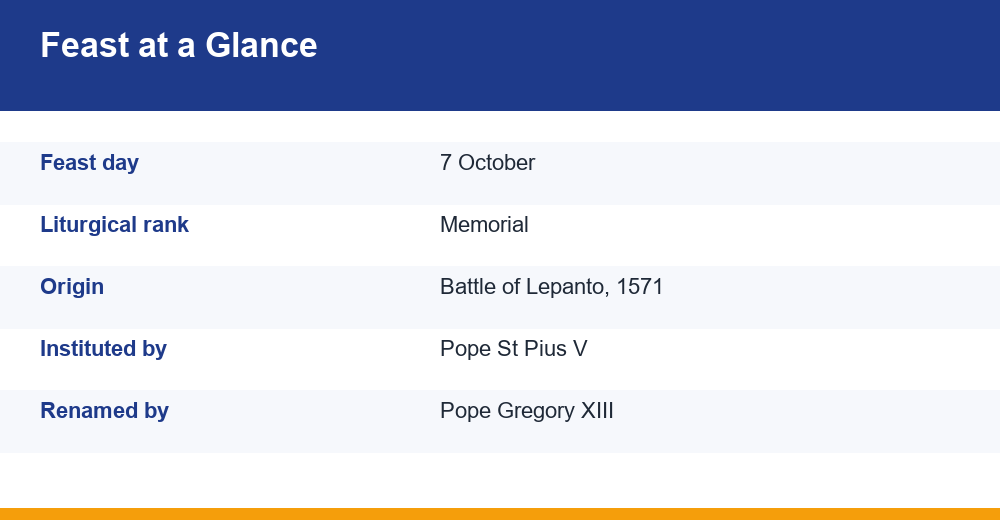
In the autumn of 1571, Christian Europe faced the powerful navy of the Ottoman Empire in the Mediterranean. A coalition of Catholic states known as the Holy League assembled a fleet to meet it. Pope St Pius V, a Dominican deeply devoted to the beads, asked the faithful across Europe to take up the Rosary and pray for the outcome.
On 7 October 1571, the two fleets met near Lepanto, in the Gulf of Corinth. Against considerable odds, the Holy League won a decisive victory. The pope and countless Christians credited the triumph to the intercession of the Blessed Virgin, invoked through the Rosary. A long-standing tradition even holds that Pius V knew of the victory in prayer before any messenger could have reached Rome.
In thanksgiving, the pope established a feast under the title Our Lady of Victory. By that point the Rosary was already a much-loved devotion with centuries of gradual development behind it; you can follow that longer story in our history of the Rosary.
From ‘Our Lady of Victory’ to the Holy Rosary
The feast we keep today did not arrive all at once. It was shaped by several popes over more than three centuries, each of whom drew out its meaning a little further.
| Year | Pope | What changed |
|---|---|---|
| 1571 | Pope St Pius V | Feast instituted as ‘Our Lady of Victory’ |
| 1573 | Pope Gregory XIII | Renamed the Feast of the Holy Rosary |
| 1716 | Pope Clement XI | Extended to the universal Church |
| 1913 | Pope St Pius X | Fixed the date as 7 October |
| 1969 | Calendar reform | Retained as an obligatory memorial |
The most significant change came early. Pope Gregory XIII renamed it, and the feast has been known as Our Lady of the Rosary ever since, so that its purpose would be unmistakable: to recognise that the grace of Lepanto came through Mary’s intercession and the prayer of ordinary believers.
Later, Pope Clement XI extended the celebration to the whole Church, and Pope St Pius X gave it the fixed date of 7 October that we still keep. Today it holds the rank of an obligatory memorial in the Church’s calendar.
The Meaning of the Feast
The word rosary comes from the Latin rosarium, meaning a ‘crown of roses.’ Each Hail Mary was pictured as a single rose offered to the Mother of God, and the whole prayer as a garland laid at her feet. The feast, in a sense, presents that garland to Mary on behalf of the entire Church.
It is worth being clear about what the day is not. It is not a celebration of warfare, nor a boast over any people. What the Church saw at Lepanto, and what she still marks, is something quieter and more enduring: that humble, united, persevering prayer is never wasted, and that God hears the poor who call on him through his Mother.
Pope St John Paul II reflected on this at length in his 2002 apostolic letter Rosarium Virginis Mariae, describing the Rosary as a school of contemplation with the face of Christ at its centre. That is the real heart of the feast: not a memory of the past, but an invitation to keep gazing on the Lord.
The Mysteries We Pray
The Rosary is prayed in sets of mysteries, each a scene from the life of Christ and his Mother that we hold in mind while the Hail Marys are recited. There are four sets, traditionally spread across the days of the week.
Each decade pairs vocal prayer with quiet meditation. The repeated Hail Marys form a gentle background, almost like music, while the mind rests on the scene being contemplated. This union of word and image is what gives the Rosary its unhurried, prayerful rhythm and keeps it from becoming mere repetition.
| Set of mysteries | What we contemplate | Traditional day |
|---|---|---|
| Joyful | The Incarnation and Christ’s early life | Monday, Saturday |
| Sorrowful | The Passion and death of Christ | Tuesday, Friday |
| Glorious | The Resurrection and the glory of heaven | Wednesday, Sunday |
| Luminous | Christ’s public ministry | Thursday |
The first three sets are ancient. The Luminous Mysteries, which contemplate Christ’s baptism, the wedding at Cana, his preaching of the Kingdom, the Transfiguration, and the institution of the Eucharist, were proposed by Pope St John Paul II in 2002 as an optional enrichment. You are always free to pray any set on any day; the weekly pattern is a gentle custom, not a rule.
How to Pray the Rosary
If the feast draws you to pick up the beads, the method is simple and quickly learned. The Rosary is prayed in five decades, each a set of ten Hail Marys framed by other familiar prayers and joined to a single mystery. Here is the traditional pattern, step by step.
- Make the Sign of the Cross and, holding the crucifix, pray the Apostles’ Creed.
- On the first bead pray the Our Father, then a Hail Mary on each of the next three beads, followed by the Glory Be.
- Announce the first mystery and pray the Our Father.
- Pray ten Hail Marys while quietly picturing that mystery, then close the decade with the Glory Be.
- Many add the Fatima Prayer, ‘O my Jesus, forgive us our sins,’ before beginning the next decade.
- Announce each following mystery in turn and repeat until all five decades are complete.
- Finish with the Hail Holy Queen and the Sign of the Cross.
Do not worry about doing it flawlessly. The words are meant to steady the mind while the heart rests on Christ, and even a single decade prayed with love is a whole and worthy prayer. The method always serves the meditation, never the other way round.
How the Feast Is Celebrated on 7 October
As an obligatory memorial, the day is marked first of all at Mass, with its own opening prayer and readings that turn our hearts toward Mary and her Son. Parishes named for Our Lady of the Rosary, and Dominican communities in particular, often keep the day with special solemnity, since the Order of Preachers has long been entrusted with spreading this devotion.
Beyond the liturgy, the feast is a wonderful day to pray the Rosary with unusual care. A few simple ways to keep it well:
- Pray at least one set of mysteries slowly, letting each scene settle before moving on.
- Gather the household for a family Rosary in the evening, even a single decade with the children.
- Attend Mass and offer the day’s prayers for a particular need, as Pius V once asked all of Europe to do.
- Join or renew your place in a Rosary confraternity, a Living Rosary group, or a parish prayer chain.
- Take a few minutes with Scripture on the mystery you are praying, so the words and the images meet.
Because the memorial falls on the same day the world over, it also joins us to a vast, unseen company: religious communities in choir, families at the kitchen table, and the sick and housebound with beads in hand. On 7 October the whole Church prays, in a sense, as one.
None of this needs to be elaborate. The feast rewards attention far more than activity, and a short Rosary prayed with love honours Mary more than a long one rushed through.
October, the Month of the Rosary
The feast does not stand alone. It sits at the very heart of a whole month that the Church has come to associate with this prayer. Pope Leo XIII, so devoted to the beads that he is sometimes called the ‘Rosary Pope,’ warmly encouraged Catholics to pray the Rosary each day throughout October, and the custom has endured for well over a century.
In many places the season carries its own gentle customs: parishes gather to pray the Rosary before evening Mass, families keep a small home shrine to Mary with a candle and fresh flowers, and children are taught their first decades. None of these are required, yet together they give October a recognisable warmth.
So 7 October is best understood as a high point rather than an isolated day: a single, radiant feast set within thirty-one days of steady, unhurried prayer. If you would like a simple plan and daily encouragement for the season, see our guide to the month of the Rosary in October.
Praying with Mary Today
You do not need a feast day, or a perfect method, to begin. A single decade, prayed slowly, is a real and complete act of devotion. Mary has never asked for eloquence; she asks only that we come.
Catholic piety also treasures the so-called fifteen promises of the Rosary, associated with the fifteenth-century Dominican Bl Alan de la Roche. These are held dear as a pious tradition rather than as defined dogma, and they are best received as encouragement to persevere, not as guarantees to be claimed.
In 1917 at Fatima, in an apparition the Church has approved as worthy of belief while noting that private revelation binds no one’s faith, the Lady identified herself as the Lady of the Rosary and asked for its daily recitation. It was a striking echo of everything this feast already proclaims.
Many people find that turning to Our Lady of the Rosary in seasons of worry brings genuine peace and consolation. Even so, the Rosary is a source of spiritual comfort, not a replacement for medical or professional care; anyone carrying heavy or lasting distress should also reach out to a doctor, counsellor, or a trusted person who can help.
Whatever this October holds, the invitation stays the same one Mary has always offered: take up the beads, and let her lead you to her Son.
Frequently Asked Questions
What is the feast of Our Lady of the Rosary?
It is a memorial in the Catholic calendar, kept on 7 October, honouring the Blessed Virgin Mary under her patronage of the Rosary. It gives thanks for the Christian victory at Lepanto in 1571 and invites the faithful to contemplate Christ through Mary’s prayer.
Why is the feast celebrated on 7 October?
The date recalls 7 October 1571, when the Holy League’s fleet defeated the Ottoman navy at Lepanto. The victory was credited to the intercession of Mary, sought through the Rosary, so the thanksgiving was later fixed by Pope St Pius X on that very day.
How is the feast different from the month of the Rosary?
They belong together. The feast is a single memorial on 7 October, while the whole of October is traditionally dedicated to the Rosary. Pope Leo XIII encouraged daily recitation through the month, so the feast becomes the high point of a longer season of prayer.
Do I have to pray all four sets of mysteries?
No. The long-standing custom is to pray one set each day, following the weekly pattern, so that all are prayed across the week. Praying even a single decade attentively is far better than rushing through more; the Church asks for love, not speed.