The connection between the rosary and Fatima is one of the most beloved threads in modern Catholic devotion. In 1917, in a quiet Portuguese valley, the Blessed Virgin Mary appeared to three shepherd children and asked them, again and again, to pray the Rosary every day for peace. What follows is the accurate history, the heart of the message, and how the Church came to recognize it.
Table of Contents
The Story Behind the Rosary and Fatima
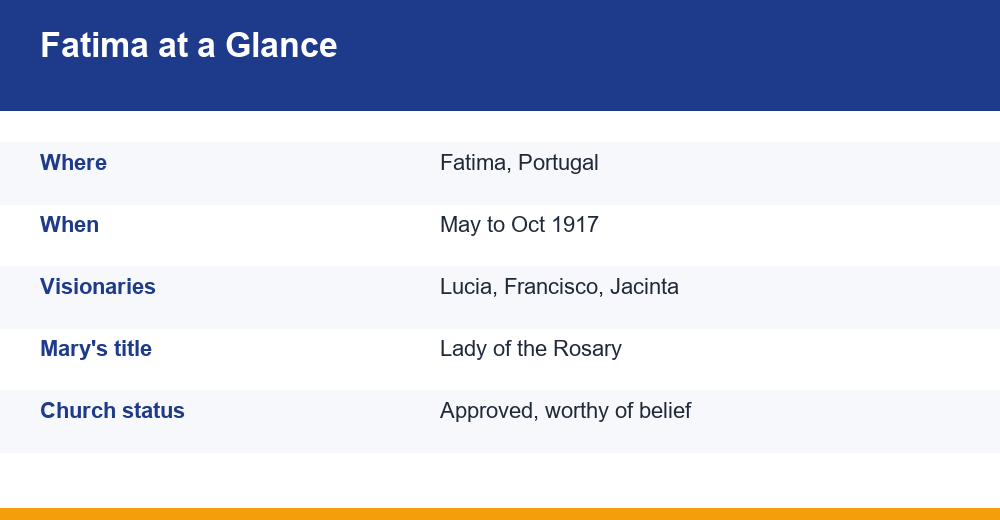
In the spring of 1917, the First World War was grinding across Europe, and few places felt further from world events than the hills of central Portugal. Near the town of Fatima, in a hamlet called Aljustrel, three cousins spent their days watching over the family’s sheep.
They were Lucia dos Santos, then ten years old, and her younger cousins Francisco and Jacinta Marto, aged nine and seven. They were poor, unschooled, and entirely unremarkable, which is part of what makes their story so striking.
The year before, the children later recounted, an Angel of Peace had visited them three times, teaching them to adore God and to pray for sinners. Then, on 13 May 1917, they described seeing a radiant woman above a small holm oak in a rocky pasture called the Cova da Iria.
From that first meeting, one request ran through everything she said. The heart of the rosary and Fatima story is not a secret or a spectacle, but a gentle, insistent invitation: pray the Rosary every day, for peace.
The Six Apparitions of 1917
Between May and October of 1917, the children reported six encounters with the Blessed Mother, always on the thirteenth of the month, with one exception. Each visit deepened the same message.
- 13 May — Our Lady first appears, asking the children to pray the Rosary daily and to return on the thirteenth of each month.
- 13 June — She again urges daily prayer of the Rosary and speaks of her Immaculate Heart.
- 13 July — The children are shown a vision of the reality of hell and are given a short prayer to add after each decade of the Rosary.
- 19 August — Detained on the thirteenth by a local anticlerical official, the children meet Our Lady days later, and she asks for prayer and sacrifice for sinners.
- 13 September — Mary asks that the Rosary be prayed for an end to the war.
- 13 October — She names herself the Lady of the Rosary and asks that a chapel be built; a large crowd witnesses the Miracle of the Sun.
By October, word had spread and a vast crowd gathered in the rain. Believers and skeptics alike later reported the sun appearing to spin and change color, an event remembered as the Miracle of the Sun.
Mary’s Repeated Call to Pray the Rosary
It would be easy to fix on the drama of Fatima and miss its plainest lesson. In every apparition, Our Lady asked for the same thing: the daily praying of the Rosary.
On 13 October, in her final visit, she gave herself a name. According to Lucia’s account, she said, “I am the Lady of the Rosary,” and asked that a chapel be built on the spot. This is where the ancient title Our Lady of the Rosary takes on fresh and personal meaning.
In July she had also given the children a brief prayer to say after each decade. By long-standing devotional custom it is now known as the Fatima Prayer: “O my Jesus, forgive us our sins, save us from the fires of hell, lead all souls to Heaven, especially those most in need of Thy mercy.”
This prayer is a cherished pious tradition rather than a required part of the Rosary, yet countless Catholics now include it, precisely because of Fatima.
Fatima also gave rise to related devotions, such as the First Saturdays, a pious practice of reparation to the Immaculate Heart of Mary. Like the Fatima Prayer, these are treasured customs offered freely, not obligations of the faith.
How the Church Approved the Fatima Message
The Church is careful, even slow, when weighing claims of the supernatural, and rightly so. Reports of apparitions are tested over years before any judgment is offered.
After a formal canonical inquiry, the Bishop of Leiria, Dom Jose Alves Correia da Silva, declared the visions worthy of belief on 13 October 1930. Devotion at Fatima has been encouraged by popes ever since.
It helps to understand what this approval means. Fatima is an approved private revelation. The Church teaches that public revelation ended with the apostles, so no Catholic is bound to accept a private revelation as an article of faith. Approval means only that the message holds nothing contrary to faith and can genuinely help the faithful. You can read the Church’s own reflection in the Vatican’s account of the Message of Fatima.
Papal devotion has at times been strikingly personal. Saint John Paul II credited Our Lady with saving his life when he was shot on 13 May 1981, the anniversary of the first apparition, and afterward had one of the bullets placed in the crown of the Fatima statue.
The children themselves became figures of holiness. Francisco and Jacinta, who both died young in the influenza pandemic that followed the war, were beatified in 2000 and canonized by Pope Francis on 13 May 2017, the centenary of the first apparition. Lucia became a Carmelite nun and lived until 2005; her own cause for sainthood has since been opened.
Why the Rosary and Fatima Still Speak Today
A message about peace, given as the deadliest war the world had yet seen raged on, has lost none of its urgency. If anything, the pairing of the rosary and Fatima feels newly relevant in a restless, anxious age.
The appeal is strikingly humble. Mary did not ask for grand gestures or great learning. She asked ordinary children, and through them ordinary people, to take up a simple string of beads and pray.
That is a large part of why the Rosary still matters a century later: it places the Gospel, meditated through Mary’s eyes, within reach of anyone, in any circumstance, without cost or condition.
The Fifteen Promises of the Rosary
Alongside Fatima, many Catholics have heard of the Fifteen Promises of the Rosary. These are traditionally associated with Our Lady’s encouragement to Saint Dominic and, centuries later, to Blessed Alan de la Roche, who helped renew the devotion in the fifteenth century.
It is important to hold them gently. The Fifteen Promises are a cherished pious tradition, not a defined teaching of the Church. They are best received as warm encouragements to faithful prayer rather than guarantees of any particular result.
- A deeper share in God’s grace for those who pray the Rosary faithfully.
- Abundant blessings for those who lovingly spread the devotion to others.
- Growth in virtue and a steadier love of God for the devout.
- Mary’s tender help and intercession, especially at the hour of death.
- The Rosary as a sure school for meditating on the life of Christ.
Understood this way, the promises point in the same direction as Fatima. They call us not to a spiritual shortcut, but to a steady, trusting friendship with Christ, formed through his Mother’s prayer over a lifetime.
How to Pray the Rosary as Fatima Asked
You do not need anything elaborate to answer Our Lady’s request. If the devotion is new to you, begin gently and let it grow.
- Hold a Rosary or simply use your fingers. Begin with the Sign of the Cross and the Apostles’ Creed.
- Pray an Our Father, three Hail Marys, and a Glory Be for an increase of faith, hope, and love.
- For each of the five decades, announce the mystery, then pray one Our Father, ten Hail Marys, and a Glory Be while quietly picturing that scene from the life of Christ.
- Add the Fatima Prayer after the Glory Be of each decade, as Our Lady requested.
- Close with the Hail Holy Queen and a short prayer for peace in the world and in your own heart.
Fatima’s counsel was never about rushing through words. Mary asked for daily, unhurried prayer offered with love, even if that means only a single decade on a busy day.
The Mysteries and a Weekly Rosary Schedule
The Rosary is arranged in four sets of mysteries, each a window onto the life of Jesus and Mary. Many Catholics follow a simple weekly pattern so that, across seven days, they walk through the whole of the Gospel story.
| Set of Mysteries | Traditional Days | Example Scenes |
|---|---|---|
| Joyful | Monday, Saturday | The Annunciation; the Nativity |
| Sorrowful | Tuesday, Friday | The Agony in the Garden; the Crucifixion |
| Glorious | Wednesday, Sunday | The Resurrection; the Ascension |
| Luminous | Thursday | The Baptism of Jesus; the Wedding at Cana |
The Luminous Mysteries were proposed by Saint John Paul II in 2002; the other three sets are far older. Whichever day it is, the aim is the same as at Fatima: to keep company with Christ through the prayers of his Mother.
Living the Message with Peace of Heart
The peace Our Lady spoke of at Fatima begins in the heart before it ever reaches the world. Many people find that praying the Rosary slowly, breathing with its rhythm, quiets anxiety and gathers a scattered mind.
It is best to receive that as a spiritual gift rather than a cure. The Rosary can be a real source of consolation in hard seasons, yet it is not a substitute for medical or psychological care. If you are carrying serious distress, please reach out to a trusted doctor, counselor, or priest as well.
Understood rightly, the message is an invitation, not a burden. To pick up the beads today, even for a few minutes, is to answer the same gentle request that three children heard in a Portuguese field more than a century ago.
The Church formally recognised the Fatima apparitions as worthy of belief in 1930, when the local bishop declared them credible after careful investigation. Later popes honoured the message, and St John Paul II attributed his survival of a 1981 assassination attempt to Our Lady of Fatima. Even so, an approved apparition remains private revelation: it adds nothing to the deposit of faith and binds no one, yet its central request could not be simpler or more urgent — pray the Rosary, and pray for peace.
Frequently Asked Questions
Why did Our Lady of Fatima ask for the Rosary?
In each of the six apparitions of 1917, Mary asked the children to pray the Rosary daily for peace as the First World War raged. She offered it as a simple, powerful way for ordinary people to draw near to God and intercede for a wounded world.
Do Catholics have to believe in the Fatima apparitions?
No. Fatima is an approved private revelation, declared worthy of belief by the Church in 1930. Public revelation ended with the apostles, so no one is bound to accept a private revelation as an article of faith, though many find it a genuine help to their devotion.
What is the Fatima Prayer added to the Rosary?
It is the short prayer, “O my Jesus, forgive us our sins, save us from the fires of hell, lead all souls to Heaven, especially those most in need of Thy mercy.” By devotional custom, many Catholics say it after the Glory Be of each decade.
Are the Fatima visionaries saints?
Two of them are. Francisco and Jacinta Marto were canonized by Pope Francis in 2017, the centenary of the apparitions. Their cousin Lucia dos Santos became a Carmelite nun, died in 2005, and has been proposed for sainthood, with her cause now underway.