For Catholics the world over, the month of the rosary arrives each October, when the Church gently invites us to take up our beads with renewed love. It is a season woven from history, gratitude, and the quiet rhythm of Marian prayer. This guide explains why October holds such a special place, what stands behind it, and simple, faithful ways to live it well.
Table of Contents
Why October Is the Month of the Rosary
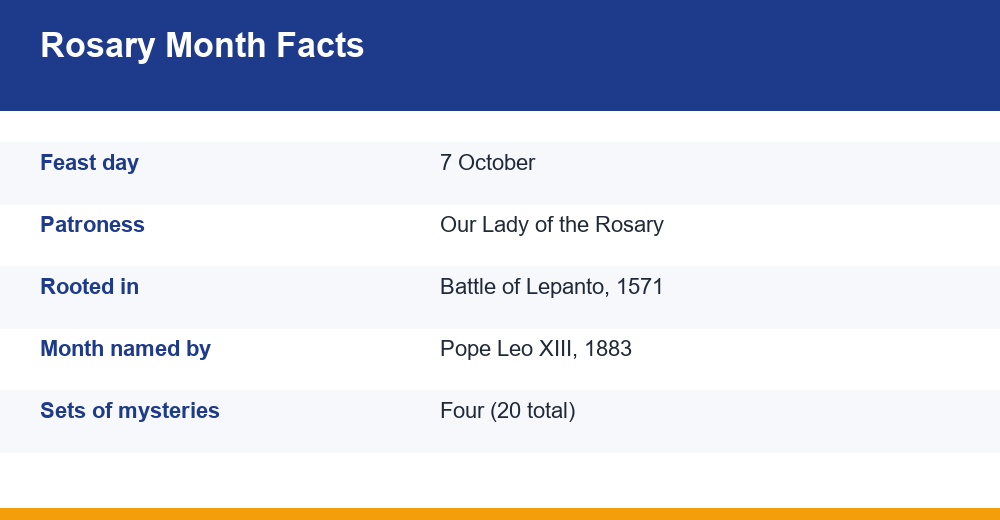
October has been set apart for the rosary for well over a century, and the custom rests on two firm pillars. The first is the Church’s liturgy, which keeps the Feast of Our Lady of the Rosary on 7 October. The second is the steady encouragement of the popes, who for generations have urged the faithful to take up this prayer throughout the autumn weeks. Feast and papal exhortation together gave the whole of October its familiar Marian character.
When we speak of the month of the rosary, then, we are naming a settled tradition of the whole Church, not a private enthusiasm. It is a yearly invitation to return to a prayer that countless believers before us have loved — a rope let down into the ordinary days of October to draw us gently back toward Christ through the hands of his Mother.
It is a modest but generous invitation. No one is asked to pray perfectly; the Church simply opens a door and points to Mary, trusting that even a few faithful minutes each day will bear fruit no one can measure.
The Feast of Our Lady of the Rosary (7 October)
The feast we now keep on 7 October began under a different name. After a decisive Christian deliverance in 1571, Pope St. Pius V — a Dominican who loved the rosary deeply — established a commemoration he called Our Lady of Victory, in thanksgiving for Mary’s intercession. It was a pope’s way of teaching the whole Church where the credit truly belonged.
The celebration soon grew. In 1573 Pope Gregory XIII gave it the enduring title Feast of the Holy Rosary, and in 1913 Pope St. Pius X fixed its date to 7 October, where it remains as an obligatory memorial in the Church’s calendar. You can explore the devotion more fully through Our Lady of the Rosary and the many titles under which the faithful honor her.
From these Roman beginnings the feast gradually spread until it belonged to the whole Church. Today it stands each 7 October as a gentle summons to gratitude, honoring Mary under the title Our Lady of the Rosary and inviting every parish to take up the beads she so often commends. It is the bright center around which the rest of October gathers.
The Battle of Lepanto and the Praying Church
The story behind the feast is among the most cherished in Catholic memory. On 7 October 1571 the fleet of the Holy League met a greatly feared Ottoman navy near the Gulf of Corinth, in the waters off Lepanto. Much of Europe believed its freedom, and even the future of the faith on the continent, hung on the outcome of that single day.
Pope Pius V had asked believers across Europe to pray the rosary and beg Our Lady’s help. As the sailors fought, rosary confraternities on land prayed their beads without ceasing. The victory that followed was received not as a triumph of arms alone but as a gift of grace, and the pope openly credited it to the intercession of the Blessed Virgin Mary.
This, of course, is only one chapter in a much longer account. To see how the prayer itself grew — from the monastic psalms to the meditative beads we hold today — it helps to know the fuller history of the rosary, a story that stretches back long before Lepanto and continues in our own hands.
Pope Leo XIII, the Rosary Pope
If one figure shaped the month of the rosary as we now keep it, it is Pope Leo XIII. Beginning with his 1883 encyclical Supremi Apostolatus Officio, he asked that the whole of October be consecrated to the Queen of the Rosary, and that the prayer be offered both in church and within the home. What had centered on a single feast day now spread across an entire month.
Leo XIII returned to this theme again and again — issuing eleven encyclicals on the rosary across his pontificate — so that he is remembered to this day as the Rosary Pope. His teaching, preserved among the papal encyclicals at the Vatican, gave October its lasting shape as a season devoted to Marian prayer for the universal Church.
His confidence was not sentimental. Leo XIII saw the rosary as a school of the Gospel and a steadying help in the troubles of his age, and he trusted that a people who prayed together each October would be strengthened in faith, family, and charity. That conviction is the reason the custom still reaches us.
Praying Through the Mysteries in October
At the heart of the rosary lie the mysteries — key events in the lives of Jesus and Mary that we hold before the eye of the heart while our lips repeat the familiar prayers. For most of the rosary’s history there were three sets. In 2002, in his apostolic letter Rosarium Virginis Mariae, Pope St. John Paul II proposed a fourth, the Luminous Mysteries, drawn from Christ’s public ministry, so the rosary might more fully become a compendium of the Gospel.
Many Catholics follow a traditional weekly pattern, letting each day carry its own set of mysteries. The table below shows the four groups, what each invites us to contemplate, and the days by custom assigned to them.
| Set of mysteries | What we contemplate | Traditional days |
|---|---|---|
| Joyful | The Incarnation and childhood of Jesus | Monday, Saturday |
| Sorrowful | The Passion and death of Christ | Tuesday, Friday |
| Glorious | The Resurrection and the glory of heaven | Wednesday, Sunday |
| Luminous | Christ’s public ministry and teaching | Thursday |
This weekly arrangement is a helpful custom rather than a binding law. You are always free to pray whichever mysteries your heart most needs on a given day, and no grace is lost by choosing differently.
To pray the mysteries is not to master a technique but to keep company with Jesus and Mary. Read the Gospel scene, picture it simply, and let one detail rest in your heart as the Hail Marys unfold. Distraction will come; when it does, return without discouragement. The rosary is patient, and so is the Lord who waits within it.
Simple Ways to Observe the Month
You need nothing elaborate to keep this holy month well. A single decade prayed with real attention is worth more than a full rosary rushed through distractedly. Here are a few gentle ways to begin, whether you are returning after years away or praying the beads for the very first time.
- Pray one decade or a full rosary each day, alone or with your family.
- Join a parish rosary before or after Mass, especially on 7 October.
- Keep your beads somewhere visible — a pocket, the car, a bedside table — as a quiet invitation.
- Pray a walking rosary, letting each step keep time with the prayers.
- Offer each day’s rosary for one intention: a loved one, the Church, or peace in the world.
If the whole rosary feels daunting, it may help to remember how simply a single decade unfolds:
- Announce the mystery and picture the scene in your imagination.
- Pray one Our Father.
- Pray ten Hail Marys slowly, resting on the mystery as you go.
- Close with the Glory Be, adding the Fatima Prayer if you wish.
Families often find a short, shared rosary easier to sustain than a long one attempted alone. Choose a time that fits the household — after supper, on the drive to school, before bed — and let consistency, rather than length, carry you through the month.
If you are just beginning, be gentle with yourself. Keep a small booklet or a trusted prayer guide nearby to recall the mysteries and the words, and do not worry if they feel unfamiliar at first. Devotion grows the way a friendship does — slowly, by simply showing up — and October is a fitting time to start.
Pious Traditions and the Promises of the Rosary
Across the centuries the rosary has gathered many beautiful devotional traditions. Among the most beloved are the fifteen promises said to be granted to those who pray the rosary faithfully, associated with St. Dominic and, later, with Blessed Alan de la Roche, who did much to spread the devotion in the fifteenth century.
These promises have encouraged real and lasting devotion, and they deserve our respect. Yet it is worth holding them clearly: they belong to pious tradition, not to the Church’s defined dogma. We receive them with gratitude and gentle discretion, as encouragements to prayer rather than guarantees to be claimed.
Other cherished customs have grown up alongside the beads. Rosary confraternities gather the faithful to pray for one another, and the First Saturday devotion, drawn from the message of Fatima, invites Confession, Communion, and the rosary on the first Saturday of five consecutive months. Like the promises, these are invitations to deeper prayer, embraced freely and never confused with binding doctrine.
The same reverent care applies to the Marian apparitions often linked with the rosary, such as Fatima, where Our Lady is remembered as asking for its daily recitation. Approved apparitions are private revelation: the faithful are free to embrace them, while the unchanging foundation of our faith remains the Gospel handed down by the Church.
The Quiet Fruit of a Faithful October
Those who faithfully keep the month of the rosary often notice something quiet taking root: a steadier peace, a softening of old resentments, a sense of Mary’s nearness in the middle of ordinary life. The repetition that can seem dull from the outside becomes, from within, a resting place for a weary and busy soul.
The rosary offers genuine spiritual consolation, and many find it a true comfort in seasons of worry or grief. It is not, however, a replacement for professional care. If you are carrying heavy anxiety or sorrow, please reach out to a trusted doctor or counselor as well — God’s grace and good human help are never rivals, but companions.
However you pray this October — a full rosary in the evening, or a single Hail Mary whispered in the dark — you join a countless company stretching across the centuries. That is the real gift of the season: not flawless devotion, but the grace of returning, again and again, to the Mother who only ever leads us to her Son.
Frequently Asked Questions
Why is October the month of the rosary?
October has been dedicated to the rosary since the nineteenth century, chiefly through Pope Leo XIII’s encyclicals beginning in 1883. October also holds the Feast of Our Lady of the Rosary on 7 October, which commemorates a Christian victory long attributed to Mary’s intercession through this prayer.
What is the Feast of Our Lady of the Rosary?
Kept on 7 October, it honors Mary under her title Queen of the Rosary. First called Our Lady of Victory by Pope St. Pius V after the Battle of Lepanto in 1571, it was renamed the Feast of the Holy Rosary in 1573 and remains an obligatory memorial today.
How often should I pray the rosary in October?
There is no obligation, only invitation. Many aim for a daily rosary, but even a single decade prayed attentively is a beautiful way to keep the month. Consistency matters more than length, so choose a rhythm you can sustain with peace rather than strain.
Are the fifteen promises of the rosary official Church teaching?
No. The fifteen promises, linked with St. Dominic and Blessed Alan de la Roche, are a cherished part of pious tradition, not defined dogma. Catholics may hold them with gratitude and devotion, while the heart of our faith rests on the Gospel handed on by the Church.