The hail holy queen meaning is simpler and deeper than many people expect: it is a cry from exiles asking their Mother to bring them home to Jesus. In Latin it is the Salve Regina, a medieval antiphon that closes the Rosary and has ended the Church’s Night Prayer for centuries. Below you will find what each line says, where the prayer came from, and why it still suits ordinary Catholics today.
Table of Contents
What Does Hail Holy Queen Mean?
Put in one sentence, the prayer greets Mary as Queen and Mother, describes our condition as exiles in a world marked by sin and sorrow, and asks her to show us Jesus when our earthly journey is over. It is not a hymn of abstract praise. It is a petition spoken from the middle of real life.
The opening word, Salve, is a Latin greeting that also carries the sense of ‘be well’ or ‘health to you.’ Regina means queen. So the first words are a respectful salute, the kind a subject offers a beloved sovereign. Yet within a few lines the tone shifts from court ceremony to the cry of a child who has lost the way home.
That movement is the key to the whole hail holy queen meaning. Mary is honoured as Queen because she is the Mother of Christ the King, and she is approached as Mother because Christ gave her to his disciples from the Cross (John 19:26-27). Royal dignity and maternal tenderness are held together, not set against each other.
The Church’s teaching supports both titles. The Catechism of the Catholic Church (n. 966), quoting the Second Vatican Council, describes Mary as exalted by the Lord as Queen over all things. Pope Pius XII’s 1954 encyclical Ad Caeli Reginam set out the doctrinal grounds for her queenship and instituted a feast in her honour, first kept on 31 May and moved in the 1969 calendar reform to 22 August, within the octave of the Assumption.
Her queenship is always a service. She reigns by interceding for the Church and by pointing to her Son, never by competing with him.
What Is the Salve Regina in Latin?
Many readers search for the Salve Regina in Latin because they hear it sung at the end of Compline, at funerals, or by religious communities. The table below sets the traditional Latin beside the familiar English used in most English-speaking parishes. The English wording follows the version published by the United States bishops on their official Hail, Holy Queen prayer page.
| Latin | English | Plain sense |
|---|---|---|
| Salve, Regina, Mater misericordiae, | Hail, holy Queen, Mother of mercy, | Greeting to Mary as Queen and merciful Mother |
| vita, dulcedo, et spes nostra, salve. | our life, our sweetness and our hope. | She leads us to Christ, our true life |
| Ad te clamamus, exsules filii Hevae. | To thee do we cry, poor banished children of Eve. | We call out as heirs of exile |
| Ad te suspiramus, gementes et flentes in hac lacrimarum valle. | To thee do we send up our sighs, mourning and weeping in this valley of tears. | Earthly life includes real grief |
| Eia ergo, advocata nostra, illos tuos misericordes oculos ad nos converte. | Turn then, most gracious advocate, thine eyes of mercy toward us, | Ask her to look on us with compassion |
| Et Iesum, benedictum fructum ventris tui, nobis post hoc exsilium ostende. | and after this our exile show unto us the blessed fruit of thy womb, Jesus. | The goal: to see Jesus in heaven |
| O clemens, O pia, O dulcis Virgo Maria. | O clement, O loving, O sweet Virgin Mary. | Three closing cries of affection |
Notice that the Latin begins and ends its first sentence with salve, a small frame of greeting. Note also the phrase benedictum fructum ventris tui, which echoes Elizabeth’s words in Luke 1:42 and links this prayer directly to the Hail Mary.
In parish use the prayer is usually followed by a versicle and response, which are not part of the antiphon itself but were attached to it in communal prayer. Most choirs use the Church Latin pronunciation common in Rome, so Iesum sounds like ‘YAY-soom’ and misericordiae like ‘mee-zeh-ree-COR-dee-ay.’
Hail Holy Queen Meaning, Line by Line
Each phrase carries its own weight. Reading them slowly is one of the best ways to pray the Salve Regina with attention rather than speed.
Mother of mercy
Mater misericordiae is the heart of the opening. Mary is not the source of mercy; God is. She is called its Mother because she bore Jesus, Mercy made flesh, and because she shares his compassion for sinners. Catholics turning to her are, in the end, being turned toward him.
Our life, our sweetness and our hope
These three titles can sound excessive at first. They make sense when read through Christ: Mary gave birth to the One who is the Life, she is sweet because grace has filled her, and she is our hope because her own glory shows what God intends for his redeemed people.
Poor banished children of Eve
This line names our inheritance. Eve, ‘mother of all the living,’ lost Eden through sin, and her children share that exile. Early Christian writers such as St Irenaeus contrasted Eve with Mary, the New Eve, whose obedience untied the knot of disobedience. Calling ourselves Eve’s banished children is a confession of need addressed to the woman who reversed Eve’s choice.
Most gracious advocate
An advocate pleads on someone’s behalf. The Catechism (n. 969) lists Advocate among Mary’s titles while stressing that this adds nothing to, and takes nothing from, the unique mediation of Christ. Asking her to turn her ‘eyes of mercy’ toward us is asking a mother to notice her struggling children.
After this our exile
Here the prayer reaches its goal. The final request is not for comfort or success but for the vision of Jesus. That is a short summary of Christian hope: the reward of faith is to see God.
O clement, O loving, O sweet
The closing triple cry is generally thought to be a later addition. A popular legend credits St Bernard of Clairvaux with adding it in Speyer Cathedral, but that story is tradition rather than documented history. Either way, it ends the antiphon with simple affection rather than argument.
Taken together, these lines show that the hail holy queen meaning moves from greeting, to lament, to petition, to longing for heaven, which is roughly the shape of every Christian life.
What Does Vale of Tears Mean?
‘Vale’ is an old English word for valley. The Latin lacrimarum valle literally means ‘valley of tears.’ The image draws on Psalm 84 (83 in the older numbering), which speaks of pilgrims passing through a dry valley, often rendered the valley of weeping, on their way to God’s house.
The phrase does not claim that life is only misery. It acknowledges honestly that sickness, death, betrayal and failure are part of every human story after the Fall. Christians are pilgrims passing through, not settlers who must pretend the road is easy.
- Realism: the prayer lets grief be spoken without embarrassment.
- Direction: a valley is something one walks through, not a final home.
- Companionship: we mourn ‘to thee,’ meaning our sorrow is addressed to someone who listens.
- Hope: the next lines point beyond the valley to the vision of Jesus.
People who are grieving often find this line the most consoling in the whole prayer, precisely because it does not hurry them past their tears.
Who Wrote the Hail Holy Queen Prayer?
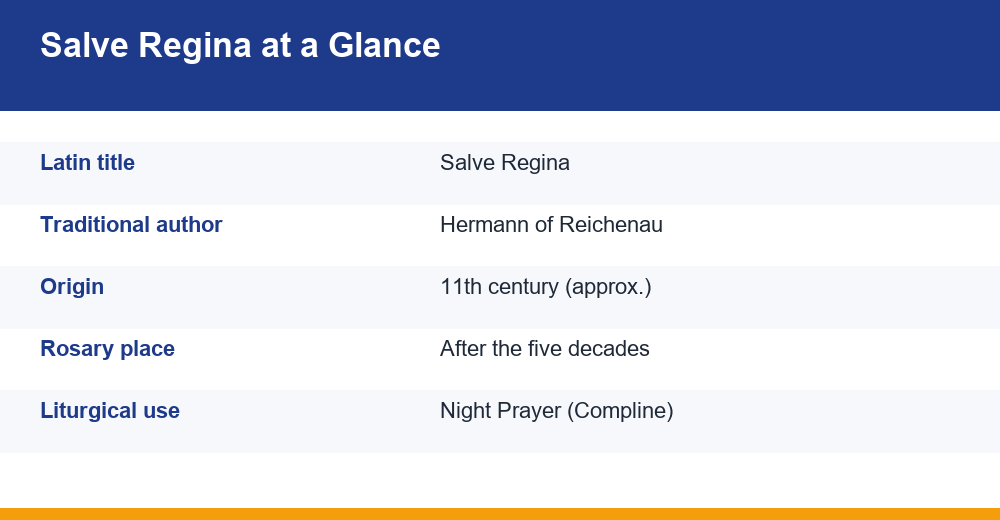
No one can say with certainty. The author most often credited is Blessed Hermann of Reichenau (1013-1054), a Benedictine monk known as Hermannus Contractus, ‘Hermann the Lame,’ because of a severe physical disability. Despite being unable to walk and barely able to speak, he became a respected scholar of mathematics, astronomy, music and history.
Older sources also name other possible authors, among them Bishop Adhemar of Le Puy and Bishop Peter of Compostela. The attribution to Hermann rests mainly on later tradition, and many modern musicologists treat the chant as anonymous. What can be said safely is that it was in use by the late 11th or early 12th century.
| Period | Development |
|---|---|
| 11th century | Antiphon composed, traditionally by Hermann of Reichenau |
| Early 13th century | Cistercians sing it regularly (dates vary by source) |
| 1220s-1230s | Dominicans begin the nightly Salve procession after Compline |
| Later Middle Ages | Becomes a standard Marian antiphon closing Compline |
| 1880s | Leo XIII includes it in the prayers after Low Mass |
| Mid-1960s | Prayers after Low Mass dropped in liturgical reform |
Dates in the table are approximate where historians disagree; for instance, accounts differ on whether the Dominican procession began around 1221 or a few years later under Blessed Jordan of Saxony. What is clear is that the prayer spread quickly through monastic communities and from them into the wider Church.
The Dominican connection matters for Rosary devotion, since the Order of Preachers did much to spread the Rosary. You can read more about that heritage in our article on Our Lady of the Rosary and her feast.
The Salve Regina at Night Prayer
The Church’s official prayer before sleep is Compline, called Night Prayer in English editions of the Liturgy of the Hours. It traditionally ends with an antiphon to the Blessed Virgin Mary, sung or said after the final blessing.
In the older Roman arrangement, four Marian antiphons rotated through the year, each tied to a season. The Salve Regina belonged to the long stretch from Trinity Sunday until Advent, roughly corresponding to today’s Ordinary Time after Pentecost.
| Antiphon | Traditional season |
|---|---|
| Alma Redemptoris Mater | Advent through the Presentation (2 February) |
| Ave Regina Caelorum | From the Presentation until Holy Week |
| Regina Caeli | Easter season |
| Salve Regina | From Trinity Sunday until Advent |
In the current Liturgy of the Hours, the Marian antiphon remains, and more freedom is allowed in choosing it, though the Regina Caeli is kept for Easter. Many communities still follow the seasonal pattern, and the Salve Regina is often the antiphon used on ordinary nights outside special seasons.
There is something fitting in ending the day this way. Night is a small image of death, and the Salve Regina asks for the grace to see Jesus ‘after this our exile.’ Prayed at bedtime, the hail holy queen meaning becomes very concrete: we entrust the night, and one day the hour of death, to Mary’s care.
Why It Ends the Rosary
In the usual Western form of the Rosary, the Hail Holy Queen is prayed after the fifth decade, followed by a versicle and response and a concluding prayer. Our guide to the Rosary prayers in order sets out the full sequence from the Sign of the Cross to the final collect.
- Finish the fifth decade with the Glory Be (and the Fatima Prayer, if used).
- Pray the Hail, Holy Queen.
- V. Pray for us, O holy Mother of God. R. That we may be made worthy of the promises of Christ.
- Pray the closing collect, ‘O God, whose only begotten Son…’, which asks that by meditating on the mysteries we may imitate what they contain and obtain what they promise.
- End with the Sign of the Cross.
Why this prayer? Partly history: it was already the Church’s beloved evening farewell to Mary when the Rosary took its familiar shape, so it was natural to use it as the closing antiphon. Partly theology: after meditating on the mysteries of Christ’s life, the soul is ready to ask for the one thing that matters most, to see Jesus face to face.
The ending also answers a common objection that the Rosary is ‘all about Mary.’ Its final petition asks Mary to show us Jesus. That is why many Catholics argue, as we do in why the Rosary still matters, that it is a thoroughly Christ-centred prayer.
Praying It Well Today
Because it is short, the Salve Regina is easy to rush. A few simple habits can help you pray it with understanding rather than habit alone.
- Pause at the commas. Each title of Mary is a separate act of trust.
- Bring a real sorrow to the ‘valley of tears’ line, naming a person or situation.
- Learn the Latin from the table above, especially if you attend sung Compline or a traditional Mass community.
- Pray it at night, alone or as a family, as a brief form of Night Prayer.
- Remember the dying. The words ‘after this our exile’ make it a fitting prayer at a sickbed or wake.
Families sometimes worry that the older English, with ‘thee’ and ‘thine,’ sounds distant to children. It can help to explain one phrase each week. Once children understand that ‘banished children of Eve’ describes all of us, the prayer stops sounding strange and starts sounding honest.
Above all, remember where the prayer is heading. The full hail holy queen meaning is fulfilled only when its final request is granted: that Mary, who once showed the infant Jesus to shepherds and Magi, will one day show him to us.
Frequently Asked Questions
What does Hail Holy Queen mean?
It is the English title of the Salve Regina, a Marian prayer that greets Mary as Queen and Mother of mercy. The prayer describes humanity as exiled children of Eve living in a valley of tears, asks Mary to look on us with compassion, and ends by asking her to show us Jesus after this earthly life is over.
Who wrote the Hail Holy Queen prayer?
Authorship is traditionally credited to Blessed Hermann of Reichenau, an 11th-century Benedictine monk called Hermannus Contractus because of his severe disability. The attribution rests largely on later tradition, other medieval bishops have also been proposed, and many musicologists regard the chant as anonymous, so Hermann is best described as the traditional rather than proven author.
Why is the Hail Holy Queen said at the end of the rosary?
By the time the Rosary took its familiar form, the Salve Regina was already a beloved closing antiphon at Night Prayer. It suits the Rosary’s ending because, after meditating on the mysteries of Christ, the prayer asks Mary for the final grace of seeing Jesus in heaven, keeping the whole devotion centred on him.
What does vale of tears mean?
Vale is an older English word for valley, so vale of tears means valley of tears, from the Latin lacrimarum valle. It describes earthly life after the Fall, with its grief and suffering, as a road pilgrims pass through. The image echoes Psalm 84 and points toward a final home with God rather than despair.