The Sorrowful Mysteries are, by common admission, the most difficult set to pray attentively. The Joyful invite warmth and the Glorious invite hope, while these ask the person praying to stay with something painful for twenty minutes without looking away. The usual result is that the decades are completed and the mind has been elsewhere for most of them. That is not a failure of devotion so much as an ordinary consequence of how attention works, and there are remedies. What follows is the scripture for each mystery, a short reflection, the traditional fruit attached to it, and some practical help for the distraction that comes with them.
Table of Contents
When the Sorrowful Mysteries are prayed
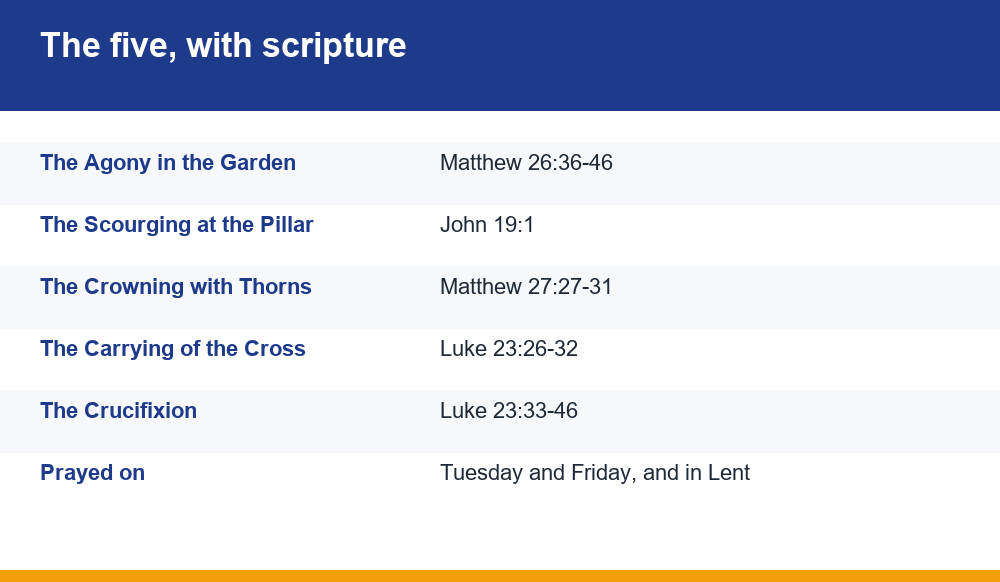
They are prayed on Tuesdays and Fridays throughout the year, and on the Sundays of Lent. Friday carries the obvious association with the Passion; Tuesday has no symbolic reason beyond the distribution of the sets across the week.
During Lent they frequently replace the Sunday set, which places them at the centre of the season rather than at its edges. Many people also return to them outside the schedule during illness, bereavement or difficulty, which is a long-standing instinct rather than an irregularity.
A note on the week
Since the Luminous Mysteries were proposed in 2002, Thursday carries those and the Sorrowful sit on Tuesday and Friday. Older books list a different arrangement, which causes occasional confusion when praying from an inherited pamphlet.
The Agony in the Garden
Matthew 26:36-46. Christ in Gethsemane, asking that the cup pass from him, and adding: not as I will, but as you will. The disciples sleep a short distance away.
What distinguishes this mystery is that nothing has yet happened. No one has struck him. The suffering is entirely anticipatory, which is a form most people recognise immediately: the night before the diagnosis, the hours before a conversation that cannot be avoided.
The detail worth sitting with is the request itself. He asks for it to be taken away. The prayer of submission that follows does not replace that asking; it comes after it, and it does not pretend the first part was not meant. That order is a considerable comfort to anyone who has felt that wanting relief is itself a failure of faith.
The Scourging at the Pillar
John 19:1, which records the event in a single sentence: Then Pilate took Jesus and had him flogged.
The brevity is striking and worth noticing. The Gospels do not dwell on the physical detail, and the devotional tradition that does so at length is an addition to them rather than a reading of them. Praying this mystery does not require constructing the scene in anatomical detail, and for many people doing so becomes an obstacle rather than an aid.
What the single verse holds is the procedural quality of it. The flogging is administered by men doing their work, under orders, without particular malice. Suffering inflicted by a system rather than by an enemy is harder to place and, for a great many people, more familiar.
The Crowning with Thorns
Matthew 27:27-31. The soldiers dress him in a scarlet cloak, press a crown of thorns onto his head, put a reed in his hand and kneel in mockery: Hail, King of the Jews.
This mystery is about humiliation rather than pain, and the two are not the same. The thorns hurt; the kneeling is designed to degrade. It is the one scene in the Passion where the cruelty is recreational rather than functional.
There is a particular bitterness in the mockery being accurate. They jeer at a claim to kingship that the Church holds to be true, and they are closer to the truth than they know. The tradition has long found in this the suggestion that contempt frequently lands on exactly what deserves honour, which is worth holding when praying for anyone who has been made small by others.
The Carrying of the Cross
Luke 23:26-32. Simon of Cyrene is compelled to carry the cross, and the women of Jerusalem weep as Christ tells them to weep instead for themselves and their children.
Simon is the figure most people find themselves attending to here. He did not volunteer; he was pressed into it while passing. The tradition has always treated him generously, because help given under compulsion is still help, and most assistance any of us gives is somewhat less freely chosen than we would like to remember.
This is also the mystery where the journey is extended deliberately. Nothing required the condemned man to carry the instrument through the streets. The distance is part of the punishment, and anyone praying through a difficulty that is simply taking a long time will recognise the specific weight of that.
The Crucifixion
Luke 23:33-46, with the words from the cross distributed across the Gospels: the forgiveness of the executioners, the promise to the thief, the cry of abandonment, and the final commendation into the Father’s hands.
Most people find the cry of abandonment the hardest line in scripture, and it is worth not moving past it quickly. It is also the opening of Psalm 22, which a listener of the time would have recognised, and that psalm ends in vindication. Both readings are held together in the tradition: genuine desolation, and a psalm that does not end there.
The promise to the thief is the other place to rest. It is made to someone with no time left to amend anything, and it is unconditional. For anyone praying for a person who died badly or late, that exchange is the single most consoling passage available in the whole of the Passion.
The fruit traditionally attached to each
Each mystery carries a virtue traditionally sought while praying it. The list varies slightly between sources, and the version below is the most widely printed.
| Mystery | Fruit |
|---|---|
| The Agony in the Garden | Sorrow for sin, conformity to God’s will |
| The Scourging at the Pillar | Purity, mortification of the senses |
| The Crowning with Thorns | Moral courage, contempt of the world |
| The Carrying of the Cross | Patience in bearing one’s own cross |
| The Crucifixion | Perseverance, and love for the dying |
These are intentions rather than instructions, and holding one in mind at the start of a decade is a simple way of giving the attention somewhere to settle. Those who find them distracting may leave them entirely; they are an aid, not a requirement.
When the words run ahead of the mind
This is the common experience with these mysteries and it is worth addressing directly rather than treating as a private failing. The decade ends, and you realise you have been thinking about tomorrow for most of it.
The traditional counsel is reassuringly undramatic: notice it and return, without recrimination. The returning is the prayer. A rosary made up largely of returning is not a poor rosary, and treating each distraction as a fault simply adds a second distraction to the first.
- Read the scripture passage aloud before beginning the decade
- Hold one short phrase, a single line, through the ten
- Pray more slowly than feels natural; speed drives distraction
- Use the beads deliberately, since the hands help the mind
- If the whole rosary is beyond you today, pray one decade well
We set out the broader approach to this in our notes on the Luminous Mysteries, where the same difficulty arises in a gentler key.
Praying them while suffering
People reach for the Sorrowful Mysteries most often when something is wrong, and the experience is different from praying them on an ordinary Tuesday.
Two things are worth saying. The first is that these mysteries do not explain suffering and were never intended to. They place a person beside someone who suffered, which is a different kind of help and frequently the only one that reaches anybody in the middle of it.
The second is that it is entirely permissible to pray them badly at such times: distracted, angry, or barely at all. Christ in Gethsemane asked for the cup to be removed before he accepted it, and nothing in the tradition requires a person to arrive at acceptance faster than he did.
For anyone sitting with someone who is ill or dying, the fifth mystery is the one most often returned to, and the promise to the thief is the sentence most worth carrying into that room.
Praying them with children
Families reach the Sorrowful Mysteries and hesitate, reasonably, over how much to say. The scenes are violent and children ask direct questions.
The approach most parents settle on is to stay with what the Gospels actually say, which as noted above is remarkably restrained. The single verse on the scourging says what happened and no more. Children are generally better served by that brevity than by the elaborated descriptions found in some devotional material.
It also helps to name what each mystery is about in one phrase before beginning: being afraid, being mocked, being helped by a stranger, being with someone as they die. Children follow those categories readily, and they are closer to what the mysteries are for than a catalogue of injuries.
A shortened form is perfectly acceptable. One decade, prayed attentively, with a sentence of explanation beforehand, is better formation than five decades endured. The full rosary can wait; the habit is what is being built.
Where a child is grieving, the fifth mystery tends to arrive differently, and many parents find it carries the conversation better than an explanation would. That is, in the end, what these mysteries have always been for.
One practical note on where to pray them. The Sorrowful Mysteries ask more of the attention than the other sets, which makes the setting matter more than usual. A quiet room, or a church, or a walk alone will all sustain them better than a crowded kitchen with a phone within reach.
Many people also find a physical crucifix or a single image helpful here in a way they do not with the Joyful Mysteries, because it gives the eyes somewhere to rest and keeps the mind from drifting into the day ahead. The beads themselves do a great deal of this work, which is part of why the devotion has survived in the form it has.
And if you arrive at the end having been absent for most of it, pray them again tomorrow. The tradition has never suggested that a distracted rosary is wasted, only that it is ordinary.
Frequently Asked Questions
When are the Sorrowful Mysteries prayed?
On Tuesdays and Fridays throughout the year, and on the Sundays of Lent. Friday carries the association with the Passion. Older pamphlets printed before the Luminous Mysteries were proposed in 2002 show a different weekly arrangement, which causes some confusion.
What are the five Sorrowful Mysteries?
The Agony in the Garden, the Scourging at the Pillar, the Crowning with Thorns, the Carrying of the Cross, and the Crucifixion. Each has a scripture passage and a traditional fruit or virtue sought while praying it.
Why are these mysteries harder to pray?
Because they ask the person praying to stay with something painful rather than something consoling, and attention naturally moves away from distress. Distraction here is ordinary rather than a failure, and the counsel is to notice it and return without recrimination.
What is the fruit of the Carrying of the Cross?
Patience in bearing one’s own cross. The figure of Simon of Cyrene is central to how this mystery is usually prayed, because he was compelled rather than volunteering, and help given under compulsion is still treated by the tradition as help.
Can I pray them outside Tuesday and Friday?
Yes. Many people return to them during illness, bereavement or difficulty regardless of the day, and this is a long-standing practice rather than an irregularity. The weekly scheme is an ordering of the devotion, not a restriction on it.