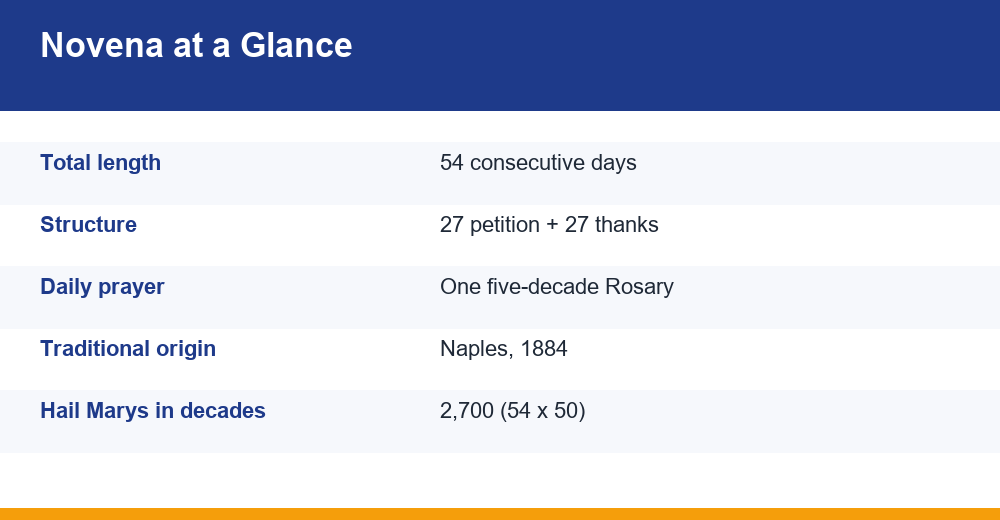
The 54 day rosary novena is a commitment to pray one five-decade Rosary every day for 54 days: 27 days asking for a particular grace, then 27 days giving thanks. This guide covers the daily structure, the order of the mysteries, what to do about the Luminous Mysteries and missed days, and includes a tracker you can copy. It makes no promise of guaranteed results, because no honest guide can.
Table of Contents
What Is the 54 Day Rosary Novena?
A novena is nine days of prayer. The word comes from the Latin novem, meaning nine, and recalls the disciples praying with Mary between the Ascension and Pentecost. The 54-day form puts six of these novenas back to back, and each day’s prayer is a full Rosary of five decades.
The six novenas fall into two halves:
- Petition (days 1-27): three novenas in which you ask for one specific intention.
- Thanksgiving (days 28-54): three novenas in which you give thanks, whether or not the request seems to have been answered yet.
The second half is what sets this devotion apart. Most novenas end once the request has been made. Here you spend just as long thanking God as you spent asking, so the prayer is less about getting a result and more about trust. Many people find the thanksgiving weeks harder than the first 27 days, and also more rewarding.
In total you pray 54 Rosaries, which comes to 270 decades and 2,700 Hail Marys within the decades. At an unhurried pace a single Rosary takes roughly 15 to 20 minutes, so you are committing to about a quarter of an hour a day for close to eight weeks.
What Is the Origin of the 54 Day Rosary Novena?
The devotion traces back to Naples in 1884. Tradition tells of Fortuna Agrelli (also given as Fortunata or Fortunatina), a young woman who had been gravely ill for more than a year. Her doctors had given up hope of a cure.
Many accounts say her family began a novena of Rosaries on 16 February 1884. The story continues that Our Lady of the Rosary appeared to her, most often dated to 3 March of the same year, and Fortuna was later healed. She was told that anyone who wanted favours should pray three novenas of the Rosary in petition and three in thanksgiving. That instruction is where the 54-day pattern comes from.
Accounts link the event to Our Lady of the Rosary of Pompeii, whose shrine was founded by Bartolo Longo. He was a former occultist who returned to the faith through the Rosary. He was beatified by Pope John Paul II in 1980 and canonised by Pope Leo XIV on 19 October 2025. Pope Leo visited Pompeii on 8 May 2026, the first anniversary of his election, and prayed at the chapel holding the new saint’s relics.
How much weight should the story carry?
Sources disagree on details such as the spelling of Fortuna’s name and the exact dates, and there is no independent historical record of the apparition. The Agrelli story is a pious tradition, not Church doctrine. Catholics are free to find it inspiring. Nobody has to believe it in order to pray the novena, and the Rosary itself rests on the Church’s teaching, not on this one account.
How to Pray It, Step by Step
You don’t need special prayers to pray the 54 day rosary novena well. What matters is a clear intention and the commitment to keep going every day. Here is a simple routine:
- Choose one intention and keep it the same for all 54 days. Write it down so it doesn’t drift.
- Pick your start date and work out day 27 and day 54 ahead of time (the tracker below shows how).
- Begin each day with the Sign of the Cross. Then say a short offering, for example: “Blessed Mother, I offer this Rosary in petition for [intention].” From day 28, change it to an offering in thanksgiving.
- Pray the full Rosary: the Apostles’ Creed, Our Father, three Hail Marys and Glory Be, then five decades with their mysteries.
- Close with the Hail, Holy Queen and any concluding prayer you usually use.
- Mark the day on your tracker.
Devotional booklets in print since the 1920s include longer petition and thanksgiving prayers, many of which describe each Rosary as a spiritual bouquet of roses offered to Mary. They are good to use, but they are optional. The Rosary prayed with attention is the heart of the novena.
Praying with others
Families, parish groups and prayer chains often pray it together, sometimes each for their own intention and sometimes for one shared intention. Agree on the start date and the mystery rotation before you begin so everyone stays on the same day.
Which Mysteries to Pray in the 54 Day Rosary Novena
The traditional method doesn’t follow the days of the week. You cycle through three sets of mysteries in order: Joyful, Sorrowful, Glorious, then start again. Since 54 divides evenly by three, the cycle runs exactly 18 times. Every nine-day novena holds three full cycles, so each novena ends on the Glorious Mysteries.
| Day in cycle | Mysteries | Days in the novena | Focus |
|---|---|---|---|
| 1st | Joyful | 1, 4, 7 … 52 | Annunciation to Finding in the Temple |
| 2nd | Sorrowful | 2, 5, 8 … 53 | Agony in the Garden to Crucifixion |
| 3rd | Glorious | 3, 6, 9 … 54 | Resurrection to Coronation of Mary |
A simple test: divide the day number by three. No remainder means Glorious, a remainder of one means Joyful, and a remainder of two means Sorrowful. On day 27, the last day of petition, you pray the Glorious Mysteries. Day 28, the first day of thanksgiving, starts again with the Joyful.
Can you use the weekday schedule instead?
Yes. Some people find it easier to follow the Church’s usual weekly pattern of mysteries, especially if they already pray that way. In Rosarium Virginis Mariae, Pope John Paul II presented that schedule as a guide that is not meant to limit a rightful freedom in personal prayer. If you go this way, our guide to the rosary mysteries by day sets out the full weekly pattern. Pick one method at the start and stay with it.
Should You Include the Luminous Mysteries?
This is the question people ask most often, and it has a clear history behind it. In October 2002, Pope John Paul II’s apostolic letter Rosarium Virginis Mariae proposed the Mysteries of Light: the Baptism of Jesus, the Wedding at Cana, the Proclamation of the Kingdom, the Transfiguration and the Institution of the Eucharist. He suggested praying them on Thursdays.
The 54 day rosary novena is more than a century older than that letter, so its original form has only the Joyful, Sorrowful and Glorious Mysteries. That is why so many guides leave the Luminous Mysteries out of the three-day rotation. Leaving them out is a matter of history, not a judgement on their value.
The full list of the twenty mysteries, grouped into four series, is on the Holy See’s page on the Mysteries of the Rosary. Catholics in practice handle the question in one of three ways:
- Traditional rotation: Joyful, Sorrowful, Glorious only. This is the most common choice and keeps the neat 18-cycle pattern.
- Extra Rosary on Thursdays: keep the traditional rotation and add a separate Luminous Rosary on Thursdays as an additional offering.
- Weekday schedule: follow the weekly pattern, which includes the Luminous Mysteries on Thursdays.
None of these is wrong. The Church sets no rule for private novenas, so choose the option that helps you pray with attention and that you can keep up for eight weeks.
What If You Miss a Day?
Illness, travel, a newborn or plain forgetting can break a streak. Start with the most important point. A novena is a private devotion, so missing a day is not a sin and the Church attaches no penalty to it. God is not counting beads against you.
Still, the 54-day form is built on perseverance. Faithful Catholics usually respond in one of three ways:
| Approach | What you do | Best for |
|---|---|---|
| Make it up | Pray the missed Rosary as soon as you can, ideally the same or next day, alongside that day’s Rosary | An isolated, unavoidable lapse |
| Start again | Return to day 1 and begin the 54 days afresh | Those who want the strict traditional form, or after several missed days |
| Continue and offer it | Carry on without restarting and offer the gap to God with humility | Serious illness or circumstances beyond your control |
A common piece of pastoral advice is to make up a single missed day and save a full restart for a real collapse of the commitment. If a novena keeps falling apart, the problem is usually the routine, not your devotion. Our guide to building a daily rosary habit covers fixed times, linking prayer to an existing routine and praying while commuting, all of which help you stay consistent.
Practical safeguards
- Pray at the same time every day, for example straight after breakfast or before bed.
- Keep a rosary in your bag or car for days when your routine is disrupted.
- Split the Rosary into decades across the day if one sitting isn’t possible.
- Use the tracker and tick each day as soon as you finish.
A Printable 54-Day Tracker
Copy or print the table below and fill in the dates once you pick a start day. To find any date, add (day number minus one) to your start date. For example, starting on 1 November 2026 puts day 27 on 27 November, day 28 on 28 November and day 54 on 24 December. That makes a quiet run of prayer up to Christmas Eve.
| Novena | Days | Purpose | Mystery cycles | Date range | Done |
|---|---|---|---|---|---|
| 1 | 1-9 | Petition | Joyful, Sorrowful, Glorious x3 | ____ to ____ | [ ] |
| 2 | 10-18 | Petition | Joyful, Sorrowful, Glorious x3 | ____ to ____ | [ ] |
| 3 | 19-27 | Petition | Joyful, Sorrowful, Glorious x3 | ____ to ____ | [ ] |
| 4 | 28-36 | Thanksgiving | Joyful, Sorrowful, Glorious x3 | ____ to ____ | [ ] |
| 5 | 37-45 | Thanksgiving | Joyful, Sorrowful, Glorious x3 | ____ to ____ | [ ] |
| 6 | 46-54 | Thanksgiving | Joyful, Sorrowful, Glorious x3 | ____ to ____ | [ ] |
Start dates with a liturgical fit
Some start dates line up with the Church’s calendar. If you start on Ash Wednesday, day 54 always lands on Divine Mercy Sunday, because Easter Sunday is 46 days after Ash Wednesday and the Second Sunday of Easter is a week later. In 2027 that means 10 February to 4 April. Other people time the 54 day rosary novena so it finishes on a Marian feast such as 7 October, Our Lady of the Rosary, or 8 December, the Immaculate Conception. To finish on a chosen date, count 53 days back from it to find your start.
Keeping the Right Perspective
Many pages call this the “irresistible” or “miracle” novena and suggest that finishing it guarantees results. That isn’t Catholic teaching. Prayer is not a transaction or a formula. The Church teaches that God hears every prayer and answers in the way that is best for our salvation. Sometimes the answer is yes, sometimes it is wait, and sometimes it is a different gift from the one we asked for.
This is why the thanksgiving half matters so much. Giving thanks for 27 days before you know the outcome teaches trust, which is the grace the devotion is really meant to build. People who finish it often say the biggest change was in how they bore the situation, not in the situation itself.
Traditional lists such as the 15 promises of the Rosary belong to the same category of private revelation as the Agrelli story. They can encourage faithful prayer, but they shouldn’t be treated as contracts. Pray the novena for the intention on your heart, alongside the sacraments, especially Confession and the Eucharist, and leave the outcome to God.
- Pray for one sincere intention, not a list of demands.
- Keep thanking God even if nothing seems to change.
- Pair the novena with charity: the Rosary should make us more generous, not only more hopeful.
- When the 54 days are over, think about keeping a daily Rosary going.
Frequently Asked Questions
How do you pray the 54 day rosary novena?
Pray one five-decade Rosary every day for 54 days in a row. For the first 27 days, offer each Rosary in petition for one specific intention. For the last 27 days, offer it in thanksgiving, whether or not the prayer seems to have been answered yet. A short opening offering each day and a tracker help you stay on course.
What mysteries do you pray in the 54 day novena?
The traditional method rotates three sets in order: Joyful on day 1, Sorrowful on day 2, Glorious on day 3, then repeats. Because 54 divides evenly by three, the cycle runs 18 times and every nine-day novena ends on the Glorious Mysteries. Some people follow the weekday schedule instead, which is also acceptable.
Do you include the Luminous Mysteries in the 54 day novena?
Traditionally, no. The novena dates from 1884, and the Luminous Mysteries were proposed by Pope John Paul II in 2002, so the original rotation uses only the Joyful, Sorrowful and Glorious. You may add a separate Luminous Rosary on Thursdays or follow the weekday schedule. The Church sets no rule either way.
What happens if you miss a day of the 54 day novena?
Nothing sinful happens, because a novena is a private devotion. Most people make up a single missed day by praying an extra Rosary as soon as they can. Others prefer to start again from day one, especially after several missed days. If illness interrupts you, you can carry on and offer the gap to God.