Ask around a parish and you will get two answers about gambling, both delivered with confidence. One is that the Church forbids it. The other is that the Church does not really mind, since the parish itself runs a raffle every autumn.
Neither is what the Catechism says. The actual passage is three or four sentences long, sits among the paragraphs on the seventh commandment, and refuses both the blanket prohibition and the easy permission. It is also more demanding than either, because it moves the question somewhere most people are not expecting.
The passage itself
Paragraph 2413 begins by saying that games of chance and wagers are not in themselves contrary to justice. That is a carefully limited statement rather than an endorsement, and the limitation is doing deliberate work.
The sentence that follows carries the weight: such games become morally unacceptable when they deprive someone of what is necessary to provide for his needs and those of others. The paragraph then adds that the passion for gambling risks becoming an enslavement, and that unfair wagers and cheating at games are grave matter unless the harm done is genuinely slight. The whole of paragraph 2413 sits in the Catechism’s section on respect for the goods of others, and it takes under a minute to read in its own words, which is worth doing before accepting anyone’s summary of it, this one included.
Notice what is absent. There is no language of vulgarity or unseemliness, no suggestion that wagering is beneath a Christian. The Church is not expressing distaste. It is applying a principle about property and obligation that runs through that entire section of the Catechism, and the restraint of the wording is the point rather than an oversight.
Why it turns on justice
Most moral questions about gambling get asked in the wrong form. The common question is whether the activity is sinful. The question the Catechism answers is different: what does this particular act do to the obligations the person is already carrying?
That shift explains why a small stake among friends and a sustained habit funded from household money are not the same act in different sizes. They differ in kind. The first takes nothing from anyone with a prior claim on it. The second does, and the amount is nearly beside the point.
It also makes the test unusually concrete, and unusually uncomfortable. Before the question of whether a wager was wise comes the question of whether the rent, the school fees, the medicine and the food were secure without it. If they were not, the failure of justice occurred at the moment the stake was placed, and a win afterwards does not reach back and alter it. That is one of the few places where the teaching is stricter than almost every summary of it.
The word the Catechism chooses
Enslavement is a strong word and it was not chosen loosely. It belongs to the discussion of freedom rather than of recreation, and it points at the loss of the very thing that makes an act a moral act at all.
Pastorally this changes what is called for. Somebody whose freedom has been diminished is not in the same position as somebody making an unwise but free decision, and treating the two alike helps neither. The first needs help; the second might benefit from an argument. Telling them apart is usually the most useful thing anyone nearby can do, and the signs are not subtle once you are looking: stakes rising to chase a loss rather than by choice, concealment from the household, borrowing to continue, and relief instead of enjoyment when the game is on.
What the example in the text assumes
The Catechism offers card games as its illustration, and that example quietly carries a whole world with it. A card game had a beginning and an end. It happened among people who could see each other’s faces. Somebody had to leave the house, or at least open the door. The stakes were whatever was in a pocket.
None of those limits survives on a phone, and every one of them was load-bearing. Colour-prediction and instant-round platforms such as bdggameloging.com compress stake, result and next stake into well under a minute, available at three in the morning, funded by a transfer that clears in seconds, with nobody present to notice. The moral principle has not altered in the slightest. What has altered is how quickly a person travels from the first sentence of 2413 to the third.
A weekly game leaves room for reflection between occasions. A game with a round every thirty seconds does not, and is not designed to. For anyone examining their own habits, or worried about someone else’s, frequency turns out to be a far more revealing measure than amount, because the amount tends to follow the frequency rather than the other way round.
The raffle question
Which brings us back to the parish fundraiser and the apparent contradiction, which dissolves once the actual teaching is read rather than the assumed one. Since games of chance are not condemned in themselves, a raffle is not condemned either, and the same conditions apply to it as to anything else.
Those conditions do real work here. A ticket bought from money the person can freely spare, at a price small enough that losing it changes nothing, with the purpose stated plainly and the proceeds going where they were said to go, satisfies every element of the passage. The usual parish practice of a low fixed price and a published cause is not merely convention; it is the teaching applied without anyone having to think about it.
Two failures are worth naming because both occur. A raffle that is socially difficult to decline begins taking from people who would not otherwise have given. And vagueness about where the money goes falls under the same heading as any unfair wager, since the participant is agreeing to terms that are not the real ones. Neither failure has anything to do with chance. Both are about justice and truthfulness, which is exactly consistent with the rest of that section.
Where this leaves a family
Most people who go looking for the Church’s position on this are not settling a theological question. They are worried about somebody, and they have usually exhausted the arguments long before they start reading.
The teaching offers them something a blanket condemnation could not. Because it locates the wrong in injustice and in lost freedom rather than in the act itself, it leaves room to approach a person without first having to condemn them. That room is usually where anything helpful actually happens.
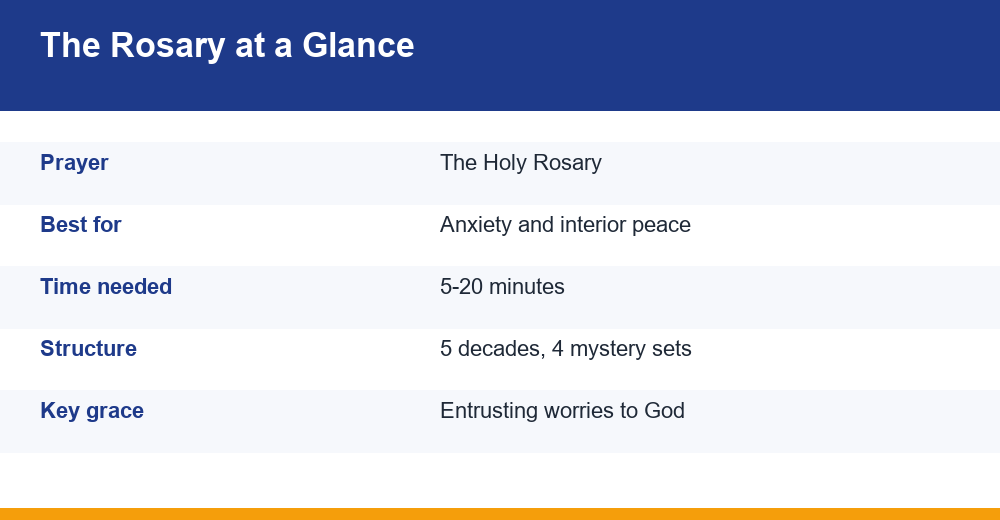
What remains after the arguments is prayer and patience, and a long intention suits this better than an urgent one, because the difficulty is rarely resolved quickly. Much of what we set out about the rosary for peace in anxious times applies here unchanged, since the household living alongside this is usually carrying the same strain as the person at the centre of it.