A rosary plenary indulgence is one of the most accessible plenary indulgences the Church offers, yet most explanations stay vague about where you have to pray, how much of the Rosary counts, and what the conditions really require. This guide walks through the official norm in the Enchiridion Indulgentiarum, answers the common questions, and ends with a simple checklist a family can follow on an ordinary evening.
Table of Contents
What the Rosary Plenary Indulgence Grants
An indulgence is not forgiveness of sin. Sin is forgiven in the sacrament of Penance. An indulgence is the remission before God of the temporal punishment still due to sins whose guilt has already been forgiven. The Church grants it from the treasury of the merits of Christ and the saints, as the Catechism (n. 1471) and Pope Paul VI’s 1967 apostolic constitution Indulgentiarum Doctrina explain.
A partial indulgence removes part of that punishment. A plenary indulgence removes all of it. That is why the Church attaches demanding conditions to a plenary one, while a partial indulgence asks only a contrite heart and the prescribed work.
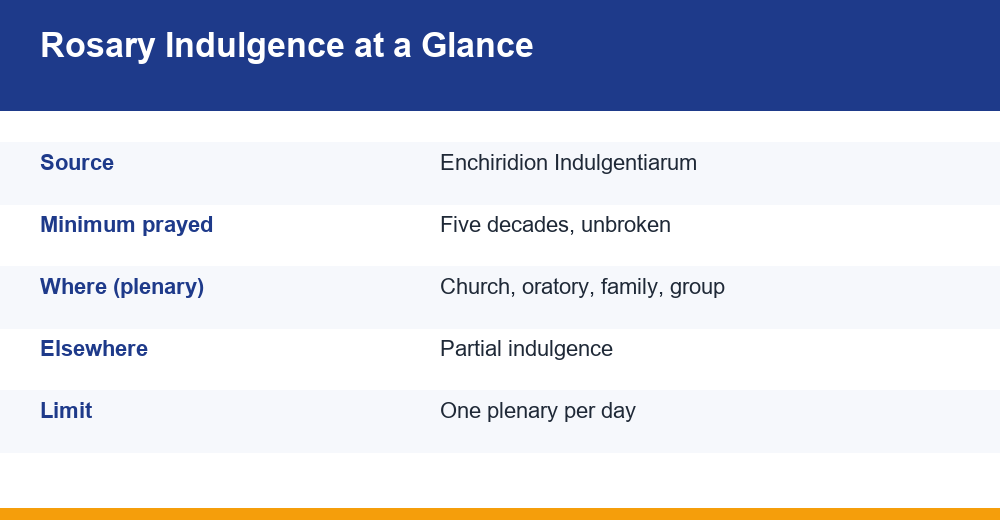
The current norms are found in the Enchiridion Indulgentiarum, the official handbook of indulgences issued by the Apostolic Penitentiary. Its fourth Latin edition appeared in 1999, and the approved English translation, the Manual of Indulgences, was published by the USCCB in 2006. The Rosary appears there among the grants for Marian prayer; in the older 1968 edition it was listed as number 48, which is why some articles still cite that number.
In plain terms, the grant says this: a plenary indulgence is granted to the faithful who devoutly recite the Marian Rosary in a church or oratory, or in a family, a religious community or a pious association. In all other circumstances, the same prayer earns a partial indulgence.
Nothing in the norm suggests that the indulgence is a reward for counting prayers. The Church attaches it to the Rosary because the Rosary is a summary of the Gospel, prayed with Mary, and because praying it together builds up families and parishes.
Can You Gain a Plenary Indulgence by Praying the Rosary?
Yes. The Rosary is one of a small number of everyday works to which the Church attaches a plenary indulgence on any day of the year, alongside adoration of the Blessed Sacrament for at least half an hour, reading Scripture for at least half an hour, and making the Way of the Cross. What sets the rosary plenary indulgence apart is that the setting matters as much as the prayer itself.
The norm names specific places and groups. Where the Rosary is prayed in one of them, a plenary indulgence is possible; anywhere else, the grant is partial. The table below summarises how this works in practice.
| Setting | Indulgence | Notes |
|---|---|---|
| Parish church or chapel | Plenary | Alone or with others |
| Oratory | Plenary | A place set aside for worship, e.g. a school or hospital chapel |
| Family praying together | Plenary | At home, in the car, anywhere the family gathers to pray |
| Religious community | Plenary | Convent, monastery, seminary house |
| Pious association | Plenary | Rosary group, Legion of Mary, parish prayer circle |
| Joining the Pope’s recitation broadcast live on radio or television | Plenary | The Manual extends the grant to those who devoutly unite themselves to it |
| Alone at home, on a walk, in the car | Partial | Still a real and valuable grace |
Notice what the list does not say. It does not require a priest to lead the prayer, a particular time of day, or a minimum number of people beyond what makes a family or group what it is. That simplicity is what makes a rosary plenary indulgence realistic for ordinary households. A husband and wife praying together, or a parent with one child, are praying as a family.
A note on chapels: a church or public oratory clearly qualifies. If you are unsure whether a particular chapel counts, for example one inside a private institution, your parish priest can tell you how it is designated.
Praying the Rosary Alone at Home
This is the question people ask most often. If you pray the Rosary alone at home, the norm grants a partial indulgence, not a plenary one. The plenary grant is tied to the church, the oratory, or the communal settings listed above.
That should not discourage anyone. A partial indulgence is a genuine gift, and the Rosary prayed alone remains, as Saint John Paul II wrote in Rosarium Virginis Mariae, a way of contemplating the face of Christ in the company of Mary. The indulgence is a help, not the reason for the prayer.
Practical ways to qualify for the plenary grant
- Pray your Rosary in a church before or after Mass, or during a visit to a chapel with the Blessed Sacrament.
- Invite another member of your household to pray with you; even two people praying together as a family qualify.
- Join a parish Rosary group or a recognised Marian association that meets in person.
- Unite yourself devoutly to a Rosary led by the Holy Father when it is broadcast live on radio or television.
People who are housebound through illness or age, and who cannot fulfil the usual work, may ask their confessor about commuting the work or the conditions. The norms allow confessors to make such adjustments for those legitimately impeded, so it is worth asking rather than assuming the door is closed.
How Many Decades Are Needed?
For the indulgence, five decades are enough. You do not need to pray all twenty mysteries, nor all fifteen of the traditional cycle. One set of mysteries, such as the Joyful, Sorrowful, Glorious or Luminous, fulfils the requirement for a rosary plenary indulgence.
The Manual adds three specific requirements that many articles leave out:
- No interruption. The five decades must be prayed continuously. A brief unavoidable pause is human; splitting the decades between morning and evening does not meet the norm.
- Meditation on the mysteries. The vocal prayer must be joined to devout meditation on the mysteries. Reciting Hail Marys while the mind is deliberately elsewhere is not what the Church asks.
- Announcing the mysteries in public. When the Rosary is prayed publicly, the mysteries are to be announced according to approved local custom. In private recitation, it is enough to add meditation on the mysteries to the vocal prayer.
If you are unsure of the structure, our guide to the rosary prayers in order lists each prayer from the Sign of the Cross to the Hail Holy Queen. The Luminous Mysteries, proposed by Saint John Paul II in 2002, are optional; praying them is fully in keeping with the grant.
| Day | Usual mysteries |
|---|---|
| Monday and Saturday | Joyful |
| Tuesday and Friday | Sorrowful |
| Wednesday and Sunday | Glorious |
| Thursday | Luminous |
This weekly pattern, suggested in Rosarium Virginis Mariae, is a custom rather than a condition. Any one set of five mysteries satisfies the norm on any day.
The 4 Usual Conditions for a Plenary Indulgence
Every plenary indulgence, the Rosary included, requires the prescribed work plus what the Church calls the usual conditions. They are the same whether the work is the Rosary, Eucharistic adoration or a visit to a cemetery in early November.
| Condition | What it means | Timing |
|---|---|---|
| 1. Sacramental confession | A good confession in the sacrament of Penance | Several days (about 20) before or after the work |
| 2. Holy Communion | Receiving the Eucharist worthily | Ideally the same day; one Communion per plenary indulgence |
| 3. Prayer for the Pope’s intentions | Any prayer; an Our Father and Hail Mary is the usual suggestion | Ideally the same day; once per plenary indulgence |
| 4. Detachment from all sin | No attachment to any sin, even venial | At the time the work is completed |
The Apostolic Penitentiary’s 2000 note on the gift of the indulgence explains that one sacramental confession can serve for several plenary indulgences, but each one needs its own Communion and its own prayer for the Holy Father’s intentions. The full text is available on the Vatican website.
Why the fourth condition matters
Detachment from sin is the condition people find hardest to judge. It means the will is not clinging to any sin, not that you never fall. If this disposition is lacking, or any other condition is not fulfilled, the indulgence becomes partial rather than plenary. That is not a failure; it is an invitation to keep praying for a freer heart.
General requirements behind the conditions
- You must be baptised and not excommunicated.
- You must be in the state of grace, at least when the work is completed.
- You should have at least a general intention to gain indulgences; many Catholics make this intention once in their morning offering.
- A plenary indulgence can be gained only once a day, except at the hour of death. Partial indulgences can be gained several times a day.
Offering a Rosary Indulgence for the Dead
Yes, you can. Canon 994 of the Code of Canon Law states that the faithful can gain partial or plenary indulgences for themselves or apply them to the dead by way of suffrage. This means you offer the indulgence to God on behalf of a soul in purgatory, trusting it to his mercy.
What you cannot do is apply an indulgence to another living person. Someone on earth must gain their own. So a rosary plenary indulgence may be offered for a grandparent who has died, but not transferred to a sick friend, for whom the Rosary is of course still a powerful prayer of intercession.
Families often make this part of their November devotions, when the Church remembers the faithful departed. For prayer ideas and intentions, see our page on the rosary for the dead, which includes the Eternal Rest prayer and suggestions for each mystery.
- Make the intention before you begin: “I offer this indulgence for the soul of N.”
- Fulfil the work and the usual conditions as normal.
- Leave the outcome to God; the Church does not claim to know how he applies a suffrage to a particular soul.
A Family-Friendly Checklist
Praying together at home is the easiest way most households can seek the plenary grant regularly. If you are just starting, our guide to praying the rosary as a family covers how to involve young children and keep the prayer peaceful. The checklist below turns the norm into steps you can follow on any evening.
- Intention: Before starting, someone says aloud for whom the family offers the indulgence, for yourselves or for a deceased person.
- Gather together: At least two household members praying as a family.
- Choose the mysteries: One set of five, usually the set assigned to that day of the week.
- Announce each mystery: The leader names it, perhaps with a short Scripture verse to focus meditation.
- Pray without stopping: All five decades in one sitting.
- Pray for the Pope: End with an Our Father and Hail Mary for the Holy Father’s intentions.
- Plan the sacraments: Note when the family last went to confession and plan Communion at the next Mass.
Children who have not yet made their First Communion can still pray and, once they have reached the use of reason, gain partial indulgences. For parents, the evening Rosary offers a regular chance at a rosary plenary indulgence while teaching children that prayer is part of family life.
Keep it realistic. Twenty minutes on a weeknight is plenty, and a family that prays one set of mysteries peacefully does more good than one that rushes through extra decades out of anxiety.
Common Misunderstandings to Avoid
Because the topic is surrounded by half-remembered rules, a few misconceptions come up again and again. Clearing them up helps people pray with confidence rather than anxiety.
- “A blessed rosary is required.” It is not required for the plenary grant. Devoutly using a rosary blessed by a priest carries its own partial indulgence, as the Manual notes for blessed religious objects.
- “You need all twenty mysteries.” Five decades prayed without interruption are sufficient.
- “Counting on fingers doesn’t count.” The current norm speaks of reciting and meditating on the Rosary; it does not lay down a requirement about the beads themselves.
- “Confession must be the same day.” The Apostolic Penitentiary allows several days, about twenty, before or after.
- “Indulgences can be bought or earned automatically.” They cannot be sold, and they depend on interior disposition, not mechanical repetition.
- “Praying alone gives nothing.” It earns a partial indulgence and, more importantly, draws the soul closer to Christ through Mary.
Finally, remember the order of things. The Church offers indulgences to encourage conversion and charity, not to replace them. A Rosary prayed with love, even imperfectly, is never wasted, whatever the indulgence attached to it.
Frequently Asked Questions
Can you get a plenary indulgence by praying the rosary?
Yes. The Enchiridion Indulgentiarum grants a plenary indulgence for devoutly reciting the Marian Rosary in a church or oratory, or in a family, religious community or pious association. You must also fulfil the usual conditions: sacramental confession, Holy Communion, prayer for the Pope’s intentions, and detachment from all sin. In other settings the grant is partial.
Do you get an indulgence praying the rosary alone at home?
Praying the Rosary alone at home earns a partial indulgence, not a plenary one. To seek the plenary grant, pray in a church or oratory, with members of your family, or with a recognised group. Housebound people who cannot do this may ask a confessor, who can commute the work or conditions for those legitimately impeded.
How many decades are needed for a rosary indulgence?
Five decades are sufficient, prayed continuously without interruption. One set of mysteries, Joyful, Sorrowful, Glorious or Luminous, meets the requirement. The vocal prayer must be joined to devout meditation on the mysteries, and when the Rosary is prayed publicly, each mystery should be announced according to approved local custom.
Can you offer a rosary indulgence for the dead?
Yes. Canon 994 of the Code of Canon Law allows the faithful to apply partial or plenary indulgences to the dead by way of suffrage. Make the intention before praying and fulfil the usual conditions. Indulgences cannot be applied to other living persons, though you can always pray the Rosary for their needs.