When the world feels loud and your own thoughts will not settle, the rosary for peace offers something rare: a quiet place to rest your heart in God. It is an ancient, unhurried prayer that lets you hand your worries to Christ through the hands of his Mother, one bead at a time. This guide will show you how that steady rhythm can become a source of hope and interior calm, whatever storm you are facing.
Table of Contents
Why the Rosary Calms an Anxious Heart
Anxiety thrives on speed. It races ahead into tomorrow, replays yesterday, and rarely lets us stand still in the present moment. The Rosary works in the opposite direction. Its slow, familiar pattern gently pulls a scattered mind back to one thing at a time.
Saint John Paul II, who cherished this prayer, encouraged an unhurried, contemplative pace rather than a rushed recital. That calm cadence is not mindless repetition. It is closer to the rhythm of waves, or a mother’s lullaby, a sound so steady that the body begins to unclench and the soul at last grows quiet.
Some worry that repeating the same words is empty. But repetition is how we soothe children, memorize what we love, and steady ourselves under pressure. The words of the Hail Mary are drawn largely from Scripture, so with every bead you are, in a sense, praying the Bible back to God.
There is a deeper movement here too. To pray the Rosary is to entrust your burdens to the merciful hearts of Jesus and Mary. Each bead becomes a small act of trust: I cannot carry this alone, so I place it in your hands.
For many people, this is where relief begins. The problem may not vanish, but you are no longer facing it by yourself. That shift, from isolation to companionship, is quietly powerful.
The Peace Christ Promises
Christian peace is not merely the absence of trouble. On the night before he died, Jesus promised his friends, ‘Peace I leave with you; my peace I give to you’ (John 14:27). This is the peace the Rosary seeks: not a guarantee that nothing will go wrong, but the steady nearness of Christ within whatever comes.
Because that peace is a gift, we can only receive it; we cannot manufacture it. This is quietly freeing. You do not have to argue yourself into calm or perform your way to serenity. You simply keep company with the Lord, bead by bead, and let him give what only he can give.
| Where you long for peace | A short intention |
|---|---|
| In your heart | Lord, quiet my restless mind |
| In your home | Bless and reconcile my family |
| In your work | Free me from anxious striving |
| In the world | Comfort the suffering and end all war |
| In your soul | Draw me back into your mercy |
Notice that none of these intentions demand a particular outcome. They ask, above all, for God himself. That is the secret of a peaceful prayer: we seek the Giver more than the gift, and in seeking him we often find the calm we were chasing all along.
Bring one of these longings to your Rosary today. Name it before the first bead, then return to it gently whenever your mind drifts, offering the same simple request again and again.
How to Pray the Rosary for Peace
You do not need to be an expert to begin. The rosary for peace is meant to be simple enough for a child and deep enough for a lifetime. If you own a set of beads, hold them; if not, your ten fingers work just as well.
Before you start, name your intention quietly. You might offer this prayer for calm in your home, for someone you love who is suffering, or simply for a settled heart of your own.
- Make the Sign of the Cross and pray the Apostles’ Creed.
- On the first bead, pray the Our Father.
- On the next three beads, pray a Hail Mary on each, asking for a deepening of faith, hope, and love.
- Pray the Glory Be.
- Announce the first mystery, pray an Our Father, then ten Hail Marys while gently picturing that moment in the life of Christ.
- Close the decade with the Glory Be, and if you wish, the Fatima Prayer. Repeat for all five decades.
- Finish with the Hail, Holy Queen and the Sign of the Cross.
Do not worry about praying it perfectly. If your attention wanders to the very worry you are carrying, gently return to the words. The wandering is not failure; the returning is the prayer.
Choosing Mysteries That Meet Your Fear
Each Rosary invites us to meditate on a set of mysteries, key scenes from the lives of Jesus and Mary. There are four sets, traditionally prayed on set days, and different scenes speak to different burdens.
| Day | Mysteries | Consolation for the anxious |
|---|---|---|
| Monday, Saturday | Joyful | God’s care hidden in small beginnings |
| Tuesday, Friday | Sorrowful | Christ beside us in fear and pain |
| Wednesday, Sunday | Glorious | Hope that darkness does not win |
| Thursday | Luminous | Light for ordinary choices and days |
If you carry dread, the Agony in the Garden may become your closest companion. There Jesus himself trembles, sweats, and asks the Father to take the cup away, yet he keeps praying. He does not shame our fear. He shares it.
On brighter days, the Joyful Mysteries can rekindle gratitude, while the Glorious Mysteries lift the eyes toward a hope no headline can cancel. Let your season guide your choice; there is no wrong door.
Try not to rush. You are not performing a task or hitting a word count. You are keeping company with Christ and his Mother, letting a scene from the Gospel sink slowly into the places where fear usually lives.
Joining the Church’s Prayer for the World
Interior calm is not the whole story. From its earliest centuries, the Church has reached for this prayer in times of danger, and popes have entrusted the cause of peace among nations to it again and again.
That trust runs deep. The feast of Our Lady of the Rosary, kept each October 7, grew from the Church’s long habit of turning to Mary’s intercession in seasons of crisis. Ordinary Catholics have prayed these beads through wars, plagues, and famine, confident that heaven hears the humble.
Saint John Paul II taught that the Rosary is by its nature a prayer for peace, and he asked the faithful to pray it for an end to conflict and for the good of families. You can read his reflections in the apostolic letter Rosarium Virginis Mariae.
The message of Fatima, which the Church recognizes as private revelation worthy of belief rather than a required article of faith, likewise urged the daily Rosary for a world wounded by war. Whatever we make of the details, its heart is simple: peacemakers are first made peaceful within.
So when you pray the rosary for peace in Ukraine, the Holy Land, or your own divided family, you are not praying alone. You join a chorus that spans continents and centuries, asking God to still the storms we cannot calm ourselves.
This wider view can itself be healing. When your own troubles feel all-consuming, praying for a suffering world gently widens the horizon and reminds you that you belong to something far larger than your fear.
Praying for Peace Together
Peace has a way of spreading. When one anxious heart grows quieter, a whole household often breathes a little easier. This is why the Church has long encouraged families to pray the Rosary together, gathering children and grandparents around the same handful of beads.
A family Rosary need not be long or polished. Even a single decade after dinner, with interruptions and wandering toddlers, plants something durable. Children learn that God can be spoken to plainly, that worries can be handed over, and that home is a place where prayer belongs.
If praying aloud with others feels awkward at first, begin gently. Take turns leading, keep it brief, and let the rhythm do its patient work. Over time, this shared prayer becomes a quiet school of peace that outlasts any single hard day.
Making Room When You Feel Too Restless to Pray
Anxiety often whispers that you have no time, or that you are too scattered to pray well. Both claims are worth ignoring. A Rosary prayed poorly is still prayed, and God receives the effort of a distracted heart with great tenderness.
- Pray a single decade when the full five feel like too much.
- Match the beads to your breath: inhale through the first half of the Hail Mary, exhale through the second.
- Walk while you pray, since gentle movement can settle a restless body.
- Keep beads in your pocket, your car, or on the nightstand as a quiet reminder.
- Let a recorded or app-guided Rosary lead you when your own focus fails.
If your days already feel overloaded, our guide to praying the Rosary in a busy life offers honest, workable ways to begin. And if you long for steadiness, building a daily Rosary habit can turn an occasional prayer into an anchor you reach for every day.
Consistency matters more than length. Five faithful minutes, repeated, will do more for an anxious soul than one hour attempted once and then abandoned.
Spiritual Consolation, Not a Substitute for Care
Honesty matters here. The rosary for peace is a true gift of faith and a source of genuine spiritual consolation, but it is not a medical or psychological treatment, and it was never meant to replace one.
Anxiety can have real physical, emotional, and chemical roots. If worry is stealing your sleep, straining your relationships, or making daily life hard to manage, please reach out to a doctor, counselor, or another trusted professional. Seeking help is not a lack of faith; it is good stewardship of the life God gave you.
Nor is it selfish to pray for your own peace. A soul at rest in God has more to give, not less. As you grow calmer, you become a steadier friend, a gentler parent, and a more patient neighbor, and in that quiet way your prayer begins to bless the very world you carry to God.
Grace and good care work together, not against each other. Many people find that prayer steadies them for the harder work of healing, and that healing, in turn, opens fresh room for prayer.
A Gentle Way to Begin Today
You do not have to feel peaceful to pray for peace. Come as you are, anxious, tired, unsure of the words, and let the prayer do its slow, patient work in you.
Start small. Choose one mystery, sit somewhere quiet, and pray a single decade. Notice your breath. Picture the scene. Offer whatever weighs on you, and then let it rest in God’s hands rather than snatching it back.
However you begin, let the rosary for peace be less a task to master and more a hand you reach for in the dark. Mary has held the fearful before, and she will hold you too.
Frequently Asked Questions
Can praying the Rosary really reduce anxiety?
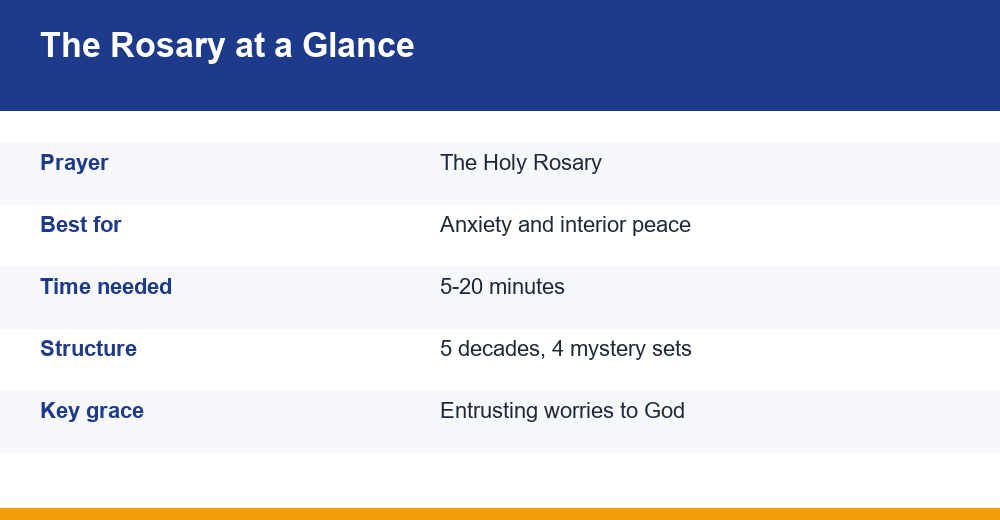
The Rosary can bring genuine spiritual consolation and a sense of calm through its meditative rhythm and its trust in God. It is not a medical treatment, however. If anxiety is severe or persistent, please also seek help from a doctor or counselor.
Which mysteries are best when I feel afraid?
Many find the Sorrowful Mysteries comforting, especially the Agony in the Garden, where Christ shares our fear. The Glorious Mysteries offer hope beyond suffering. There is no wrong choice; pray whichever set matches your day and your heart.
How long does it take to pray the Rosary?
A full five-decade Rosary usually takes about twenty minutes, though it can be shorter or longer depending on your pace. When time is tight, praying a single decade of ten Hail Marys is a faithful and worthy way to begin.
Are the Rosary’s famous promises official Church teaching?
The traditional fifteen promises attached to the Rosary are a cherished part of Catholic piety, but they belong to private devotional tradition rather than defined dogma. The Church wholeheartedly commends the Rosary itself while encouraging a mature, trusting faith.