The rosary for the dead is one of the oldest and most consoling ways Catholics keep faith with those who have gone before them. It uses the familiar beads and mysteries, adds a short prayer for the departed, and turns grief into intercession. This guide explains how to pray it at home, at a wake and through November, and why the Church encourages it.
Table of Contents
Can You Pray a Rosary for the Dead? What the Church Teaches
Yes. Offering a rosary for the dead is fully in keeping with Catholic teaching. The Church believes that death does not break the bond of charity between the faithful on earth and those who have died. We call this the communion of saints: one family in Christ, some still on pilgrimage, some being purified, some already in glory.
The Catechism teaches that those who die in God’s grace and friendship, but are still imperfectly purified, are assured of their eternal salvation, yet undergo a purification after death so as to achieve the holiness needed to enter the joy of heaven. The Church calls this final purification purgatory, and stresses that it is entirely different from the punishment of the damned. You can read the full text in the Catechism’s section on the final purification (paragraphs 1030-1032).
Paragraph 1032 links this teaching directly to prayer. It recalls the scene in 2 Maccabees 12, where Judas Maccabeus has an offering made for fallen soldiers so that they might be delivered from their sin. From the beginning the Church has honoured the memory of the dead and offered prayers for them, above all the Eucharistic sacrifice. It also commends almsgiving, indulgences and works of penance offered on their behalf.
What the rosary does, and what it does not do
The rosary is not a formula that guarantees an outcome. It is a prayer of trust: we place our loved one in the hands of a merciful God, through the intercession of Mary. Two points help keep it in proportion:
- The Mass remains the greatest prayer for the dead. Having a Mass offered for a loved one is the first thing the Church recommends.
- We pray for the dead without presuming on their eternal state. We do not know any soul’s final judgement, so we entrust each one humbly to God’s mercy.
Why Catholics Pray for the Dead in November
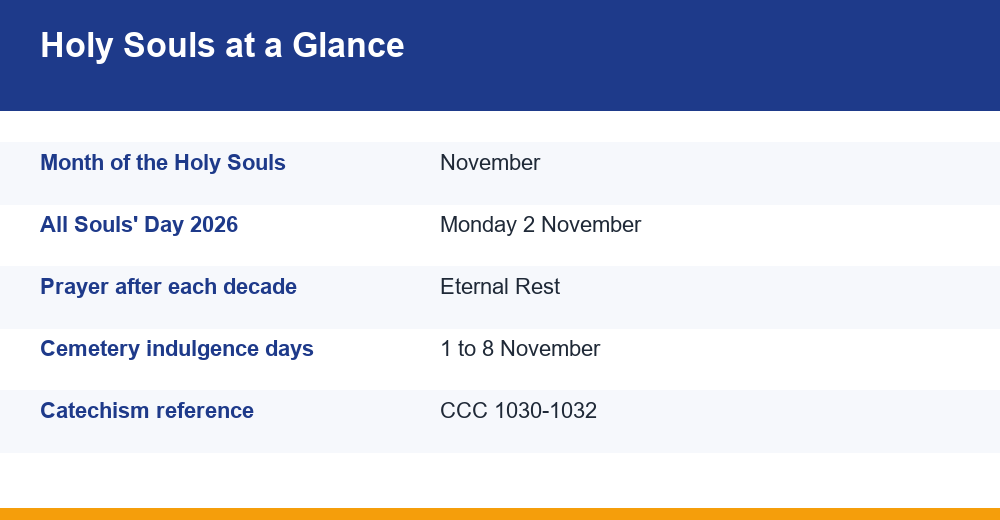
November opens with two linked days. On 1 November the Church celebrates the Solemnity of All Saints, honouring everyone already in heaven, known and unknown. On 2 November comes the Commemoration of All the Faithful Departed, better known as All Souls’ Day, when the whole Church prays for those still being purified. In 2026 All Saints falls on a Sunday and All Souls on the Monday that follows.
The custom of a dedicated day for all the dead is usually traced to St Odilo, abbot of Cluny, who established an annual commemoration in his monasteries around the year 1000. The practice spread through Western Christianity and was eventually adopted by the universal Church. Over time the whole month came to be associated with the holy souls.
Several reasons make November a natural season for this prayer:
- The liturgy itself turns toward the last things as the Church year draws to a close before Advent.
- Special indulgences for the souls in purgatory are attached to the first days of the month.
- Families visit graves, light candles and write the names of their dead in parish books of remembrance.
- In the northern hemisphere, the shortening days invite reflection on mortality and hope.
Many parishes place a Book of the Dead near the altar for the whole month and remember those names at Mass. Praying the rosary at home with the same names in mind is a simple way to join that intention.
How to Pray the Rosary for a Deceased Loved One
A rosary for the dead follows the ordinary structure of the rosary. The difference lies in the intention you name at the beginning and the short prayer for the departed added at the end of each decade. Nothing else needs to change.
- Make the Sign of the Cross and state your intention, for example: “I offer this rosary for the soul of [name] and for all the faithful departed.”
- On the crucifix, pray the Apostles’ Creed.
- On the first large bead, pray the Our Father; on the next three small beads, three Hail Marys; then the Glory Be.
- Announce the first mystery and pause briefly to picture the scene.
- Pray the Our Father, ten Hail Marys and the Glory Be.
- Add the Eternal Rest prayer for the deceased, and the Fatima prayer if you wish.
- Repeat for the remaining four decades.
- Close with the Hail, Holy Queen, the concluding prayer, and a final Eternal Rest.
Small touches that help
- Say the person’s name aloud in the Eternal Rest prayer. It keeps the intention concrete.
- Place a photograph or a lit candle nearby, as families often do at home altars.
- If five decades feel too much in fresh grief, pray one decade each day. Any sincere prayer is pleasing to God.
- Pray for those who have no one to remember them. The tradition has always included the forgotten souls.
Can you pray for someone who was not Catholic?
Yes. The Church’s prayer for the dead is not limited to her own members. The Eucharistic Prayers at Mass commend all who have died in God’s mercy, and canon law allows a priest to apply the Mass for anyone, living or dead. You can offer the rosary for a non-Catholic parent, spouse or friend with the same confidence, entrusting them to God, who alone knows the heart.
What Prayer Is Said After Each Decade?
The prayer customarily added after each decade is the Eternal Rest, known in Latin as the Requiem aeternam. Its words echo the Church’s funeral liturgy:
Eternal rest grant unto them, O Lord, and let perpetual light shine upon them. May they rest in peace. Amen. May their souls and the souls of all the faithful departed, through the mercy of God, rest in peace. Amen.
For one person, change “them” to “him” or “her”, or use the name. At a wake the prayer is usually said as a call and response, so everyone takes part.
| Leader | All respond |
|---|---|
| Eternal rest grant unto [name], O Lord, | and let perpetual light shine upon him/her. |
| May he/she rest in peace. | Amen. |
| May his/her soul and the souls of all the faithful departed, through the mercy of God, rest in peace. | Amen. |
Where the Fatima prayer fits
Many Catholics also add the Fatima prayer after the Glory Be: “O my Jesus, forgive us our sins, save us from the fires of hell; lead all souls to heaven, especially those in most need of thy mercy.” There is no fixed rule about order. A common pattern is Glory Be, then Fatima prayer, then Eternal Rest.
Some local customs say the Eternal Rest after every Hail Mary instead of after each decade. Others replace the Hail Marys of one decade with ten Eternal Rest prayers. These are devotional variants rather than official rubrics, so follow your parish or family tradition.
Which Mysteries Are Prayed for the Dead?
The Church has not assigned special mysteries for the dead. Any set may be used. In practice, people choose in one of two ways: they follow the usual weekly pattern, or they pick the mysteries that speak most directly to death and resurrection. If you need a refresher on all twenty, see our guide to the mysteries of the rosary.
For a rosary for the dead, the Glorious Mysteries are a frequent choice because they centre on the Resurrection, the Ascension and the hope of heaven. The Sorrowful Mysteries are also common, uniting the suffering of the bereaved with Christ’s Passion.
| Mysteries | Usual days | Why they suit prayer for the dead |
|---|---|---|
| Glorious | Wednesday, Sunday | Resurrection, Ascension and Assumption point to eternal life and the resurrection of the body |
| Sorrowful | Tuesday, Friday | Christ’s agony and death accompany the grief of family and friends |
| Joyful | Monday, Saturday | Recall the gift of life; fitting for a peaceful death or a child’s funeral |
| Luminous | Thursday | The Eucharist and the Transfiguration offer a glimpse of glory |
The weekly pattern above follows the suggestion St John Paul II made when he added the Luminous Mysteries in 2002. At a wake, many families simply use the mysteries of the day. Others choose the Glorious set no matter the day. Both are correct; what matters is praying attentively.
How to Pray the Rosary at a Wake or Vigil
In many Catholic cultures, a rosary for the dead is prayed at the wake the night before the funeral, often in the funeral home, the family’s home or the parish church. The Church’s official funeral rites include a Vigil for the Deceased, a short Liturgy of the Word with readings, intercessions and prayers. The rosary is a cherished devotion that families often pray alongside it, before or after, with the guidance of the priest or funeral director.
A simple order for a wake rosary
- A short welcome from the leader, naming the deceased and inviting everyone to pray.
- Sign of the Cross, Apostles’ Creed, and the opening Our Father, three Hail Marys and Glory Be.
- Five decades, each announced clearly, with the Eternal Rest in call-and-response form.
- Hail, Holy Queen and the concluding prayer.
- A closing prayer for the deceased and for the comfort of the family.
Practical tips for leaders
- Print the Eternal Rest response or put it on a card. Some guests may not be Catholic or may have forgotten the words.
- Ask different family members to lead each decade. It gives grieving relatives a way to take part.
- Keep a steady, unhurried pace. A full five-decade rosary takes roughly 20 minutes, depending on the group.
- Invite non-Catholic guests simply to sit quietly; no one should feel pressured to recite prayers.
Whoever leads need not be a priest or deacon. A family member, friend or parish volunteer can lead with complete propriety. If a priest is present, he may lead the Vigil and invite a lay person to lead the rosary.
November Indulgences and the Holy Souls
The Church teaches that indulgences can be applied to the dead (Catechism 1471). November offers two well-known plenary indulgences that can be gained only for the souls in purgatory:
| When | What to do | Notes |
|---|---|---|
| 1 to 8 November | Devoutly visit a cemetery and pray for the dead, even mentally | Plenary once each day; partial on other days of the year |
| 2 November (All Souls’ Day) | Devoutly visit a church or oratory and pray the Our Father and the Creed | With the bishop’s consent, may be moved to the Sunday before or after, or to All Saints |
The usual conditions apply: sacramental confession, Holy Communion, prayer for the Pope’s intentions (an Our Father and Hail Mary is enough), and freedom from all attachment to sin, even venial sin. These conditions may be fulfilled several days before or after the prescribed work. Dioceses publish local guidance, so check your parish bulletin.
The rosary itself carries a plenary indulgence when prayed under certain conditions, such as in a church or oratory or as a family. Our article on the rosary plenary indulgence explains those conditions in detail. Praying five decades at a loved one’s grave in early November is a beautiful way to combine both practices.
Making the Rosary Part of Your Grief
Grief is not a lack of faith. Christ wept at the tomb of Lazarus. A rosary for the dead gives sorrow a shape: repeated words when you have none of your own, and mysteries that place your loss inside the story of Christ’s death and resurrection.
Many people find the rhythm of the beads calming in the weeks after a funeral. The same quiet repetition that makes the rosary for peace so steadying can bring rest to a heart unsettled by loss.
Ways to keep remembering
- Pray a decade on the anniversary of death, the person’s birthday and on All Souls’ Day.
- Have a Mass offered on significant dates; ask at your parish office.
- Keep a short list of your dead in your prayer book and name them in each rosary.
- Join a parish November novena or a group rosary for the holy souls.
- Teach children the Eternal Rest so the family keeps praying together for grandparents and relatives.
Above all, pray with hope. The Church prays for the dead because she believes in the resurrection. Each Eternal Rest is a small act of faith that the love you shared is not finished.
Frequently Asked Questions
Can you pray the rosary for the dead?
Yes. The Church teaches that the faithful on earth can help souls being purified after death through prayer, especially the Mass, as well as almsgiving, indulgences and penance (Catechism 1032). Offering a rosary for a deceased person is a long-standing Catholic devotion. You simply name the intention at the start and add the Eternal Rest prayer after each decade.
Which mysteries are prayed for the dead?
No mysteries are required. Many families follow the usual weekly schedule: Joyful on Monday and Saturday, Sorrowful on Tuesday and Friday, Glorious on Wednesday and Sunday, Luminous on Thursday. Others choose the Glorious Mysteries for any day because they focus on the Resurrection and eternal life, or the Sorrowful Mysteries to unite grief with Christ’s Passion.
What prayer is said for the dead after each decade?
The customary prayer is the Eternal Rest: Eternal rest grant unto them, O Lord, and let perpetual light shine upon them. May they rest in peace. Amen. It usually follows the Glory Be, and often the Fatima prayer. At wakes it is commonly said as a call and response, with the leader naming the deceased.
How do you pray the rosary at a wake?
A leader welcomes everyone, names the deceased and begins with the Sign of the Cross and the Creed. Five decades follow, each announced aloud, with the Eternal Rest said as a call and response after each one. It closes with the Hail, Holy Queen and a prayer for the family. Any family member or friend may lead.