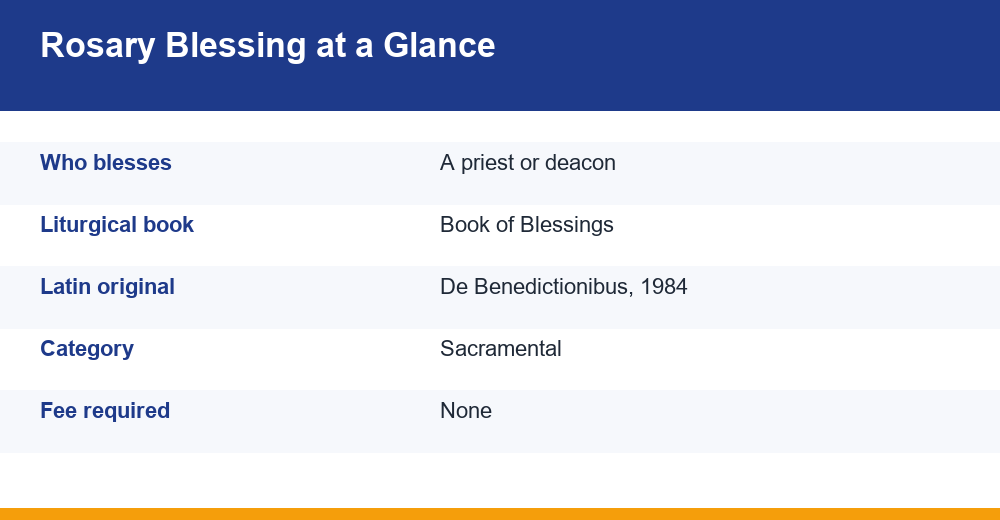
If you want to know how to bless a rosary, the short answer is that you ask a priest or deacon, because the Church gives this blessing through her ordained ministers. The rest of this guide explains what the blessing is, what the rite contains, and what to do if you can’t find a priest, if the beads break, or if you are wondering whether a blessing is needed at all.
Table of Contents
What a Rosary Blessing Really Is
A blessed rosary is a sacramental. The Catechism describes sacramentals as sacred signs, instituted by the Church, that bear a resemblance to the sacraments. Through the Church’s prayer they prepare us to receive grace and dispose us to cooperate with it. They are not sacraments themselves, and they do not work automatically.
The Catechism also notes that sacramentals always include a prayer, often with a specific sign such as the sign of the cross or a sprinkling with holy water, which recalls Baptism. A rosary blessing follows that pattern: an ordained minister prays over the beads and the person who will use them, and traces the sign of the cross over them.
What the blessing does, and what it does not do
The blessing sets the rosary apart for prayer. From then on it is a sacred object meant for worship, not a piece of jewellery or a decoration. The Church’s prayer goes with it, asking God to bless the one who prays with it.
What the blessing does not do matters just as much. It does not turn the beads into a charm, protect you mechanically from harm, or make your prayers “count” more than prayers on an unblessed rosary. Treating a sacramental like a lucky object is one of the common misunderstandings about the rosary that the Church has always corrected.
- Sacrament: instituted by Christ, gives grace by the rite itself (for example, Baptism or the Eucharist).
- Sacramental: instituted by the Church, disposes the person to grace through the Church’s prayer and the user’s faith.
- Blessed rosary: a sacramental object whose value lies in the prayer it supports.
Can a Deacon Bless a Rosary?
Yes. A priest or a deacon can bless a rosary. The Code of Canon Law states that any priest can impart blessings except those reserved to the Pope or to bishops (canon 1169 §2), and that a deacon can impart only those blessings the law expressly permits to him (canon 1169 §3).
The introductions in the Book of Blessings state, rite by rite, who may preside. Deacons are permitted to give many of them, including the blessing of devotional objects such as rosaries, medals and small crosses. So a deacon at your parish is a perfectly good person to ask.
| Who | Can bless a rosary? | Notes |
|---|---|---|
| Bishop | Yes | Can give any blessing a priest can, plus those reserved to bishops |
| Priest | Yes | Any priest may bless rosaries and other devotional objects |
| Deacon | Yes | Permitted by the Book of Blessings for devotional objects |
| Religious brother or sister (not ordained) | No liturgical blessing | May pray with and for you |
| Lay Catholic | No liturgical blessing | May pray over the rosary personally; see below |
A bishop’s blessing carries one extra traditional feature. Under the current norms on indulgences, the faithful who devoutly use an object of piety blessed by the Pope or a bishop can gain a plenary indulgence on the Solemnity of Saints Peter and Paul (29 June), adding a profession of faith to the usual conditions: sacramental confession, Holy Communion and prayer for the Pope’s intentions.
How to Bless a Rosary: The Church’s Rite
The official answer to how to bless a rosary is found in the Book of Blessings, the English edition of the Latin De Benedictionibus, which was issued in 1984. It contains a dedicated order for the blessing of rosaries among the blessings of objects used in the devotions of the Christian people.
The orders in the Book of Blessings generally follow a common shape. When time allows, especially when several people bring rosaries together, the full celebration looks like this:
- Introductory rites: the sign of the cross and a greeting from the minister.
- Brief introduction: the minister explains the meaning of the rosary and of the blessing.
- Reading of the Word of God: often a Gospel passage connected to Mary or the life of Christ.
- Intercessions: short petitions, which may be led together with those present.
- Prayer of blessing: the minister prays over the rosaries and those who will use them, making the sign of the cross.
- Sprinkling with holy water: optional, depending on the circumstances.
- Concluding rite: a final blessing and dismissal.
The short form you will usually see
In practice, most rosaries are blessed in a few seconds after Mass. The priest or deacon says a brief prayer of blessing over the beads, often asking God to bless both the rosary and the person who uses it, and makes the sign of the cross over it. That short form is just as truly the Church’s blessing as the longer celebration.
Some priests use the older Roman Ritual, which has its own Latin formula for blessing rosaries. Either way, the rosary is blessed. If you have a preference, it is fine to mention it politely, but the choice belongs to the minister.
| Element | Full celebration | Quick blessing after Mass |
|---|---|---|
| Sign of the cross and greeting | Yes | Sometimes |
| Scripture reading | Yes | Usually omitted |
| Intercessions | Yes | Usually omitted |
| Prayer of blessing | Yes | Yes |
| Sign of the cross over the beads | Yes | Yes |
| Holy water | Optional | Optional |
How Do You Get a Rosary Blessed?
Getting a rosary blessed is easy, and priests are generally glad to do it. Here is the practical side of how to bless a rosary when you are the one bringing it.
- Choose a moment. After Sunday or weekday Mass is the most common time. You can also ring the parish office and ask when a priest or deacon is available.
- Have the rosary ready. Take it out of its box or plastic bag and hold it in your open hand. If you have several, bring them together.
- Ask simply. “Father, would you bless my rosary, please?” or “Deacon, could you bless these rosaries?” is all you need to say.
- Pray along. Answer “Amen” at the end of the prayer and make the sign of the cross yourself.
- Say thank you. No payment is needed or expected.
A blessing must never be bought. Charging for a spiritual good is the old sin of simony, which the Church condemns. If you want to make an offering to the parish, that is a free gift, not a fee.
Other good opportunities
- Parish missions, retreats and pilgrimages, where priests often bless religious items for the whole group.
- First Communion or Confirmation days, when many families bring new rosaries.
- Shrines and cathedrals, which often have priests available at set times.
- Catholic schools and campus ministries, where a chaplain can usually help.
A rosary bought online or received by post does not need any special handling before it is blessed. Simply keep it with care and bring it along the next time you go to Mass.
If you are just starting to pray with your new beads, our guide to the rosary for beginners walks you through the prayers and the order of the decades.
Can You Bless Your Own Rosary?
Not in the liturgical sense. A layperson cannot give the Church’s blessing that makes a rosary a sacramental. That blessing is given by a priest or deacon, as the Book of Blessings provides.
This is not a slight to the laity. The Catechism teaches that every baptized person is called to be a blessing and to bless, and that some blessings may be presided over by lay people. But it adds that the more a blessing concerns ecclesial and sacramental life, the more its administration is reserved to the ordained ministry: bishops, priests or deacons.
The USCCB’s overview of sacramentals and blessings explains that lay people who give certain blessings do so by reason of the universal priesthood or a special office, such as parents blessing their children. Even then, the lay minister uses the rites and formulas designated for lay people, and the introduction to each rite says who may preside.
What you can do yourself
- Pray over your rosary and dedicate your use of it to God, for example by offering your first rosary on it for a particular intention.
- Sprinkle it with holy water you already have at home, as an act of personal devotion.
- Keep it in a clean, set-apart place until you can have it blessed.
- Bless your children by tracing a cross on their foreheads, a lay blessing the Church encourages in families.
If you were hoping to learn how to bless a rosary yourself, these acts are the right place to start. They are good and devout, but simply not the same thing as the Church’s official blessing, and it helps to call them what they are.
Does a Rosary Need to Be Blessed?
No. An unblessed rosary is a perfectly good tool for prayer. The rosary is a prayer first and a string of beads second; you can even pray it on your fingers. What gives the rosary its strength is meditation on the life of Christ with Mary, not the material of the beads.
Every decade invites you to dwell on an event in the Gospel. If you are learning those events, our page on the mysteries of the rosary sets out all twenty with their scripture references.
Why it is still worth having it blessed
- The Church’s prayer: a blessing joins your devotion to the prayer of the whole Church.
- A partial indulgence: the current norms grant a partial indulgence to the faithful who devoutly use a crucifix, cross, rosary, scapular or medal properly blessed by any priest or deacon.
- Reverence: a blessed rosary reminds you that this object belongs to God and is for prayer.
Separately, a plenary indulgence is attached to praying the Marian rosary in a church or oratory, or together as a family, religious community or pious association, under the usual conditions. That grant is tied to the prayer itself, not to whether the beads are blessed.
| Question | Unblessed rosary | Blessed rosary |
|---|---|---|
| Can I pray the rosary with it? | Yes | Yes |
| Is it a sacramental? | No, a devotional aid | Yes |
| Partial indulgence for devout use | No | Yes |
| Plenary indulgence for praying in church or as a family | Yes, with usual conditions | Yes, with usual conditions |
| Must it be treated as a sacred object? | Respect is fitting | Yes (canon 1171) |
What to Do With a Broken Blessed Rosary
Rosaries break. Links open, cords fray, and crucifixes come loose. When that happens, you have two good options: repair it or dispose of it respectfully.
Repairing it
Many breaks are minor. A link that has opened can often be closed with small pliers, and replacement links and findings are inexpensive. A rosary with precious metal or stones may be worth taking to a jeweller. The common pastoral view is that a blessed rosary repaired in this way keeps its blessing, because it is still essentially the same object.
If the rosary was rebuilt with mostly new parts, or you simply feel unsure, ask a priest or deacon to bless it again. It costs nothing and takes a moment.
Disposing of it respectfully
Canon 1171 asks that sacred objects, set apart for worship by dedication or blessing, be treated reverently and not put to profane or inappropriate use, even when privately owned. Church law does not prescribe a disposal method, but Catholic custom is clear: burn or bury blessed items rather than throwing them in the rubbish.
| Rosary material | Traditional option | Practical note |
|---|---|---|
| Wood, cord or seeds | Burn, then bury the ashes | Burn small amounts safely, following local fire rules |
| Metal | Bury, or take apart so it can’t be misused | Some parishes collect metal items |
| Glass, plastic or stone beads | Bury in clean ground | Taking it apart first is acceptable |
| Any material | Take it to your parish | Many parishes will dispose of it for you |
If it is still usable, you can also pass it on to someone who will pray with it. Some groups collect old rosaries, repair them, and send them to missions and prisons.
Treating a Blessed Rosary With Reverence
Once you understand how to bless a rosary and what the blessing means, a few habits follow naturally. None of them are complicated; they are simply the ways Catholics have shown respect for holy things.
- Keep it in a pouch, box or a clean pocket rather than loose in a bag with keys and coins.
- Pray with it. A rosary that is used daily is honoured more than one kept untouched in a drawer.
- Avoid wearing it as a fashion necklace; the Church’s tradition is to carry it, hang it, or pray with it.
- Do not sell a rosary at a higher price because it is blessed. A blessing is not a commercial feature.
- When giving one as a gift, you can have it blessed beforehand, or let the recipient bring it to their own priest.
A rosary hanging from a car mirror or a bedpost is a long-standing custom in many Catholic homes. It is fine, as long as it is a reminder to pray and not a token believed to bring luck. The intention behind the use is what makes the difference.
In the end, the blessing is the Church’s invitation to prayer. The best way to honour a blessed rosary is to take it in your hands, begin with the Creed, and keep going.
Frequently Asked Questions
How do you get a rosary blessed?
Bring your rosary to a priest or deacon, most easily after Mass, and simply ask him to bless it. Take it out of its packaging and hold it in your open hand. He will say a short prayer of blessing and make the sign of the cross over it. Answer “Amen”. There is no fee, and none should ever be asked for a blessing.
Can you bless your own rosary?
Not with the Church’s liturgical blessing, which the Book of Blessings gives to priests and deacons. You can still pray over your rosary, dedicate your use of it to God and sprinkle it with holy water as personal devotion. These are good acts, but they do not replace the blessing given by an ordained minister.
What do you do with a broken blessed rosary?
If it can be fixed, repair it; a lightly repaired rosary is generally considered to keep its blessing, and a priest can bless it again if you are unsure. If it cannot be used, do not throw it in the rubbish. Burn or bury it respectfully, or take it to your parish, which will usually dispose of it for you.
Can a deacon bless a rosary?
Yes. Canon law lets deacons give the blessings the law expressly permits them, and the Book of Blessings includes the blessing of devotional objects such as rosaries, medals and small crosses among them. A deacon’s blessing is a real blessing of the Church, just like a priest’s, so asking your parish deacon is completely appropriate.