The rosary prayers in order are simple once you see them laid out bead by bead: the Sign of the Cross and the Apostles’ Creed on the crucifix, then the Our Father, Hail Mary and Glory Be, and finally the Hail, Holy Queen with a closing prayer. Below you will find the complete text of each prayer, the bead it belongs to, where it comes from, and which parts the Church treats as optional, so you can pray with confidence instead of guessing.
Table of Contents
The Rosary Prayers in Order at a Glance
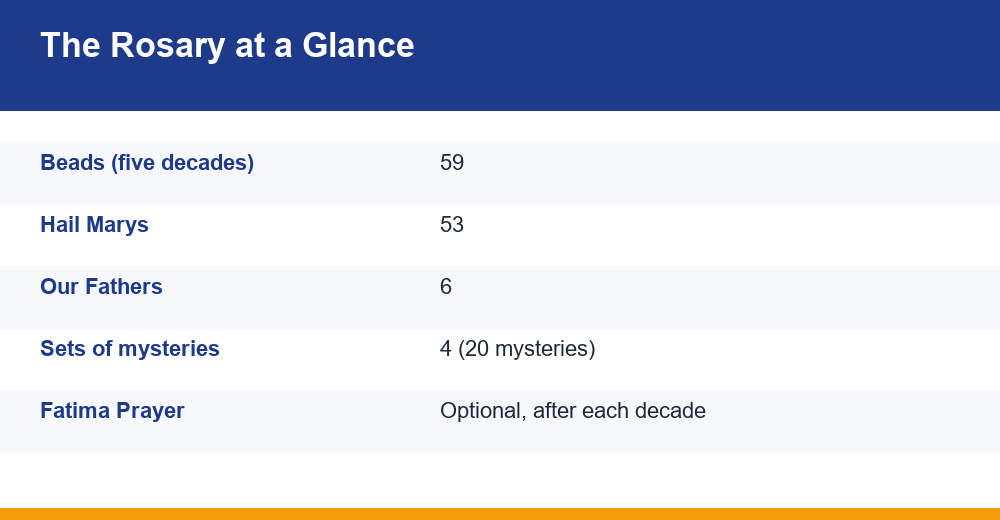
So, what are the prayers of the rosary in order? A standard five-decade rosary has 59 beads: a crucifix, a short pendant strand of five beads, a centrepiece medal, and a loop of five decades. Each part of the chain tells your fingers which prayer comes next.
The table below gives the full sequence of the rosary prayers in order, from start to finish. Keep it open the first few times you pray; after a week or two the pattern becomes second nature.
| Step | Where on the beads | Prayer | How many times |
|---|---|---|---|
| 1 | Crucifix | Sign of the Cross | Once |
| 2 | Crucifix | Apostles’ Creed | Once |
| 3 | First large bead | Our Father | Once |
| 4 | Next three small beads | Hail Mary | Three times |
| 5 | Chain before the next large bead | Glory Be | Once |
| 6 | Fifth pendant bead, then each large bead in the loop | Announce the mystery, then Our Father | Five times (once per decade) |
| 7 | Ten small beads | Hail Mary | Ten per decade (50 in all) |
| 8 | Chain after each decade | Glory Be, then Fatima Prayer (optional) | Five times |
| 9 | Medal | Hail, Holy Queen, versicle and response | Once |
| 10 | Medal or crucifix | Closing prayer and Sign of the Cross | Once |
Counting it all up, a complete rosary includes 53 Hail Marys, six Our Fathers and six Glory Bes. That is the whole structure. Everything else in this guide simply fills in the words and the history behind them.
Opening Prayers: The Crucifix and First Beads
What prayer do you say on the crucifix of the rosary?
Holding the crucifix, you begin with the Sign of the Cross and then pray the Apostles’ Creed. Starting with the Creed is fitting: before meditating on the life of Christ, you profess the faith that the mysteries unfold.
The Sign of the Cross
In the name of the Father, and of the Son, and of the Holy Spirit. Amen.
Tracing the cross is one of the oldest Christian gestures. The North African writer Tertullian, writing around the year 200, already described Christians marking their foreheads with the cross throughout the day. The Trinitarian words echo the baptismal command in Matthew 28:19.
The Apostles’ Creed
I believe in God, the Father almighty, Creator of heaven and earth, and in Jesus Christ, his only Son, our Lord, who was conceived by the Holy Spirit, born of the Virgin Mary, suffered under Pontius Pilate, was crucified, died and was buried; he descended into hell; on the third day he rose again from the dead; he ascended into heaven, and is seated at the right hand of God the Father almighty; from there he will come to judge the living and the dead. I believe in the Holy Spirit, the holy catholic Church, the communion of saints, the forgiveness of sins, the resurrection of the body, and life everlasting. Amen.
The Creed grew out of the ancient baptismal profession used in the Church of Rome, often called the Old Roman Creed. A pious legend says each of the Twelve contributed one article; historians instead see a gradual development, with the text reaching its familiar Western form in the early Middle Ages. The wording above is the one used in the current English translation of the Roman Missal.
The pendant beads
- On the first large bead, pray one Our Father.
- On each of the next three small beads, pray a Hail Mary. Many Catholics offer these for an increase in faith, hope and charity.
- On the chain after the third Hail Mary, pray the Glory Be.
- On the next large bead, announce the first mystery and pray the Our Father that begins the first decade.
If the whole sequence still feels unfamiliar, our step-by-step rosary guide for beginners walks through a first rosary slowly, including how to hold the beads.
Praying Each Decade: Our Father, Hail Mary, Glory Be
The heart of the rosary is the five decades. Each one follows the same rhythm: announce the mystery, pray one Our Father, ten Hail Marys and one Glory Be. The words repeat, but the mind moves on to a new scene from the Gospel each time.
Announcing the mystery
At the large bead, name the mystery, for example “The first Joyful Mystery, the Annunciation.” The USCCB notes that a short Scripture reading may follow. The four sets of mysteries are traditionally assigned to particular days, as the table shows.
| Mysteries | Usual days |
|---|---|
| Joyful | Monday and Saturday (Sundays of Advent) |
| Sorrowful | Tuesday and Friday (Sundays of Lent) |
| Glorious | Wednesday and other Sundays |
| Luminous | Thursday |
For each of the twenty mysteries and its Scripture passage, see our guide to the mysteries of the rosary.
The Our Father
Our Father, who art in heaven, hallowed be thy name; thy kingdom come, thy will be done on earth as it is in heaven. Give us this day our daily bread, and forgive us our trespasses, as we forgive those who trespass against us; and lead us not into temptation, but deliver us from evil. Amen.
This is the prayer Jesus himself taught his disciples, recorded in Matthew 6:9-13 and in a shorter form in Luke 11:2-4. In the rosary it is prayed without the doxology “For the kingdom, the power and the glory,” which appears separately at Mass and is joined to the prayer in many Protestant traditions.
The Hail Mary
Hail Mary, full of grace, the Lord is with thee. Blessed art thou among women, and blessed is the fruit of thy womb, Jesus. Holy Mary, Mother of God, pray for us sinners, now and at the hour of our death. Amen.
Ten of these make up each decade. Pope St. John Paul II, in his 2002 apostolic letter Rosarium Virginis Mariae, called the name of Jesus the centre of gravity of the prayer, and commended the custom of adding a short phrase after it that recalls the mystery being contemplated.
The Glory Be
Glory be to the Father, and to the Son, and to the Holy Spirit, as it was in the beginning, is now, and ever shall be, world without end. Amen.
Known as the lesser doxology, this short hymn of praise to the Trinity goes back to the early Church. The phrase “as it was in the beginning” became standard in Western use by the sixth century. It closes every decade, turning the meditation back toward God.
Where Does the Hail Mary Prayer Come From?
The Hail Mary developed in two stages, and knowing them deepens the way you pray it. The first half is drawn from Scripture; the second half is the Church’s own petition, added over centuries.
- “Hail, full of grace, the Lord is with thee” are the words of the Angel Gabriel at the Annunciation (Luke 1:28).
- “Blessed art thou among women, and blessed is the fruit of thy womb” is Elizabeth’s greeting at the Visitation (Luke 1:42).
- The names Mary and Jesus were added in the Middle Ages to make the greeting personal.
- “Holy Mary, Mother of God, pray for us sinners” appeared gradually in the late Middle Ages, in a period marked by plague and widespread fear of sudden death.
The title “Mother of God” (in Greek, Theotokos) had been solemnly affirmed at the Council of Ephesus in 431, so the petition rests on long-established doctrine. The prayer reached its fixed, universal wording when Pope St. Pius V promulgated the reformed Roman Breviary in 1568, following the Council of Trent.
Is the Fatima Prayer Required in the Rosary?
No. The Fatima Prayer is a widely loved addition, but it is not part of the rosary’s essential structure. The USCCB’s own instructions say simply that some add it after each decade. St. John Paul II likewise observed that the Glory Be is followed by a brief concluding prayer which varies according to local custom.
O my Jesus, forgive us our sins, save us from the fires of hell, lead all souls to heaven, especially those in most need of thy mercy.
According to the memoirs of Sister Lúcia, one of the three shepherd children of Fátima in Portugal, Our Lady taught this prayer during the apparition of 13 July 1917 and asked that it be said after each mystery. It spread widely after the Bishop of Leiria declared the apparitions worthy of belief in October 1930.
Many families and parishes pray it as a matter of course, and there is every reason to include it. But if you are praying with a group that leaves it out, or using an older prayer book that does not print it, your rosary is still complete.
The Closing Prayers of the Rosary
What is the closing prayer of the rosary? After the fifth decade, most English-speaking Catholics pray the Hail, Holy Queen, followed by a versicle and response and a short collect, then end with the Sign of the Cross.
Hail, Holy Queen (Salve Regina)
Hail, holy Queen, Mother of mercy, our life, our sweetness and our hope. To thee do we cry, poor banished children of Eve. To thee do we send up our sighs, mourning and weeping in this valley of tears. Turn then, most gracious advocate, thine eyes of mercy toward us, and after this our exile show unto us the blessed fruit of thy womb, Jesus. O clement, O loving, O sweet Virgin Mary.
V. Pray for us, O holy Mother of God.
R. That we may be made worthy of the promises of Christ.
The Salve Regina is one of four great Marian antiphons of the Liturgy of the Hours. It dates to at least the eleventh century and is traditionally attributed to Blessed Hermann of Reichenau, a German Benedictine monk, though scholars regard the authorship as uncertain. Cistercians and Dominicans made it a nightly chant, and from there it passed into the rosary. Our article on the meaning of the Hail Holy Queen explains its striking images, from “banished children of Eve” to the “valley of tears.”
The concluding prayer
Let us pray. O God, whose only begotten Son, by his life, death and resurrection, has purchased for us the rewards of eternal life; grant, we beseech thee, that while meditating on these mysteries of the most holy Rosary of the Blessed Virgin Mary, we may imitate what they contain and obtain what they promise, through the same Christ our Lord. Amen.
This collect comes from the liturgy of the feast of Our Lady of the Rosary, kept on 7 October. Its petition sums up the purpose of the whole devotion: to imitate what the mysteries contain and obtain what they promise.
Local custom shapes this final stage. Rosarium Virginis Mariae mentions prayer for the intentions of the Pope and the Litany of Loreto, and the USCCB notes that a prayer to St. Joseph may follow. Some communities also add the prayer to St. Michael.
Required and Optional Parts Compared
Many guides present every prayer as obligatory, which can leave newcomers anxious about getting it “wrong.” In reality, the rosary has a fixed core and a flexible frame. The table separates the two.
| Element | Status | Origin |
|---|---|---|
| Five decades (Our Father, 10 Hail Marys, Glory Be) | Core of the devotion | Shaped by the Dominicans; confirmed by St. Pius V in 1569 |
| Meditation on a mystery | Essential to the rosary’s spirit | Medieval; Luminous set added in 2002 |
| Sign of the Cross and Apostles’ Creed | Customary opening | Early Church; Old Roman Creed |
| Opening Our Father, 3 Hail Marys, Glory Be | Customary | Later devotional custom |
| Fatima Prayer | Optional | Fátima, 1917 |
| Hail, Holy Queen | Customary closing; may vary | At least 11th century |
| Concluding collect, Litany of Loreto | Optional; varies locally | Liturgical and devotional tradition |
A few practical consequences follow from this:
- Praying a single decade with attention is real rosary prayer, even if you cannot finish all five.
- The Luminous Mysteries are an invitation, not an obligation; St. John Paul II proposed them in 2002 to include Christ’s public ministry, while leaving the traditional fifteen intact.
- Families may adapt the opening and closing to local custom, as long as the decades and the meditation remain.
Tips for Praying the Rosary Prayers in Order
Learning the rosary prayers in order is the easy part; praying them with attention is the lifelong work. A few habits help.
- Pace yourself. A full five decades usually takes roughly 15 to 20 minutes. Rushing to finish defeats the purpose.
- Picture the scene. Before each decade, spend a few seconds imagining the mystery: the stable, the garden of Gethsemane, the empty tomb.
- Offer an intention. Dedicating each decade to a person or need keeps the mind from drifting.
- Pray in a group. In family or parish recitation, a leader says the first half of each prayer and everyone answers with the second.
- Use your fingers if needed. No beads? Your ten fingers count a decade perfectly well.
For a short, authoritative summary you can share with a parish group, the bishops’ How to Pray the Rosary page from the USCCB sets out the same sequence of rosary prayers in order used here.
Whether you pray the whole rosary daily or one decade on the bus, the words stay the same, and over time they become a quiet companion. Keeping the rosary prayers in order holds you steady so your heart can rest on Christ and his Mother.
Frequently Asked Questions
What are the prayers of the rosary in order?
Begin with the Sign of the Cross and the Apostles’ Creed on the crucifix, then one Our Father, three Hail Marys and a Glory Be. Each of the five decades has an Our Father, ten Hail Marys and a Glory Be, often followed by the Fatima Prayer. Finish with the Hail, Holy Queen, a closing prayer and the Sign of the Cross.
Is the Fatima Prayer required in the rosary?
No. The Fatima Prayer, which Sister Lúcia said Our Lady taught during the apparition of 13 July 1917, is a popular addition said after the Glory Be in each decade. The USCCB says only that some add it, and St. John Paul II noted the prayer after each decade varies by local custom. Leaving it out does not make your rosary incomplete.
What prayer do you say on the crucifix of the rosary?
On the crucifix you make the Sign of the Cross and then pray the Apostles’ Creed. The Creed summarises the core beliefs of the Christian faith, which makes it a natural opening before meditating on the mysteries of Christ’s life. After the Creed, move to the first large bead for the Our Father.
What is the closing prayer of the rosary?
Most English-speaking Catholics close with the Hail, Holy Queen, the versicle “Pray for us, O holy Mother of God,” and the collect beginning “O God, whose only begotten Son.” The concluding prayers vary by local custom, so some add the Litany of Loreto, a prayer to St. Joseph or St. Michael, then end with the Sign of the Cross.